
If you're setting up a business in Dubai, Sharjah, or anywhere else in the UAE, you'll quickly come across the term WPS. It stands for the Wage Protection System, and it's something you absolutely need to get right.
So, what is it? Think of WPS as a secure digital handshake between you (the employer), your employees, and the UAE government. It’s a mandatory electronic system that ensures every private sector employee gets paid the right amount, on time, every single month.
Understanding the UAE Wage Protection System

This system isn't just another piece of administrative paperwork; it's a cornerstone of the UAE's labour market stability. By mandating that all salaries flow through approved financial channels, the government creates an official, verifiable record of every single payment. No more cash-in-hand payments, no more "he said, she said" disputes.
Launched back in 2009, the WPS was a joint initiative between the Ministry of Human Resources and Emiratisation (MoHRE) and the UAE Central Bank. The goal was simple but powerful: bring transparency and accountability to how private companies pay their staff.
The Core Purpose of WPS
At its heart, the system was designed to tackle a few key issues and strengthen the employer-employee relationship. Its main goals are to:
- Protect Workers' Rights: This is the big one. WPS guarantees that every employee receives the exact salary stated in their official labour contract, without any delays.
- Eliminate Wage Disputes: With an electronic paper trail, disagreements over payments are virtually eliminated. Both the employer and the employee have clear, undeniable proof of salary transactions.
- Enhance Transparency: The government gets a clear, real-time overview of private sector wage practices, which helps them enforce labour laws and protect everyone involved.
A common misconception is that WPS is just another layer of bureaucracy. In reality, it’s a protective measure that actually benefits responsible employers. It provides you with indisputable proof of salary payment, safeguarding your business from potential legal claims down the line.
Key Players in the WPS Ecosystem
To get WPS right, you need to understand who's involved. For any new business, getting properly registered with these organisations is a foundational step. This process involves securing essential company documents, like the Establishment Card in the UAE, which is a critical prerequisite.
Here’s a quick rundown of the main players and what they do.
Key Players in the UAE WPS Ecosystem
| Stakeholder | Role in WPS |
|---|---|
| The Employer | You. Your company is responsible for registering with WPS, preparing the correct payroll files, and making sure funds are transferred on time. |
| The Employee | The beneficiary. They receive their salary directly into their bank account or onto a special WPS-approved payroll card. |
| WPS Agent | These are the banks and registered exchange houses authorised by the Central Bank to actually process the WPS payments. |
| UAE Central Bank | The financial overseer. It regulates the agents and ensures all transactions are secure and compliant. |
| MoHRE | The Ministry of Human Resources & Emiratisation. They are the governing body that monitors compliance, enforces the rules, and manages the entire system. |
Essentially, the system is a collaborative effort between these key stakeholders, all working together to create a fair and transparent payroll environment across the country.
Figuring out if the Wage Protection System applies to your business is one of the first—and most important—steps you’ll take. The short answer is pretty clear: if you’re running a private sector company registered with the Ministry of Human Resources and Emiratisation (MoHRE), you must use WPS.
This isn’t a rule that only applies to big corporations. Whether you have just one employee or a team of a hundred, the legal requirement to pay salaries through this official channel is exactly the same. The system was built to protect every worker, so it doesn't differentiate between a small startup and a massive enterprise.
For any entrepreneur or new business owner, this means WPS has to be a fundamental part of your payroll setup from day one. If you don't register and comply, you can run into immediate problems, like being blocked from getting new work permits for future hires.
Mainland Companies in Dubai and Across the UAE
For any business setting up shop on the mainland, WPS compliance is completely non-negotiable. This is a consistent rule across all seven emirates, from the bustling commercial hubs of Dubai and Abu Dhabi to Sharjah and beyond. If your company is licensed by a Department of Economic Development (DED), you fall directly under MoHRE’s authority.
It’s a step that’s woven right into your initial company formation. As you complete your business setup in mainland UAE, you'll also need to register your company with MoHRE and then with the WPS. This ensures your payroll is compliant right from the very first salary you pay out.
Think of it this way: if MoHRE is the authority issuing your employees' labour contracts and work permits, then you are legally required to pay their salaries through the WPS. It creates a transparent and unbroken link between what’s on the contract and what actually lands in their bank account.
Navigating the Rules for Free Zone Companies
This is where things can get a bit more complex, and it’s a common point of confusion for many business owners. While all mainland companies operate under one set of rules, free zones often have their own regulatory bodies and, sometimes, their own payroll regulations.
Not every single free zone mandates the use of the MoHRE-governed WPS. Some, like those under the Dubai Development Authority (DDA), have put their own wage payment systems in place. That said, a growing number of free zones are now aligning with federal labour laws and making WPS a requirement for their registered companies.
The only way to be sure is to check the specific rules of your free zone authority. Making an assumption here can be a costly mistake. For instance, several major free zones absolutely require WPS registration:
- Jebel Ali Free Zone (JAFZA): As one of the largest and most well-known free zones, JAFZA is fully integrated with the WPS.
- Dubai Airport Freezone (DAFZA): Companies based here are also required to process all salaries through the WPS.
- Dubai Multi Commodities Centre (DMCC): This major free zone also falls under the WPS mandate for paying employees.
To be certain of your obligations, your best bet is to either check directly with your free zone's administration or speak with a corporate services specialist who handles these matters daily.
Your Step-by-Step Guide to WPS Setup and Payroll
Getting your business set up on the Wage Protection System might sound complicated, but it’s actually a straightforward process once you know the steps. If you get it right from day one, you’ll ensure every payroll run is smooth and fully compliant. The whole system really hinges on correct registration and submitting accurate data each month.
First things first, you'll need a corporate bank account. This isn't just any bank account; it has to be with a UAE-based bank that's authorised to handle WPS transactions. This account is the starting point for all your company’s salary payments.
With your bank account ready, the next step is to officially partner with a WPS agent. This is usually your bank, but it can also be an exchange house approved by the UAE Central Bank. You'll sign a formal agreement with them, which officially enrols your company into the Wage Protection System.
Preparing Your First Payroll File
Once the setup is done, your focus shifts to the monthly payroll run. The key to this is a document called the Salary Information File (SIF). Think of the SIF as a detailed set of instructions you give to your WPS agent every single month.
This isn’t just a simple spreadsheet of names and numbers. The SIF has to be in a very specific format required by the authorities, and it must contain precise details for every employee on your payroll.
Here’s what needs to be in every SIF:
- Employee Details: Their full name and your internal employee ID.
- Ministry of Labour ID (MOL ID): The unique 14-digit number assigned to each employee.
- Salary Information: The fixed basic salary, any additional allowances or variable pay, and the final total to be paid.
- Pay Period: The exact month and year the salary is for.
Getting these details right is critical. Even a small typo in the SIF can get the whole file rejected, leading to payment delays and putting you at risk of non-compliance. Most WPS agents will give you a template to follow, and good payroll software can often generate the SIF for you automatically.
The whole point of the SIF is to create a solid electronic paper trail. It directly links the salary you pay to the employee's official labour contract registered with MoHRE. This transparency is what the entire WPS framework is built on.
The Monthly Payroll Process
After you've double-checked your SIF, you upload it to your WPS agent's online portal. From there, your agent sends it to the UAE Central Bank. The Central Bank then checks the file against MoHRE's records to make sure everything matches up.
Once it's verified, the Central Bank green-lights the payment, and your agent releases the funds directly into your employees' bank accounts or onto their WPS-compliant payroll cards.
The diagram below shows how this flow works for companies on the mainland and in free zones, showing how wages must pass through a regulated channel.
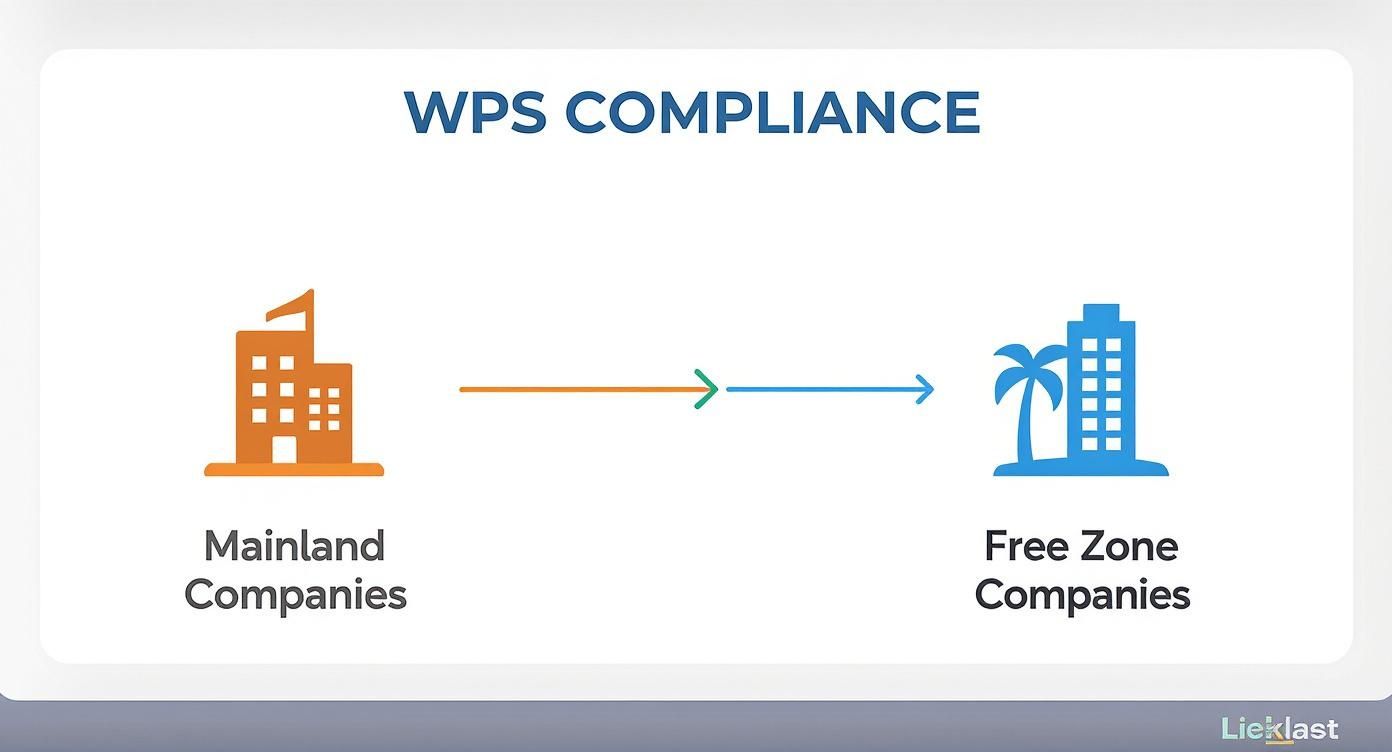
As you can see, no matter where your business is registered, the core rule is the same: salaries must be paid through the official system. The first critical step is getting your bank sorted, and for more on that, check out our guide on how to open a business bank account in Dubai. It’s a must-do before you can even begin with WPS.
The Real Cost of WPS Non-Compliance
Ignoring the rules of the Wage Protection System isn't really an option for any business operating in the UAE. The consequences are far more serious than a simple warning; they're designed to be a powerful deterrent. The Ministry of Human Resources and Emiratisation (MoHRE) has a system of escalating penalties that can seriously hurt your company’s bottom line and even its ability to operate.
It might start with a formal notice, but if you don't correct the issue, the financial penalties can pile up fast. A common mistake, like failing to pay an employee's salary on time, can trigger a fine. And this isn't just a single charge—it can be applied for every single employee affected, turning a small oversight into a major financial headache.
Financial Penalties and Fines
The financial hit for WPS violations can be substantial. For example, failing to pay salaries on time can lead to a fine of AED 1,000 per employee, with a maximum penalty of AED 50,000 if multiple workers are involved. Submitting incorrect data in your Salary Information File (SIF) can also lead to fines because it undermines the entire system's integrity.
These penalties aren't just empty threats; they are actively enforced. The WPS system is built to automatically flag any issues, meaning late payments or incorrect salary amounts are quickly spotted by MoHRE, prompting swift action. For a wider view on meeting regulatory standards, you can also explore different types of compliance reports, which offer good context on formal adherence.
Operational and Legal Consequences
Beyond the fines, the most damaging outcome of continued non-compliance is having your company's ability to issue new work permits suspended. This can bring your business growth to a dead stop, making it impossible to hire new staff and expand your team.
In more serious situations, your company’s file could be handed over to the Public Prosecution for legal action. This doesn't just mean court dates; it can lead to your company's operations being suspended entirely.
Proactive compliance is a core business strategy, not just an administrative task. A simple mistake like a delayed payroll submission can trigger a chain reaction of penalties that jeopardise your company's future in the UAE.
To give you a clear picture of what's at stake, here’s a quick breakdown of the potential penalties.
WPS Non-Compliance Penalties at a Glance
| Violation Type | Potential Penalty |
|---|---|
| Late Salary Payment | Fines of AED 1,000 per worker, up to AED 50,000. |
| Incorrect SIF Data | Financial penalties and potential system rejection. |
| Repeated Offences | Suspension of new work permit issuance. |
| Severe Violations | Referral to Public Prosecution and legal action. |
Staying on top of your WPS obligations is non-negotiable. The risks of falling behind are simply too high for any business to ignore.
How to Streamline Your WPS Compliance

As an entrepreneur, your focus should be on building your business, not getting buried in administrative paperwork. Managing the UAE’s Wage Protection System requires a level of precision and timing that can easily become a major distraction. This is where a strategic partner can make all the difference.
Outsourcing your entire WPS process literally lifts this weight off your shoulders. Instead of wrestling with complex Salary Information File (SIF) formats and stressing over deadlines, you can hand the whole thing over to specialists. It transforms a potential compliance headache into a smooth, automated part of your business, freeing you up to do what you do best.
Partnering with Corporate PRO Services
Think of an expert Corporate PRO service as your in-house payroll compliance team. At PRO Deskk, our specialists take care of every single step. We handle the initial WPS registration with your bank and then manage the accurate creation and submission of your SIF every month. We make sure every detail is right, which helps you avoid frustrating rejections or delays.
This kind of partnership brings a few key advantages to your business:
- Guaranteed Accuracy: Our team meticulously cross-checks all employee data against official records, preventing simple mistakes that can become costly problems.
- Freedom from Penalties: With experts managing your payroll, the risk of fines or work permit suspensions due to non-compliance practically disappears.
- More Time for Growth: You can get back to focusing on your core business activities with the confidence that your payroll is in good hands.
A dedicated PRO partner doesn't just manage tasks; they provide peace of mind. Our 24/7 support ensures that no matter when a question pops up, an expert is ready to help, keeping your operations running without a hitch.
Tailored Solutions for Your Business
Whether you're setting up a new company in mainland Dubai, Sharjah, Abu Dhabi, or establishing a presence in a free zone, we design solutions to fit your exact needs. We’re well-versed in the different payroll rules across various jurisdictions and make sure your business stays compliant from day one.
For companies bringing in an international team, using Employer of Record (EOR) services can further simplify things by managing complex local employment laws.
Our cost-effective business setup solutions are built to support entrepreneurs just like you. By entrusting your WPS management to PRO Deskk, you don’t just get a service provider—you get a partner genuinely invested in your success. Don't let payroll admin slow you down. Let us handle the details so you can focus on building your enterprise.
Your WPS Questions, Answered
When you're setting up a business in the UAE, the Wage Protection System often brings up a lot of practical questions. Getting straight answers is the key to staying compliant and making sure your payroll runs like clockwork. Let’s dive into some of the most common queries we hear from entrepreneurs just like you.
These are the real-world situations that can trip you up, so getting them right from the start is crucial.
Do Companies in UAE Free Zones Have to Use WPS?
This is easily one of the most common points of confusion, and the answer isn't a simple yes or no. It really depends on the specific free zone you're in. While every mainland company registered with the Ministry of Human Resources and Emiratisation (MoHRE) absolutely must use WPS, many free zones have their own regulatory bodies and, sometimes, their own salary systems.
However, don't let that fool you. More and more of the major free zones are aligning with federal labour laws and now require their companies to be WPS-compliant. Never assume your free zone is exempt. The only way to be sure is to check the payroll rules directly with your free zone’s governing authority. Our team can give you the exact requirements for your jurisdiction, whether you’re setting up in a Dubai free zone or one in Sharjah or Abu Dhabi.
What Exactly Is a Salary Information File (SIF)?
The Salary Information File (SIF) is the heart of every WPS payment. Think of it as the standardised digital report that tells the system what to do. It’s a specific data file loaded with all the salary details for your employees for a given month, which you then submit to your WPS agent.
This file isn’t just a simple spreadsheet; it has to follow a very strict format laid out by the UAE Central Bank. It includes critical details like:
- Employee labour card numbers
- Bank routing codes (IBANs)
- The exact basic salary and any allowances
- The specific pay period
Making sure your SIF is 100% accurate is non-negotiable for a smooth and compliant payroll run each month.
Think of the SIF as the official instruction manual you're handing over to both the bank and the government. Even a tiny error can get the entire payroll rejected, causing delays and putting you at risk of non-compliance penalties.
Can I Pay Salaries in a Foreign Currency Through WPS?
This is a firm "no." All salaries that go through the WPS must be paid in UAE Dirhams (AED). The employment contract you register with MoHRE has to list the salary in AED, and the amount you transfer through the system must match that figure perfectly.
If you happened to make an employee an offer in another currency, that’s fine for the initial letter. But for the official MoHRE contract and every single WPS payment that follows, it must be converted to and paid in AED.
What if a Public Holiday Delays a Payment?
MoHRE is clear that salaries need to be paid on time, which typically means within 15 days of the pay period ending. While there might be some leniency for an unexpected public holiday, the legal responsibility to pay on time still rests with the employer.
The best way to handle this is to plan ahead. As soon as a public holiday is announced, process your payroll well in advance. Being proactive is the best way to avoid delays that could trigger a non-compliance warning or even a penalty. This is where a reliable PRO service can be a lifesaver, helping you manage these timelines so you never miss a deadline.
Navigating the complexities of WPS compliance, visa services, and company formation is what we do best. At PRO Deskk, we are specialists in:
✅ Mainland Company Formation in Dubai, Sharjah & Abu Dhabi
✅ Freezone Company Formation across the UAE
✅ Golden Visa on Property and Investor Visa
✅ Corporate PRO Services and Attestation Services
Our team provides cost-effective business setup solutions tailored to your needs, helping you enjoy UAE tax benefits as an international entrepreneur. With our 24/7 support service, we're always here when you need us.
📞 Call Us Now: +971-54-4710034
💬 WhatsApp Us Today for a Free Consultation at https://prodesk.ae