
Setting up an offshore company in the UAE is a smart, strategic move for entrepreneurs with a global footprint. It’s all about protecting your assets, optimising your tax position, and boosting your international credibility.
In simple terms, you register a company that technically operates outside the UAE's local economy. This structure allows for 100% foreign ownership and gives you a much higher degree of confidentiality when managing your international business.
Why a UAE Offshore Company Is a Strategic Asset

It’s best to think of a UAE offshore company as more than just a business licence—it’s a powerful financial instrument. It’s a distinct legal structure created specifically for international business, letting you run global operations from a stable, well-regarded hub without getting tied up in local commercial regulations.
For international entrepreneurs, this setup serves a few critical purposes. First, it puts a clear line between your personal and business assets, which is fundamental for wealth protection. It also provides a legitimate and secure framework for holding valuable assets, whether that’s a portfolio of real estate or intellectual property rights.
Unlocking Global Business Potential
The real power of a UAE offshore company is its ability to centralise your international activities. This kind of structure is a perfect fit for a whole range of business activities that cross borders.
We see them used most often for things like:
- International Trading: You can manage import and export deals without needing a physical office in the UAE, making cross-border transactions much smoother.
- Asset Holding: It’s a secure legal umbrella for your global assets—properties, shares in other companies, or various investments.
- Intellectual Property Management: Holding patents, trademarks, and copyrights in a secure jurisdiction simplifies managing licensing agreements across the world.
- Global Consulting Services: It allows you to offer professional services to a global client base while tapping into the UAE's business-friendly ecosystem.
This structure is especially useful for entrepreneurs who need a credible corporate entity for international contracts and invoicing.
The Strategic Advantages of the UAE
Choosing the UAE for your offshore company isn’t a random decision; it comes with real benefits tied to the country's economic and political stability. The UAE has a solid legal framework that is constantly being updated to meet global standards, giving investors a real sense of confidence and security.
Plus, its location at the crossroads of Europe, Asia, and Africa is a major geographical win for international trade.
A key reason people flock to the UAE is its commitment to a tax-efficient environment. While the country has introduced a new corporate tax, offshore companies handling qualifying activities are largely unaffected. This keeps them as an effective tool for smart financial planning.
This approach lets entrepreneurs enjoy significant UAE tax benefits. Getting the details right is crucial, and you can learn more about what corporate tax in the UAE means for different business setups.
At PRO Deskk, we cut through the complexity. We offer straightforward, cost-effective business setup solutions that keep you compliant while helping you make the most of your financial advantages. Whether you're looking at a mainland, free zone, or offshore entity, our specialists are on hand with 24/7 support to build a solution that works for you.
Choosing Your Jurisdiction: JAFZA vs. RAK ICC
Picking the right jurisdiction for your offshore company in the UAE is one of the first, and most critical, decisions you’ll make. This isn’t just about getting a certificate with a fancy name on it; it’s about choosing a legal framework that actually supports what you want to do with the company for years to come.
In the UAE, this choice almost always boils down to two heavyweights: the Jebel Ali Free Zone Authority (JAFZA) and the Ras Al Khaimah International Corporate Centre (RAK ICC).
Each has its own unique strengths, and the best fit for you depends entirely on your business goals. Think of it like this: a sleek sports car is fantastic for cruising down Sheikh Zayed Road, but you'd want a rugged 4×4 for a desert safari. JAFZA and RAK ICC are built for different journeys.
JAFZA: The Dubai Powerhouse for Property and Prestige
Based right in Dubai, JAFZA is the older, more established player. For international investors, the JAFZA name carries serious weight and immediately projects an image of stability and credibility.
But its most powerful and unique feature is the ability for a JAFZA offshore company to hold real estate directly in Dubai. This is an absolute game-changer for anyone investing in the property market. If your main goal is to manage a portfolio of Dubai properties, a JAFZA entity is the most straightforward and effective structure, period.
Let's look at a real-world scenario. Imagine a family office in Europe wants to buy several luxury villas in Dubai Marina and a commercial tower in Business Bay. By setting up a single JAFZA offshore company, they can consolidate ownership of all these assets under one corporate roof. This makes inheritance planning infinitely simpler, shields the properties from personal liabilities, and creates a clean, professional structure for managing everything from rental income to future sales.
JAFZA’s direct integration with the Dubai Land Department makes property transactions incredibly smooth. It’s a purpose-built solution for serious real estate investors in the emirate.
Of course, this prestige and specialised capability come at a price. Setup and annual renewal fees for JAFZA are typically a bit higher than other options. You're investing in a premium brand with a very specific, high-value function.
RAK ICC: The Modern Hub for Flexibility and Cost-Effectiveness
RAK ICC, operating out of Ras Al Khaimah, has quickly become the go-to jurisdiction for a massive range of international business activities. It’s known for its modern, flexible regulations and a very competitive fee structure. This makes it a fantastic choice for entrepreneurs needing an efficient, all-purpose International Business Company (IBC).
RAK ICC really shines in a few key areas:
- Asset Protection: Its legal framework is perfectly designed for creating trusts and foundations to safeguard family wealth and assets for the long term.
- Intellectual Property Holding: Entrepreneurs can park international trademarks, patents, and copyrights within a RAK ICC entity, which simplifies global licensing and royalty collection.
- International Trading: It’s an ideal vehicle for managing international contracts, invoicing clients around the world, and holding shares in other companies globally.
Here's a practical example. An e-commerce entrepreneur has a global brand with trademarks registered across Europe, Asia, and North America. By placing all this intellectual property into a RAK ICC holding company, they create a central, protected entity. This move isolates their valuable IP from the day-to-day operational risks of their trading businesses and streamlines the entire process of collecting royalties.
JAFZA vs. RAK ICC Quick Comparison Guide
To help you see the differences at a glance, we've put together this quick comparison. It breaks down the core features of each jurisdiction so you can easily weigh them against your own needs.
| Feature | JAFZA (Dubai) | RAK ICC (Ras Al Khaimah) |
|---|---|---|
| Primary Use Case | Holding Dubai real estate, prestige holding company. | International trade, asset protection, IP holding. |
| Property Ownership | Can own freehold properties in Dubai directly. | Cannot directly own real estate in Dubai. |
| Cost Structure | Generally higher setup and annual renewal fees. | More cost-effective and budget-friendly. |
| Reputation | Highly prestigious, established, and globally recognised. | Modern, flexible, and rapidly growing in popularity. |
| Regulatory Framework | Well-established but more traditional regulations. | Common Law-based, flexible, and modern corporate laws. |
Ultimately, choosing between JAFZA and RAK ICC is a strategic decision that should be driven by your specific goals. For property in Dubai, JAFZA is the clear winner. For almost everything else, RAK ICC's flexibility and cost-effectiveness make it a very compelling option.
The UAE’s offshore sector has boomed around these two specialist registries. While JAFZA, established back in 1985, hosts over 9,500 companies in its wider ecosystem, the newer RAK ICC has registered tens of thousands of IBCs since its launch in 2015, making it a major hub for international business and asset protection.
Crucially, both jurisdictions allow 100% foreign ownership with minimal share capital requirements. And with the help of service providers like PRO Deskk, incorporations can be completed in just 1–5 business days—a massive advantage for entrepreneurs who need to get their offshore structure in place quickly.
For a deeper dive, check out our complete guide to setting up an offshore company in Dubai. At PRO Deskk, our specialists are here to walk you through this decision, ensuring the jurisdiction you choose is a perfect match for your business.
The Incorporation Process From Start to Finish
Setting up an offshore company in the UAE isn't a complex puzzle; it's a series of clear, manageable steps. Think of it less like filling out forms and more like methodically building a powerful, compliant corporate structure from the ground up.
The journey starts with two foundational decisions: choosing a registered agent and picking a company name. You can't just go directly to the registry in the UAE. The law requires you to work through a licensed registered agent, like PRO Deskk. We act as the official link between you and the offshore authority, whether it's JAFZA or RAK ICC.
Your company name also needs a bit of thought. It has to be unique, of course, but it also can't include words like "Bank," "Insurance," or "University" unless you have special permission for those regulated activities. The name must also end with a suffix like "Limited" or "Ltd." to show its legal status. A good agent will check your preferred names with the registry beforehand to sidestep any potential rejections and keep things moving.
This flowchart gives you a high-level look at the journey, from defining your goals to finalising the setup.
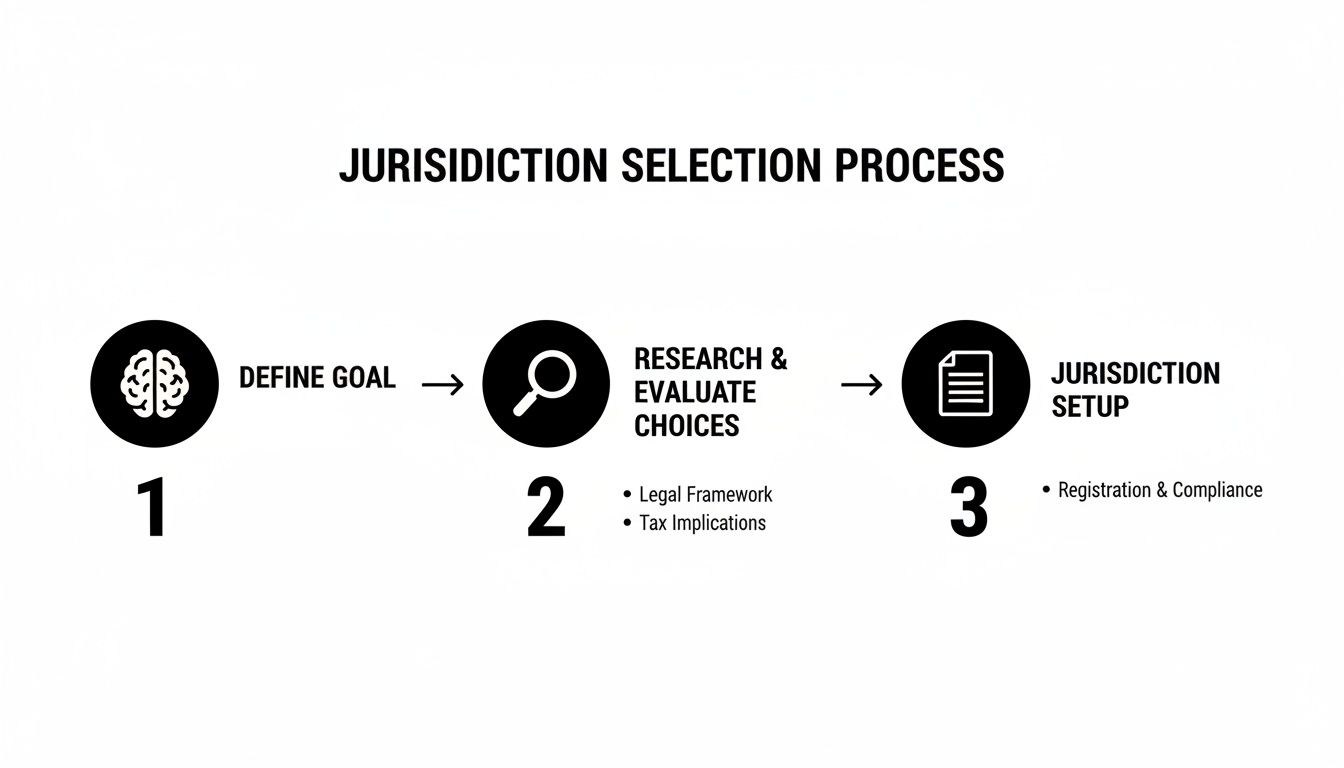
It’s a simple visual reminder that a successful incorporation begins with smart planning, not just paperwork.
Assembling Your Documentation
Once you've settled on an agent and a name, it's time to gather your documents. This is where delays often crop up, but with a bit of prep, it can be a smooth process. The authorities need to verify the identity and background of every single shareholder and director—a standard procedure known as Know Your Customer (KYC).
Typically, you'll need to provide:
- Passport Copies: Clear, valid copies for every shareholder and director.
- Proof of Address: A recent utility bill or bank statement (usually under three months old) confirming the residential address for each person.
- CV or Professional Profile: A short CV outlining the professional history of the key people involved.
- A Brief Business Plan: This isn't a massive document. A simple one-page summary explaining what the company will do is usually all that's needed. It's just to give the registry a clear picture of your intentions.
It helps to understand why these documents are requested. The passport confirms who you are, the proof of address verifies residency for compliance, and the business plan ensures your company's purpose is legitimate and fits within offshore regulations.
An experienced partner like PRO Deskk adds immense value here. We pre-clear your KYC documents, reviewing everything for accuracy and completeness before it goes to the registry. This simple step virtually eliminates rejections from basic administrative mistakes.
Submission and Registry Approval
With all your documents in order, your registered agent submits the complete file to your chosen registry—either JAFZA or RAK ICC. From there, the authorities conduct their own internal due diligence and background checks. This is a standard part of global anti-money laundering (AML) compliance and happens with every application.
This part is mostly a waiting game, but good communication from your agent is key. We stay in constant touch with the registry, ready to provide any extra information they might need and keeping you updated every step of the way.
How long does it take? With a well-prepared application, an offshore company can often be incorporated in just 1 to 5 business days. This speed is a huge advantage for international entrepreneurs who need to get their corporate structures in place quickly.
Once the review is complete and successful, the registry issues the official incorporation documents.
You'll typically receive:
- Certificate of Incorporation: The official document proving your company legally exists.
- Memorandum & Articles of Association (MOA/AOA): This is the company's constitution, detailing its rules and structure.
- Register of Shareholders and Directors: An official list of the company's owners and managers.
Getting these documents means your offshore company formation is complete. You now own a legally recognised international business, ready to hold assets, trade globally, or open a corporate bank account. Our specialists, who are well-versed in mainland and free zone setups across Dubai, Sharjah, and Abu Dhabi, can also guide you on how this offshore entity can fit into a wider UAE corporate strategy. And with our 24/7 support, you're never on your own.
Securing a Corporate Bank Account in the UAE

Let's be blunt: getting your corporate bank account approved is often the single biggest hurdle in the entire offshore setup process. While forming the company itself can be surprisingly fast, UAE banks operate under very strict international compliance rules. This makes opening an account a meticulous, detailed, and sometimes frustrating affair.
This isn't the banks being difficult for the sake of it. They are held to global anti-money laundering (AML) and Know Your Customer (KYC) standards. The UAE's financial institutions are respected worldwide, and they protect that reputation by thoroughly vetting every single corporate client. For an offshore company, that scrutiny is dialed up even further.
Understanding the Bank's Perspective
A bank's main objective is to understand your business inside and out, ensuring it's completely legitimate. They need to see a clear, logical reason for your company's existence and why it needs a UAE-based account. A vague application or an unclear business plan is the fastest route to a rejection.
What they're really looking for is substance. This doesn't mean you need a physical office with staff, but your business activities must be well-defined, credible, and backed by solid documentation. The bank wants to see a professional business profile that tells a clear story about your company's purpose and how it operates.
The bank’s compliance team isn’t just ticking boxes; they are building a risk profile for your company. Your job is to provide them with all the information they need to classify you as a low-risk, credible client.
This is exactly where many entrepreneurs stumble. They assume their new Certificate of Incorporation is the golden ticket. In reality, it's just the starting point. You need to present a complete, professional package that anticipates and answers the bank's questions before they even ask them.
The Essential Document Checklist
While every bank has its own specific quirks and requirements, there's a core set of documents you'll always need. Getting these right from the very beginning is non-negotiable.
Here’s the absolute minimum you must have ready:
- Complete Corporate File: This means your Certificate of Incorporation, Memorandum & Articles of Association (MOA), and all Share Certificates.
- Shareholder & Director Documents: You'll need certified passport copies, UAE entry stamps or visa pages (if relevant), and recent proof of address (like a utility bill) for everyone involved.
- Detailed Business Profile: This is your chance to shine. It must outline your business activities, target markets, expected annual turnover, and the nature of both incoming and outgoing payments.
- Information on the Ultimate Beneficial Owner (UBO): Banks must know who ultimately owns and controls the company. Full transparency here is mandatory, not optional.
On top of these basics, it’s common for banks to ask for a professional CV for the shareholders or even request reference letters or proof of existing business activities. Being over-prepared is always the best strategy. For a complete rundown, our guide can walk you through how to open an offshore company and bank account together.
The Insider's Edge That Makes a Difference
Having the right documents is one thing, but presenting them in a way that practically guarantees approval is something else entirely. This is where experience and established banking relationships become your most valuable asset.
An experienced partner doesn’t just forward your file to the bank; they manage the entire narrative. They help you craft a compelling business profile that aligns perfectly with what the bank needs to see.
More importantly, a firm with strong banking relationships can make direct introductions to the right people, ensuring your application gets the priority attention it deserves instead of languishing in a general queue. This expert guidance, combined with our 24/7 support service, gives you a dedicated advocate focused on getting your account open, so you can focus on what you do best—running your business.
Managing Your Offshore Company Post-Setup
Getting your offshore company incorporated is a huge milestone, but it’s really just the starting line. The true power of a UAE offshore company is unlocked by keeping it in good standing and using it correctly for the long haul. This means staying on top of your ongoing responsibilities to make sure your company stays compliant, effective, and secure.
These duties are straightforward but absolutely critical. They’re designed to keep your company legitimate in the eyes of UAE authorities and international banks. Dropping the ball on these can lead to fines, losing your company's good standing, or even getting your corporate bank account frozen—basically wiping out all your initial effort.
Core Compliance and Annual Renewals
First up is the annual renewal of your company. This isn't just a bit of paperwork; it's a legal requirement to keep your entity alive and active. The good news is that your registered agent handles the renewal process, which bundles a few key things together.
This usually includes:
- Government Registry Fees: The mandatory fee you pay to the authority (like JAFZA or RAK ICC) to keep your company officially registered.
- Registered Agent Fees: This covers the services of your corporate service provider, who acts as your official link to the registry.
- Registered Office Address: The fee for maintaining the physical address that’s legally required for all UAE offshore entities.
Missing the renewal deadline can lead to penalties. If you let it slide for too long, the registry could strike your company off its list. Getting a company reinstated is a much bigger, more expensive headache than just renewing on time.
Navigating the UAE Tax Landscape
One of the biggest draws for a UAE offshore company is how tax-efficient it is. For years, these companies have benefited from a 0% corporate tax, which is perfect for international business. And while the UAE has rolled out a Federal Corporate Tax, the advantages for offshore companies are largely still in place.
The new tax law mainly targets mainland and free zone companies with operations inside the UAE. If your offshore entity purely does business outside the UAE and is used for passive things like holding shares or property, it generally falls outside the scope of this tax. For most international investors, this means the tax benefits are business as usual.
It's crucial to understand that "tax-free" doesn't mean "no compliance." Your offshore company must still adhere to international reporting standards to maintain its favourable tax status and banking relationships.
Economic Substance and UBO Reporting
To stay in line with global standards against tax avoidance, the UAE brought in Economic Substance Regulations (ESR) and rules for reporting the Ultimate Beneficial Owner (UBO). These are two areas of compliance you absolutely have to manage.
- UBO Reporting: You need to keep an accurate, current register of who the company's ultimate beneficial owners are—the actual people who own or control it. This info isn't public, but you must have it ready for the authorities if they ask.
- ESR Filings: If your offshore company is involved in certain "Relevant Activities" (like holding company business or IP business), you must file an annual ESR notification. You might even need to submit a more detailed report to prove you have enough economic substance in the UAE.
These regulations are taken very seriously. Our corporate PRO services are designed to handle these filings correctly and on time, so you stay fully compliant without the administrative burden.
The Onshore-Offshore Hybrid Strategy
A really smart move for many international investors is to pair an offshore company with a mainland or free zone company. This hybrid structure lets you separate your high-value assets from the risks of day-to-day operations.
For example, your RAK ICC offshore company could own all the intellectual property and real estate, while your Dubai mainland company handles sales, hires staff, and deals with local clients. This way, any operational liabilities are kept within the mainland business, and your core assets remain safe and sound offshore.
This integrated approach is becoming more popular as foreign direct investment into the UAE grows, hitting over USD 23–25 billion a year recently. Even though legal changes now allow 100% foreign ownership for many mainland businesses, international investors still prefer offshore and free zone setups for their simplicity and asset protection benefits. A common model is using an offshore parent company to hold shares in a free zone or mainland subsidiary. This centralises profits in a tax-friendly vehicle while the local operations run smoothly. You can explore detailed analyses of foreign direct investment in the UAE to learn more about these investment frameworks.
With our expertise in mainland, free zone, and offshore formations across Dubai, Sharjah, and Abu Dhabi, we specialise in creating these kinds of cost-effective, custom solutions. Backed by 24/7 support, we make sure your corporate structure isn't just set up right, but managed for success in the long run.
Answering Your Key Questions on UAE Offshore Companies
When you're exploring setting up an offshore company in the UAE, a lot of questions pop up. It's completely normal. Getting straight answers is the first step to making a smart, confident decision. Let's tackle the most common queries we hear from entrepreneurs and investors, drawing from our day-to-day experience on the ground.
Can I Get a UAE Residence Visa With an Offshore Company?
This is easily the most frequent question we get, and the short answer is no. An offshore company, by itself, doesn't make you eligible for a UAE residence visa. These companies are designed specifically for international business—things like holding assets or managing global trade—not for living or operating locally.
But there's a very popular and effective strategy we often implement for our clients. You can set up your offshore company to be the legal owner, or shareholder, of a UAE free zone or mainland company. This creates a clever two-layer structure. Your assets stay shielded offshore, while your onshore company qualifies you to apply for an Investor Visa or even the sought-after Golden Visa. We specialise in putting these integrated setups together, ticking both your corporate and residency boxes.
What Are the Annual Renewal Costs Like?
This is one of the big advantages of going offshore—the annual renewal fees are significantly lower than what you'd pay for a mainland or free zone business. The costs are predictable and straightforward, usually covering just three things:
- The government's annual registry fee.
- The fee for your registered agent (that's us!).
- The cost of maintaining your registered office address.
While the exact figures differ a bit between JAFZA and RAK ICC, the total cost is just a small fraction of what you paid to set it up. We believe in cost-effective business setup solutions, so we give you a clear, itemised breakdown of all yearly costs right from the start. No surprises, just simple budgeting for the long haul.
Is My Information Kept Private?
Absolutely. Confidentiality is a core principle of UAE offshore jurisdictions. The names of the company’s directors and shareholders are not listed on any public database. This gives you a high level of privacy, which is crucial for asset protection and wealth management strategies.
Of course, this privacy is balanced with the need to meet global compliance standards. UAE authorities do keep a secure, private register of the company's Ultimate Beneficial Owners (UBOs). This information is only ever shared with other government bodies if there's a legitimate, official request, usually as part of international efforts to combat money laundering (AML) and terrorist financing (CTF). It’s a modern approach that provides genuine corporate privacy while maintaining the UAE's stellar international reputation.
What Are the Biggest Mistakes People Make?
Based on what we've seen over the years, the most common slip-ups are surprisingly easy to avoid if you know what to look for. Here are the top three mistakes we see time and again:
- Incomplete or Incorrect Paperwork: This is the number one reason for delays and even rejections. It sounds simple, but getting every detail right is critical.
- Choosing the Wrong Jurisdiction: Picking JAFZA when RAK ICC would have been a better match (or the other way around) can lock you into unnecessary costs or functional limits down the line.
- Underestimating the Bank Account Opening: Many people assume that once the company is incorporated, opening a bank account is a guaranteed next step. That's a major oversight; banks have their own rigorous due diligence process.
Working with an experienced team like ours helps you sidestep these problems completely. We pre-check all your documents, advise you on the best jurisdiction for your specific goals, and use our established relationships with banks to make that process as smooth as possible. With our full suite of Corporate PRO Services and 24/7 support, you have specialists guiding you every step of the way.
Navigating the details of offshore company formation UAE is much simpler with expert guidance to help you get the most out of it and avoid the common traps. At PRO Deskk, we provide clear, practical advice that’s built around your international business objectives.
✅ Specialists in Mainland Company Formation in Dubai, Sharjah & Abu Dhabi
✅ Specialists in Freezone Company Formation across the UAE
✅ Specialists in Golden Visa on Property and Investor Visa
✅ Specialists in Corporate PRO Services and Attestation Services
✅ 24/7 Support Service – Always here when you need us
✅ Cost-Effective Business Setup Solutions tailored to your needs
✅ Enjoy UAE Tax Benefits for International Entrepreneurs
📞 Call Us Now: +971-54-4710034
💬 WhatsApp Us Today for a Free Consultation: Let's Chat!