
If you're planning to rent a property in Dubai, Ejari is a word you'll get familiar with very quickly. It's the mandatory government system for registering all rental contracts, managed by the Real Estate Regulatory Agency (RERA).
Think of it as the official birth certificate for your tenancy agreement. Without it, your rental contract has no legal standing in the eyes of the law.
Understanding the Foundation of Your Dubai Tenancy
Introduced back in 2007 by RERA, Ejari—which literally means "My Rent" in Arabic—is the official online portal where every single tenancy contract in Dubai must be recorded. The whole point is to create a rental market that's transparent and secure for everyone involved. It standardises contracts and, most importantly, protects the rights of both tenants and landlords.
Let's be clear: this isn't optional. It's a legal requirement.
Registering your agreement through Ejari makes it a legally binding document. It creates an official, indisputable record of the agreed-upon terms, rent amount, and the length of your contract. This registration is absolutely essential if any disputes pop up later on.
Why Is Ejari Non-Negotiable?
Trying to skip the Ejari registration will cause you some serious headaches. The Ejari certificate is your golden ticket to accessing essential services and getting through critical administrative tasks in Dubai. Without it, you'll hit some major roadblocks.
For instance, you'll find it impossible to:
- Connect Utilities: You can't set up your Dubai Electricity and Water Authority (DEWA) account without a valid Ejari certificate. Simple as that.
- Renew Your Visa: Many visa sponsorship and renewal applications demand a registered tenancy contract as proof of where you live. This goes for your own residency visa and for sponsoring your family members.
- Secure Other Services: Need to set up a telephone or internet connection? Chances are, they'll ask for your Ejari too.
To make things easier to understand, let's look at who is responsible for what during the registration process.
Key Responsibilities in the Ejari Registration Process
This table breaks down the roles to give both tenants and landlords a clear picture of their duties.
| Responsibility | Primary Party Responsible |
|---|---|
| Initiating Registration | Landlord or their Real Estate Agent. By law, the responsibility to register the Ejari falls on the landlord. However, in practice, it's often delegated to the real estate agent or even the tenant. |
| Paying the Fees | Typically the Tenant. Although the landlord is legally responsible for registration, the associated fees are almost always paid by the tenant as part of the move-in costs. This should be clarified in the tenancy agreement. |
| Providing Correct Documents | Both Parties. The landlord must provide their passport/Emirates ID, a copy of the property title deed, and their DEWA number. The tenant must provide their passport, visa, and Emirates ID copies. |
| Ensuring Accuracy | Both Parties. Before signing off, both the tenant and landlord should double-check that all details on the Ejari contract—like rent amount, contract dates, and property details—are 100% correct to avoid any future disputes. |
| Keeping the Certificate | Tenant. The tenant needs the official Ejari certificate to connect utilities, apply for visas, and for other administrative needs. It's crucial to keep a digital or physical copy safe. |
Ultimately, both the landlord and the tenant have a vested interest in making sure the Ejari is registered correctly and on time.
The system processes hundreds of thousands of contracts annually, reflecting the high demand in Dubai's rental market which aligns with the emirate's growing population. You can learn more about the Smart Rental Index on the Dubai Land Department website.
In short, without an Ejari, your tenancy agreement has no official validity. It's the cornerstone of your rental life in Dubai, making sure your rights are protected and allowing you to live and work in the city without any unnecessary hassle.
Your Step-by-Step Guide to Ejari Registration
Getting your head around the Ejari registration process might seem a bit daunting at first, but once you break it down, it’s actually a pretty logical procedure. You’ve basically got two main ways to get your tenancy contract officially registered, each one suiting different needs for convenience and speed.
Now, legally speaking, the landlord is the one responsible for registering the Ejari. In the real world, though, it's often the tenant who takes charge of the process. Why? To get things moving faster, especially when it comes to connecting essential utilities like DEWA. Knowing the steps involved yourself means you can get your new home set up without any unnecessary hold-ups.
Choosing Your Registration Method
You have two main paths to get your Ejari registration done. The choice really boils down to whether you prefer doing things face-to-face or from the comfort of your own home.
-
In-Person at a Trustee Centre: You can pop into an approved Ejari Trustee Centre. These are authorised service points dotted across Dubai where you can hand over your documents and usually walk out with the certificate in about an hour.
-
Online via the Dubai REST App: For a completely digital route, the official Dubai REST (Real Estate Self Transaction) mobile app is your go-to. It lets you upload all your documents and handle the entire process from wherever you are.
Whichever route you take, the end goal is the same: securing that official Ejari certificate. This piece of paper is your key to activating utilities and ticking off other residency requirements, making it a top priority right after you've signed your lease.
The General Registration Flow
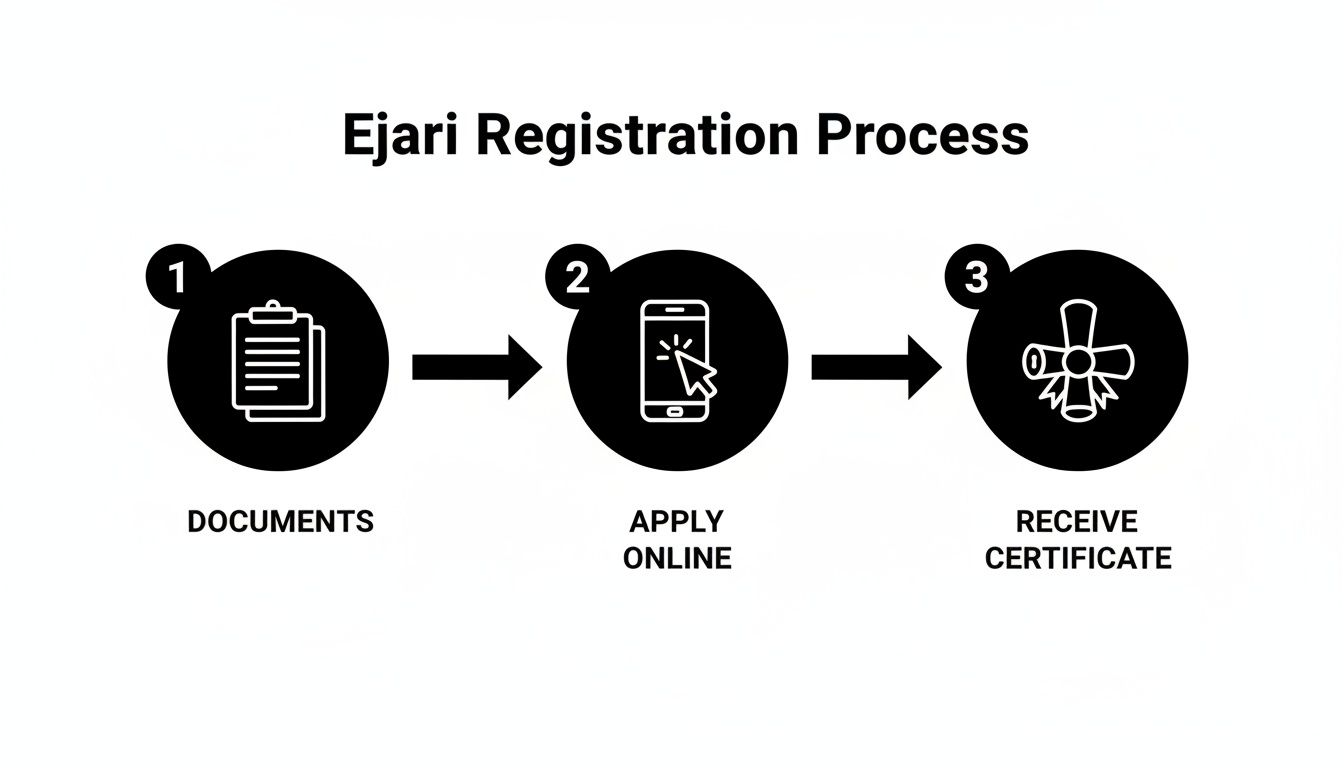
No matter which method you pick, the core steps don't really change. First things first, you need to gather all the required documents from both yourself and the landlord.
Next, you'll submit the application. This means either physically handing the papers to a representative at a Trustee Centre or uploading them through the app.
Finally, you pay the fees. Once the payment is confirmed and all the documents are verified, your official Ejari certificate is issued. While it sounds straightforward, making sure every single piece of paperwork is spot-on is critical. For instance, some processes might call for specific permissions, so it’s useful to understand documents like a No Objection Certificate. You can get more context by checking out our detailed guide on what a NOC is in the UAE.
Gathering the Correct Documents for Ejari
Getting your Ejari registration done quickly and smoothly really comes down to one thing: having all your paperwork in order beforehand. Think of it like preparing your ingredients before you start cooking – a little organisation upfront saves you from major headaches later on.
The tenancy contract is the absolute cornerstone of your application. If you're still working on drafting yours, a resource like this free rental agreement template can be a really helpful starting point to make sure you've covered all the bases.
As you can see, the path from gathering documents to getting your final certificate is pretty straightforward, but it all hinges on that first step being done right.
To make it even clearer, let's break down exactly who needs to provide what. Both the tenant and the landlord have a small but crucial set of documents to submit.
Document Checklist for Ejari Registration
| Document | Required from Tenant | Required from Landlord |
|---|---|---|
| Emirates ID Copy | ✔️ | |
| Passport & Visa Copy | ✔️ | |
| Title Deed Copy | ✔️ | |
| Landlord's Passport Copy | ✔️ (if an individual) | |
| Recent DEWA Bill | ✔️ (must show premise no.) |
Having this checklist ticked off before you begin is the best way to ensure there are no frustrating delays or rejections holding up your registration.
What the Tenant Needs to Provide
For the person renting the property, the focus is on confirming your identity and legal status in the UAE. It's quite simple.
- Emirates ID Copy: You'll need a clear copy of both the front and back. If you're new to Dubai and still sorting this out, our guide explains how to get an Emirates ID.
- Passport and Visa Copy: This includes your passport's main information page and a copy of your valid UAE residency visa.
What the Landlord Needs to Provide
The property owner's documents are all about proving their identity and, most importantly, their legal ownership of the property being rented out.
- Title Deed Copy: A recent copy of the property’s title deed is the non-negotiable proof of ownership.
- Passport Copy: If the landlord is an individual (not a company), a copy of their passport is required.
- DEWA Bill: A recent DEWA bill is usually needed. Make sure it clearly shows the 9-digit premise number for the property.
A quick pro tip: Before submitting anything, do a final check to make sure none of your documents are expired. An out-of-date passport or visa is one of the most common and easily avoidable reasons for an application to be rejected.
Understanding Ejari Fees and Renewal Requirements
Getting your Ejari registered involves a straightforward fee, but it’s really important to remember this isn't a one-time thing. The cost and the fact that it needs to be renewed every year are two of the most critical parts of managing your tenancy legally in Dubai.
So, how much will it set you back? The total cost for your Ejari registration really depends on how you choose to do it. Applying online through the Dubai REST app is usually the cheaper route. If you'd rather have someone walk you through it, you can visit an approved Real Estate Services Trustee Centre for in-person help, which will cost a bit more.
Breaking Down the Ejari Fees
No matter which path you take, the total fee is made up of a few different charges. This is to make it clear exactly what you're paying for.
A typical breakdown of Ejari registration fees includes:
- Registration Fee: This is the main charge for processing your tenancy contract.
- Knowledge Fee: A standard government fee you'll see on many official services.
- Innovation Fee: Another small charge that goes towards government initiatives.
- VAT: A 5% Value Added Tax is tacked onto the total service charge.
As an example, registering online might cost you around AED 177. On the other hand, doing it in person at a Trustee Centre could be closer to AED 220. Just keep in mind these figures can change slightly, so it's always a good idea to double-check the exact amount when you're ready to register.
Remember, Ejari registration is not a one-time event. It is directly tied to your tenancy contract and must be renewed every single year when you sign a new lease or renew your existing one.
The Importance of Annual Renewal
Letting your Ejari expire can cause some serious headaches. An out-of-date certificate is basically invalid, meaning you could run into trouble when you need to renew your residency visa or sponsor your family. It pretty much cuts you off from essential government services that require proof of your address.
The good news is that the renewal process is exactly the same as the first time you registered. You'll need to submit your new, signed tenancy contract, provide the necessary ID documents, and pay the renewal fees. Taking care of this each year ensures your legal protections stay in place and you can go about your life in Dubai without any unexpected admin problems.
How Ejari Legally Protects You in a Rental Dispute
Ejari is much more than just an administrative box to tick; it's your single most powerful tool if a rental disagreement ever pops up. Think of it as your legal shield. Registering your tenancy contract transforms it from a simple piece of paper into a government-recognised document, giving both tenants and landlords a solid foundation to protect their rights.
For a tenant, that registered Ejari contract is your official proof that you live there. This becomes absolutely critical if you ever need to challenge an unfair rent increase or fight an illegal eviction notice from your landlord. Without it, your claims simply don't have any legal weight.
On the flip side, landlords rely on the Ejari system to provide the legal framework they need to take action against a tenant for issues like not paying rent or causing significant damage to the property. It ensures any claims are based on an official, registered agreement.
The Role of Ejari in Rent Increase Disputes
One of the most common points of friction is when a landlord wants to increase the rent upon renewal. This is precisely where Ejari’s link to the Real Estate Regulatory Agency (RERA) becomes so important.
The data from every registered Ejari contract feeds directly into Dubai's Smart Rental Index. This is a clever tool that uses AI-driven, real-time data to figure out fair market rents. By analysing thousands of active contracts, the index stops landlords from setting unfair prices and makes sure the official rent increase caps—usually between 5-20%—are properly enforced by RERA. In a market that can see big swings in rent, your Ejari registration is what gives you access to this official benchmark. It provides a legal basis for negotiating your renewal and, if needed, settling things at the Rent Disputes Settlement Centre.
So, if your landlord suggests a rent hike that goes beyond what the RERA Rental Index allows, your registered Ejari contract is the proof you need to file a formal dispute with full legal standing.
Without Ejari, a rental dispute is just one person's word against another's. With it, you have a legally binding document recognised by Dubai's authorities, turning a subjective argument into a matter of official record.
This legal recognition is vital. It becomes even more crucial in complex situations, like when a landlord or tenant isn't physically in the UAE to handle matters themselves. In these cases, having all your documentation in order is key. For more on this, you might find our guide on what a Power of Attorney is and how it works helpful.
Frequently Asked Questions About Ejari in Dubai
To wrap things up, let's tackle some of the most common questions tenants and landlords have about the Ejari system. Getting straight answers can help you sidestep potential problems and keep your rental experience in Dubai a smooth one.
What Happens If My Landlord Refuses to Register Ejari?
If your landlord refuses to register the Ejari, they are breaking Dubai law. This puts you in a tough spot, as you won't be able to connect your DEWA utilities or process visa renewals without that crucial certificate.
Your first move should always be to talk to your landlord and gently remind them of their legal duty. If they still won't budge, you can visit an authorised Trustee Centre for help or file a petition with the Rent Disputes Settlement Centre (RDSC). The RDSC has the power to force the landlord to complete the registration, as it’s a non-negotiable requirement for all tenancy contracts in Dubai.
Can I Register Ejari Online by Myself?
Yes, absolutely. Both tenants and landlords can now register Ejari themselves using the official Dubai REST (Real Estate Self Transaction) mobile app. For most people, this is the quickest and most convenient way to get it done.
You’ll just need to have clear digital copies of all the required documents ready to upload. This typically includes the signed tenancy contract, the Emirates IDs of both the tenant and landlord, and a copy of the property's title deed. The app is quite user-friendly and walks you through every step, and you’ll get the certificate sent to you electronically once everything is approved.
The push towards digital registration is a big part of Dubai's plan to make essential services easier for everyone. It means no more queuing at service centres and much faster processing times.
How Long Does It Take to Get the Ejari Certificate?
The time it takes to get your Ejari certificate really comes down to which registration method you choose.
- Trustee Centre: If you go to a Trustee Centre in person with all your documents in order, you can often walk out with the certificate in less than an hour.
- Dubai REST App: Applying online through the app usually takes one to two business days for your application to be reviewed and the certificate to be issued. This assumes, of course, that all the documents you submitted are correct and complete.
Is Ejari Required for Commercial Properties?
Yes, Ejari isn't just for apartments and villas. It is mandatory for all rental properties in Dubai, and that includes commercial spaces like offices, retail shops, and warehouses. The registration process is largely the same as it is for residential tenancies.
The main difference is that for a commercial lease, you'll need to provide extra business documents, with the most important one being the company's valid trade license. Having a registered commercial Ejari is essential for renewing that trade license and for dealing with various government departments for other official business matters.
Navigating Ejari, visas, and company formation in the UAE can be complex. At PRO Deskk, we simplify these processes with expert guidance and comprehensive support.
✅ Specialists in Mainland Company Formation in Dubai, Sharjah & Abu Dhabi
✅ Specialists in Freezone Company Formation across the UAE
✅ Specialists in Golden Visa on Property and Investor Visa
✅ Specialists in Corporate PRO Services and Attestation Services
✅ 24/7 Support Service – Always here when you need us
✅ Cost-Effective Business Setup Solutions tailored to your needs
✅ Enjoy UAE Tax Benefits for International Entrepreneurs
Let us handle the paperwork so you can focus on what matters most.
📞 Call Us Now: +971-54-4710034
💬 WhatsApp Us Today for a Free Consultation at https://prodesk.ae