
So, you've landed a job in the UAE – congratulations! Now comes the paperwork. Getting your employment visa might sound a bit daunting, but it's actually a well-defined path. The best part? Your employer does most of the heavy lifting.
The whole system is designed to be straightforward. It kicks off with an entry permit to get you into the country, followed by a medical screening and biometrics for your Emirates ID once you're here. The final step is getting the residency visa stamped right into your passport. Once you understand these key stages, the whole journey becomes much clearer.
Understanding the UAE Employment Visa Journey
Navigating the visa requirements in the UAE is a journey with clear, manageable milestones. It's an employer-driven process, which means your new company is responsible for initiating and managing the application from start to finish.
Think of it as a relay race. Your employer handles all the administrative legs of the race, and you just need to show up for your part when you arrive in the country. This ensures that every foreign national working here is legally sponsored and accounted for. The process officially begins the moment you sign that formal job offer.
The main phases you'll go through are:
- Securing an Entry Permit: Your employer applies for this permit on your behalf. It’s your golden ticket to legally enter the UAE for work. It’s typically valid for 60 days, giving you plenty of time to complete the next steps.
- In-Country Procedures: Once you've arrived, the clock starts on a couple of essential appointments. You’ll need to complete a medical fitness test at a government-approved health centre and provide your biometric data (fingerprints and photo) for your Emirates ID card.
- Visa Stamping: After you get the all-clear from your medical test, your employer submits all the paperwork to get the final residence visa stamped in your passport. This stamp is what officially makes you a UAE resident.
The Three Core Stages Visualised
To make it even simpler, this flowchart breaks down the entire process from the moment you get your permit to the final residency stamp.
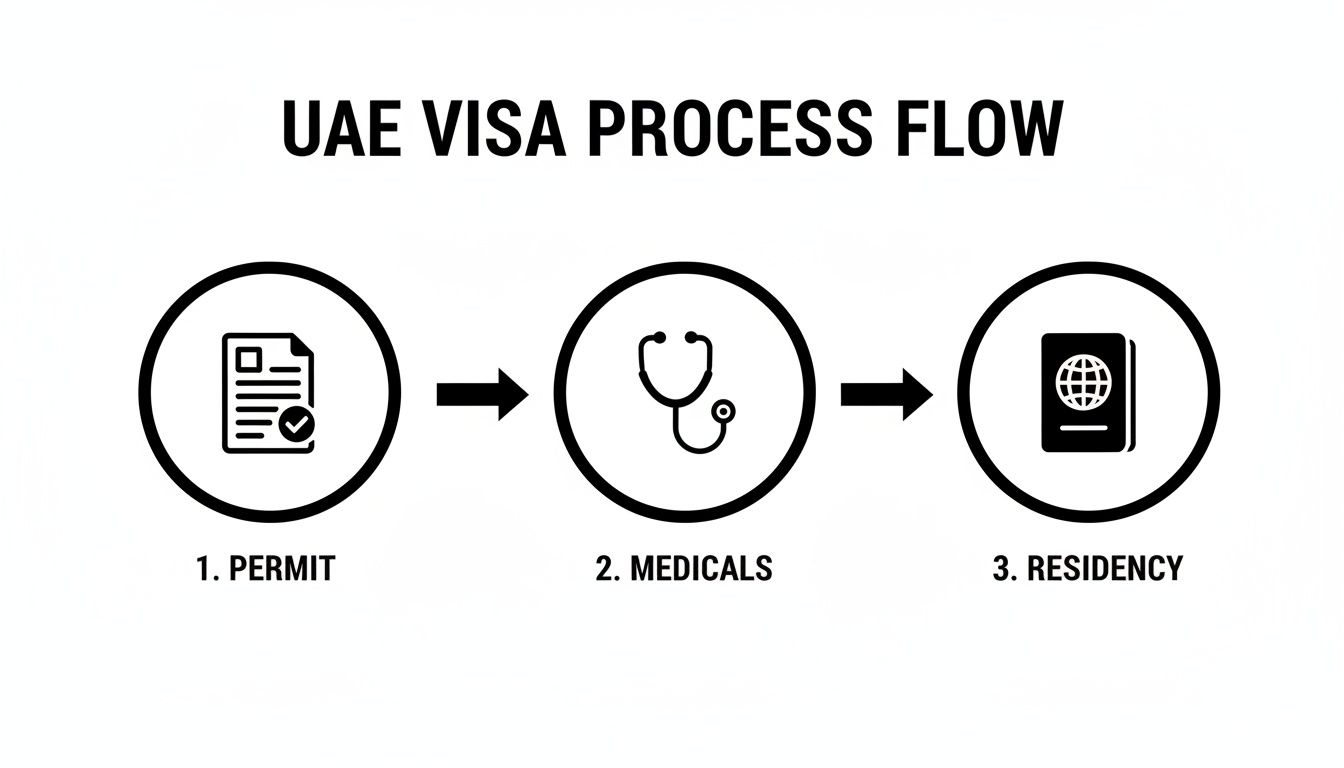
As you can see, it's a logical, step-by-step journey that's predictable and easy to follow.
To give you a clearer picture, here's a quick breakdown of what each stage involves.
UAE Employment Visa Key Stages at a Glance
| Stage | Key Action | Responsible Party | Typical Timeline |
|---|---|---|---|
| 1. Entry Permit | Application for a 60-day permit to enter the UAE for work. | Employer/Sponsor | 5-10 working days |
| 2. In-Country Checks | Medical fitness test and Emirates ID biometrics registration. | Employee (with employer guidance) | 3-5 working days after arrival |
| 3. Residency Visa | Final visa stamped into the employee's passport. | Employer/Sponsor | 5-7 working days after medicals |
This table shows how the responsibilities are split and gives you a rough idea of how long each step usually takes.
While your employer is sorting out the visa, you can start getting ready for the big move. Preparing for an international relocation is a huge task in itself, so looking into tips to make moving abroad easier can help you get organised without the stress.
The Critical Role of Employer Sponsorship
When you get an employment visa in the United Arab Emirates, it’s not just a standalone document. It's directly tied to your employer, who acts as your sponsor.
Think of it like this: your company is your anchor. The entire system for working in the UAE is built on this foundation of sponsorship. This means you can't just apply for a work visa on your own; your legal right to live and work here is guaranteed by a company that’s properly licensed in the country.
This arrangement places some serious legal and financial responsibilities on your employer’s shoulders. Whether they’re a big mainland company in Dubai or a specialised firm in a Sharjah free zone, they are the ones who have to kick off and manage the entire visa process for you.
Company Prerequisites for Sponsoring Staff
Before a company can even start thinking about bringing in talent from overseas, it has to tick a few essential boxes. These are non-negotiable requirements that prove the business is legitimate and in good standing with the UAE authorities.
First and foremost, the company needs a valid trade license. This is the official document confirming the business is legally registered and allowed to operate, whether on the mainland or in one of the UAE's many free zones. Without this, sponsoring anyone is a non-starter.
The company also has to be registered with the right immigration and labour departments. For mainland businesses, this means getting an establishment card from the General Directorate of Residency and Foreigners Affairs (GDRFA) and registering with the Ministry of Human Resources and Emiratisation (MOHRE).
Navigating Work Permits and Emiratisation
The whole sponsorship journey officially kicks off once your employer applies for your work permit. They’ll do this through MOHRE or the relevant free zone authority, which confirms you have a real job offer and the company has the green light to hire you. For a broader look at how this works in other places, you can explore general insights into employer sponsored visa pathways.
A key responsibility for sponsors is compliance with national workforce policies. This ensures that while international talent is welcomed, the local Emirati workforce is also prioritised for growth and development within the private sector.
A huge part of this is Emiratisation. This national initiative requires private sector companies with 50 or more employees to hire a certain number of UAE nationals. The goal is to have a 5% Emirati workforce by 2026, increasing to 10% by 2027. This policy is a cornerstone of the UAE's economic vision and is expected to contribute to an employment rate of 78.58% in 2025.
With all these complex rules, it’s no surprise that many businesses choose to work with corporate PRO services. These specialists handle the entire visa process, making sure everything from the trade license to Emiratisation quotas is sorted out. This helps make bringing international talent on board a much smoother, fully compliant operation.
Your Essential Employee Document Checklist
Once your employer kicks off the visa process, the ball is in your court. Your main job is to pull together a specific set of documents. Think of it like a recipe—if you use the wrong ingredient or miss one, the whole thing gets delayed.
Getting your paperwork right the first time is genuinely the best way to make sure your visa application sails through without any snags. A simple mistake, like a photo that's the wrong size or a missing stamp on a certificate, can cause frustrating setbacks that are completely avoidable.
Let’s break down exactly what you’ll need.
Personal Identification and Photos
First things first, you need to prove who you are. These documents are the foundation of your application and have very strict requirements.
The most important document is your passport. It absolutely must have at least six months of validity left from the day you plan to enter the UAE. It also needs a minimum of two blank pages for the visa stamp itself. You'll also need to provide a clear, high-quality colour copy of your passport's main information page.
Next up are your passport-sized photos. These aren't just any snapshots; they have to follow specific government rules:
- The background must be plain white. No exceptions.
- Your face should take up about 80% of the picture.
- Keep a neutral expression—no smiling. You’ll also need to remove any glasses or headwear, unless it’s for religious reasons.
Professional and Educational Credentials
With your identity confirmed, it's time to show you’re qualified for the job. This means gathering your degrees and professional certificates.
Your highest educational qualification, like a university degree, is a critical piece of the puzzle. But you can't just submit a photocopy. It has to go through a formal verification process called attestation.
Attestation is a multi-step process that officially validates your documents for use in the UAE. It confirms that your certificate is genuine and was issued by a legitimate institution, serving as a critical layer of security for the authorities.
This isn't a quick task. It usually involves a few key stages:
- Verification in your home country by the right authority (like the Ministry of Education).
- Attestation by the UAE Embassy or Consulate in your home country.
- Final attestation here in the UAE by the Ministry of Foreign Affairs (MOFA) once you arrive.
Our corporate PRO services team handles this entire process for clients all the time, saving them the headache of dealing with multiple international bodies.
Speaking of crucial documents, once your visa is approved and you start work, you'll receive a labour card, which is the official proof of your employment. To understand why this is so important, you can learn more about what is a labour card in the UAE in our detailed guide. This card is directly tied to your work permit and is essential for working legally in the country.
Navigating In-Country Medicals and Biometrics
Once you touch down in the UAE with your new entry permit in hand, a crucial new phase of your visa journey kicks off. You’ve now got a window—usually around 60 days—to complete a couple of mandatory procedures inside the country. The two big items on your to-do list are the medical fitness test and getting your Emirates ID biometrics done.
Think of your entry permit as a temporary key that gets you through the door. These next steps are what turn that key into a permanent pass, converting your temporary status into a full-blown residency. Getting this part right is non-negotiable for anyone looking to work in the UAE.
The Mandatory Medical Fitness Test
First up is the medical fitness test. This isn't just a formality; it's a public health measure the UAE takes very seriously to screen new residents for certain communicable diseases. You'll need to head to a government-approved medical screening centre to get this done.
The test itself is pretty straightforward, typically just a blood test and a chest X-ray. They are primarily screening for:
- HIV/AIDS
- Hepatitis B & C
- Tuberculosis (TB)
Getting a ‘fit’ certificate is absolutely essential. An ‘unfit’ result, unfortunately, will lead to the rejection of your visa application, and you would be required to leave the country. This really underscores just how critical this step is in the whole process.
Securing Your Emirates ID
While your medical results are being processed, you can get the ball rolling on your Emirates ID application. This card will become your official identification document in the UAE, and you’ll need it for everything from opening a bank account to signing a rental contract. The process starts at an accredited typing centre, where they will fill out the application form for you.
Once that's done, you'll get an appointment to visit a Federal Authority for Identity and Citizenship (ICA) service centre. This is where they'll capture your biometric data.
Biometrics simply means they take a high-quality digital photograph and scan your fingerprints. This data is securely linked to your profile, making the Emirates ID a vital and highly secure document for every resident. It is, without a doubt, a cornerstone of living and working legally in the UAE.
After you’ve passed your medicals and completed your biometrics, your employer (or their PRO services provider) will gather all the paperwork for the final step: the visa stamping in your passport.
Navigating these steps correctly is key. Getting professional help with your Emirates ID application can really take the pressure off, ensuring every form is filled out perfectly and submitted on time. When you partner with a specialist like PRO Deskk, every detail is handled with precision, turning what could be a confusing series of appointments and paperwork into a smooth and manageable part of your journey to becoming a UAE resident.
Exploring Flexible Visa and Work Alternatives
While the traditional employer-sponsored visa is still the most common way to work in the UAE, the country's visa system is becoming much more dynamic. We're now seeing modern alternatives pop up that offer a lot more flexibility for skilled professionals and the businesses that need them, especially for short-term gigs or specialised roles.
This change really caters to how work is evolving, particularly in fields driven by project-based assignments and freelance talent. Instead of locking into a full two-year sponsorship from the get-go, companies can now explore more agile solutions. These options are perfect for consultants, tech startups, or any business needing to bring in a specialist for a specific project without all the long-term admin.
The Sponsor-Free Job Seeker Visa
One of the biggest recent developments is the Job Seeker Visa. This visa is a genuine game-changer because it completely removes the need for an employer to sponsor you, letting qualified people come to the country specifically to find a job.
As part of the UAE's recent visa reforms, this sponsor-free Job Seeker Visa was introduced. It's valid for 60, 90, or 120 days and allows graduates and skilled professionals to enter the country without having a job offer lined up. To qualify, you’ll need to prove your credentials, like a bachelor's degree, and show you have enough funds to support yourself. Since these reforms came in, issuances for this visa have shot up, helping over 100,000 skilled individuals a year explore opportunities in high-demand fields like AI and cybersecurity. To get a better feel for these updates, you can discover more about recent UAE visa reforms.
What this really does is empower professionals. You can be on the ground, attending interviews in person and networking directly within your industry, which gives you a huge advantage in the job market before you commit to any company.
The Strategic Mission Visa
Another flexible option on the table is the Mission Visa, which you might also hear called a project-based work permit. It’s designed for people coming to the UAE to wrap up a specific, short-term project or assignment for a local company.
The Mission Visa is the ideal solution for the modern gig economy. It provides a legal framework for temporary work assignments, offering companies a compliant way to engage international talent for projects lasting up to 90 days, with the possibility of renewal.
Think of it as the perfect visa for situations like these:
- Bringing in an external consultant for a three-month project.
- Hiring a specialist technician to install or service some equipment.
- Onboarding a temporary employee to cover a short-term skills gap.
For companies, the Mission Visa is a smart, cost-effective alternative to a full employment visa when the work is only temporary. It neatly bridges the gap between a quick visit and a long-term commitment, lining up perfectly with the needs of agile, project-focused businesses. For expert advice on these visas and other options, including Investor and Golden Visas, our 24/7 support service is always here to help.
Why Expert PRO Services Are Your Greatest Asset
Trying to get your head around the UAE’s employment visa requirements can feel like solving a puzzle where the pieces keep changing. From wrestling with government portals to chasing application statuses and hitting unexpected roadblocks, the whole process can be a huge administrative drain. This is where getting professional help isn't just a good idea—it's your most powerful tool.
Think of a corporate PRO services firm as an expert guide for the complicated waters of UAE government rules. Instead of your HR team losing hours trying to make sense of the latest procedural update, a specialist takes charge of the entire visa journey, making it smooth and efficient. This hands-on approach saves your business a massive amount of time and helps you dodge expensive mistakes that could easily push back your new hire’s start date.
Smoothing Out Every Visa Type
Whether you're launching a mainland company in Dubai or growing your team in a Sharjah free zone, getting expert support means you’re compliant from day one. Our dedicated corporate PRO services in the UAE handle everything your business needs, including:
- Mainland and Free Zone Visas: We manage the process from start to finish for your whole team, ensuring every document and submission is spot on.
- Golden and Investor Visas: For your key people and high-net-worth individuals, we handle the specialised applications needed for long-term residency.
- Attestation Services: We take care of the crucial verification of educational and personal documents, which is often a major hold-up for many applicants.
Bringing an expert on board isn’t a cost; it’s an investment in a seamless, efficient, and successful UAE operation. It frees you up to focus on growing your business while we handle the headaches of compliance.
For sponsors who are filing employment visas through the MOHRE portals, the process involves fees that can range from AED 200-500, plus mandatory insurance. Processing times for applications that are fully compliant are typically 5-10 days, but any small mistake can trigger major delays. Our expertise ensures you stick to these tight timelines, which is especially critical for tech startups in RAKEZ or Ajman free zones that need to get up and running fast. You can find out more about how these visa processes support various work assignments.
With 24/7 support, we're always ready to provide cost-effective business setup solutions that fit what you need.
Got Questions? We've Got Answers
Thinking about the UAE employment visa process often brings up a few key questions. Let's walk through some of the most common ones to clear things up.
How Long Does the Visa Process Take?
From the moment you apply for the initial entry permit to finally getting that residency visa stamped in your passport, you’re typically looking at a timeframe of two to four weeks.
Of course, this is just an estimate. A number of things can slow it down, like missing documents, waiting on medical test results, or just the different processing speeds you find between mainland authorities and the various free zones.
Can I Bring My Family to the UAE?
Absolutely. Once your own residency visa is finalised and stamped, you can sponsor your immediate family, which means your spouse and children.
To get the ball rolling, you’ll need to show that you meet a minimum salary requirement. You'll also have to provide officially attested documents, like your marriage certificate and your children's birth certificates, to confirm your relationships.
What Is the Difference Between a Mainland and Free Zone Visa?
This is a really common point of confusion. A mainland visa is handled through the Ministry of Human Resources and Emiratisation (MOHRE) and lets you work for a company based anywhere in the UAE.
A free zone visa, on the other hand, ties you to a company that operates inside a specific free zone—think of the ones in Sharjah or Abu Dhabi. That zone's own authority manages the visa process. If you're setting up a business, our specialists in both Mainland and Freezone Company Formation can help you figure out which structure makes the most sense.
✅ Specialists in Mainland Company Formation in Dubai, Sharjah & Abu Dhabi
✅ Specialists in Freezone Company Formation across the UAE
✅ Specialists in Golden Visa on Property and Investor Visa
✅ Specialists in Corporate PRO Services and Attestation Services
✅ 24/7 Support Service – Always here when you need us
✅ Cost-Effective Business Setup Solutions tailored to your needs
✅ Enjoy UAE Tax Benefits for International Entrepreneurs
📞 Call Us Now: +971-54-4710034
💬 WhatsApp Us Today for a Free Consultation