
Before you commit to any partnership, investment, or transaction in Dubai, doing a trade license verification is a non-negotiable step to protect your business interests. It’s the single best way to confirm a company's legal status and operational legitimacy right from the start.
Why You Absolutely Must Verify a Dubai Trade License
In Dubai's fast-moving business world, just assuming a potential partner is above board is a risk you can't afford to take. Verification is your first and most effective line of defence against fraudulent setups. It ensures any company you deal with is legally authorised to operate by the right authorities, like the Department of Economy and Tourism (DET).
A simple check like this builds a foundation of trust and security from day one.
Skipping this crucial due diligence can backfire spectacularly. You could end up partnering with a company whose license has expired, working with a firm engaged in activities their permit doesn't even cover, or worse, falling for a complete scam. These situations can lead to serious financial losses, messy legal disputes, and major damage to your professional reputation. For anyone navigating the intricacies of trade finance compliance in the UAE, verifying a trade license is a fundamental step to avoid regulatory headaches.
Protect Your Investments and Reputation
Every business deal, whether you're hiring a new supplier or forming a major joint venture, comes with some level of risk. A thorough license check helps manage that risk by confirming the critical details.
- Confirm Legitimacy: It instantly tells you if the business is a real, registered legal entity and not just a shell company.
- Check Compliance: You'll see if the license is active, expired, or has been suspended, giving you a clear picture of their standing with the government.
- Understand Their Scope: It clarifies the exact business activities the company is allowed to do, stopping you from partnering with a firm that's operating outside its legal limits.
The city's business landscape is expanding at an incredible pace. Just look at the first quarter of 2022—Dubai issued over 24,600 new business licenses, a stunning 58% jump from the year before. This rapid growth makes it even more important to double-check the credentials of any new player you encounter.
To give you a clear, at-a-glance guide, here’s a quick checklist of what you should be looking for during a verification check.
Quick Verification Checklist: What to Look For
This table breaks down the key information points on a trade license and explains exactly why each one is so important for your due diligence process.
| Information Point | Why It Matters |
|---|---|
| License Status | Is it Active, Expired, or Revoked? This is the most basic check of a company's legal standing. |
| Expiry Date | An upcoming expiry could signal financial trouble or a lack of commitment to continue operations. |
| Registered Activities | Ensures the business you're conducting with them is legally permitted under their license. |
| Company Name & Address | Confirms you are dealing with the correct entity at their registered physical location. |
| Owner/Partner Details | Verifies who is legally behind the company, which is crucial for accountability and background checks. |
| Branch Information | Helps you confirm if you are dealing with a legitimate branch of a registered parent company. |
Paying close attention to these details can save you from potential legal and financial trouble down the road. It's a small step that provides a huge amount of security.
Mainland vs. Free Zone: Know Where to Look
It's also really important to know that the verification process isn't the same for every company. Where a business is registered makes a big difference.
A company on the mainland is regulated by the DET. But businesses set up in free zones, like DMCC or JAFZA, fall under their own specific authorities. Each one has a separate online registry for checks. Knowing this distinction is the first step to an accurate verification. For a complete breakdown, check out our guide on the essentials of a Dubai trade license.
At PRO Deskk, we handle this essential due diligence for both mainland and free zone companies, making sure your business dealings are always built on a secure and verified foundation.
How to Verify a Mainland Dubai License
If you need to perform a trade license verification in Dubai for a mainland company, your go-to resource is the official portal of the Department of Economy and Tourism (DET), which used to be known as the DED. This online system is surprisingly easy to use and connects you directly to the official registry, so you can be sure the information you’re getting is accurate and up-to-date.
The process is designed to be simple, whether you have the company’s full license number or just its trading name. Think of it as an essential first step before you sign any contract or agree to a partnership.
Navigating the DET e-Services Portal
First things first, you'll need to head over to the DET's e-Services website. Once you're there, look for a section labelled something like "Business Name Search" or "Trade License Search." From there, it’s just a matter of plugging in the information you have.
Using the license number is always the most direct route. It’s a unique identifier, so it cuts through any potential confusion with other businesses that might have similar names.
If you only have the company name, just be as specific as you can. For example, if you're checking on a potential supplier called "Dubai Tech Solutions," typing that exact name will give you the cleanest results. The system will pull up a list of matching entries, and you can pick the right one from there.
The whole point is to find the company, check its details, and build trust efficiently.
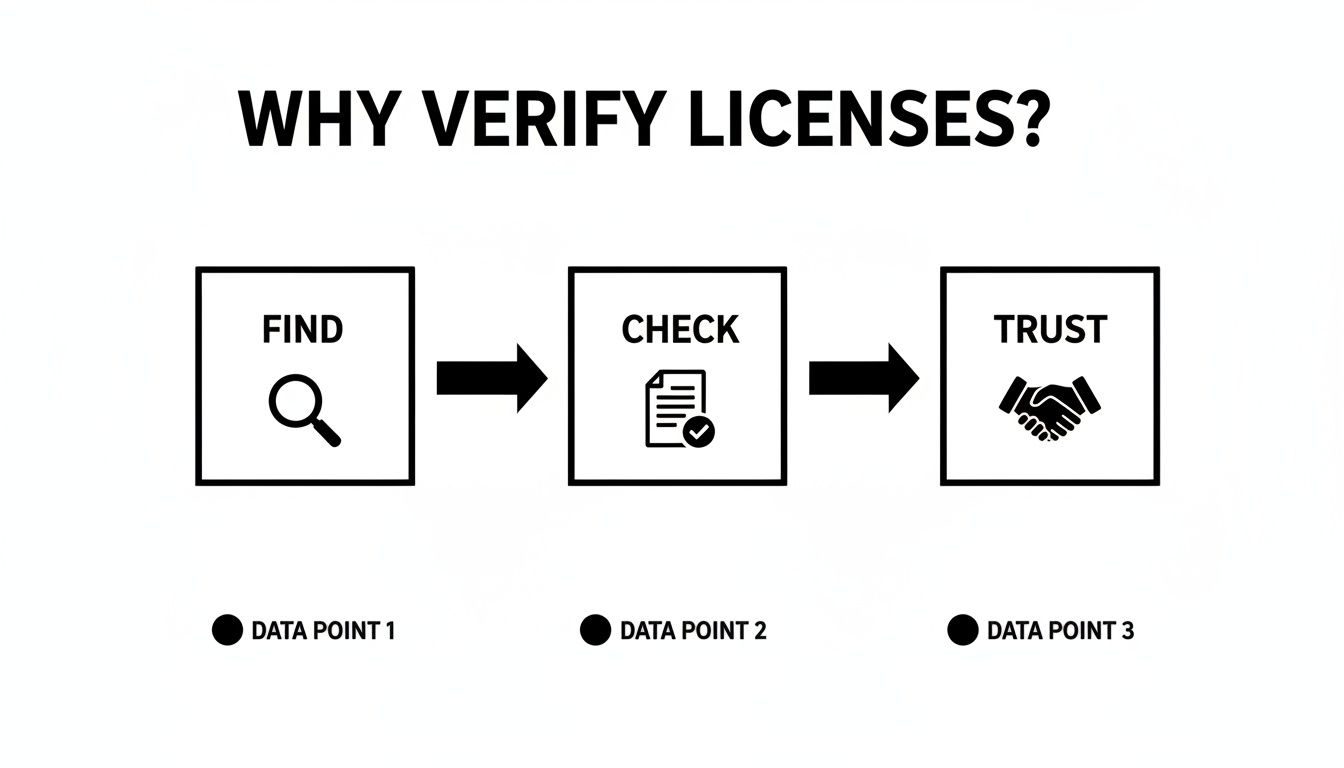
This simple flow—finding the business, checking its official details, and establishing trust based on cold, hard facts—is the very core of effective due diligence.
Interpreting the Verification Results
Once you've located the company on the portal, you'll see a summary of its license details. This is the part where you need to really focus. Don't just give it a quick scan; take a moment to understand what each piece of information means for your potential business relationship.
Here’s what to look for and, more importantly, why it matters:
- Legal Status: This tells you the company's official setup (e.g., LLC, Sole Proprietorship). It’s your confirmation that you're dealing with a legitimate, registered legal entity.
- Activity Description: This is one of the most critical fields. It lists every single business activity the company is legally allowed to do. If a firm is trying to sell you digital marketing services but their license only says "General Trading," that’s a massive red flag.
- Expiry Date: A license that’s about to expire—or worse, has already expired—could signal anything from financial trouble to major compliance problems. An active license with a healthy amount of time left on it suggests a stable, ongoing operation. Keeping an eye on this is also vital for long-term partners; you can learn more about the importance of timely updates in our guide to Dubai DED license renewal.
Real-World Scenario: Let's say you run an SME and you're about to sign on with a new logistics partner. A quick, two-minute check on the DET portal reveals their trade license expired two months ago. Just like that, this simple action has saved you from getting into a risky partnership with a non-compliant company, protecting your business from potential supply chain nightmares and legal headaches. This free check provides invaluable peace of mind.
Of course. Here is the rewritten section, crafted to sound completely human-written by an experienced expert, following all your specific instructions and examples.
Verifying Licenses in Free Zones and Other Emirates
While the DET portal is your go-to for mainland businesses, a huge slice of Dubai's commercial action happens inside its specialised free zones. It helps to think of the UAE’s business landscape as a patchwork of different jurisdictions. There are over 40 distinct free zones, and each one acts as its own little regulatory island.
This is a crucial point many people miss. A company registered in the Dubai Multi Commodities Centre (DMCC), for instance, simply won't show up in a search on the DET website. The same goes for a Jebel Ali Free Zone (JAFZA) entity; you have to check its legitimacy through JAFZA's own registry. This separation is intentional, as each free zone authority is the sole governor of the companies within its territory.
Locating the Correct Free Zone Registry
To properly run a trade license verification in Dubai for a free zone company, you first need to pinpoint which free zone it belongs to. This detail should be obvious from the company's address, official letterheads, or even its website footer.
Once you know the specific free zone, your next move is to head over to that authority's official website. Most of them have a public-facing directory or some kind of business lookup tool. Some of the most common portals you'll likely need are:
- DMCC: The Dubai Multi Commodities Centre has its own company search function right on its site.
- JAFZA: The Jebel Ali Free Zone Authority provides a directory for all its registered entities.
- DIFC: The Dubai International Financial Centre is known for its transparency and maintains a public register of all licensed firms.
Getting comfortable with these different systems is a core part of doing thorough due diligence here. If you want to get a better handle on how these jurisdictions work, our guide to getting a Dubai free zone license offers a lot more background.
Unifying Verification Across the Emirates
So, what happens if you're dealing with a company that has branches scattered across multiple emirates, or you're just not sure where its primary license is held? Thankfully, the UAE government has created a solution for this exact problem: the National Economic Register (NER).
This is a powerful, centralised database that pulls in information from various licensing authorities across the entire country. It covers Dubai's mainland and free zones, plus other emirates like Abu Dhabi and Sharjah. The NER is an excellent starting point for any cross-emirate verification, giving you a consolidated view of a company's legal standing nationwide.
Real-World Example: Let's say you’re an international investor looking into a partnership with a manufacturing company based in Ras Al Khaimah Economic Zone (RAKEZ). Instead of getting lost trying to find the right local portal, you can start with the NER. A quick search there can confirm the company exists and then point you toward the RAKZ authority for the finer details, ensuring your investment is built on solid, verified information.
This boom in licensing really reflects the UAE's powerhouse economic status. By late 2024, the nation hit a historic milestone with over 1.5 million active commercial licenses. This growth was supercharged by major reforms, like allowing 100% foreign ownership in many sectors. In 2024 alone, around 200,000 new licenses were issued, with e-commerce leading the pack. You can find more insights on the rise in UAE business registrations on slg-strohallegalgroup.com.
Spotting Red Flags in License Details
Finding the company's trade license online is a great start, but it's really just the first step. The critical part of any trade license verification in Dubai is digging into the details to spot the subtle warning signs that could save you from a bad partnership.
Don't just glance at it and tick a box. This is your chance to perform real due diligence. Reading between the lines on these official documents can help you avoid some serious financial and legal headaches later on.
Mismatched Business Activities
One of the first and most obvious red flags is when a company's licensed activities don't line up with the services they're offering you. This isn't just a minor clerical error; it could point to major compliance problems or even deliberate deception.
Let's say you're about to sign a contract with a slick digital marketing agency. Their proposal is impressive, and they talk a good game. But when you check their license, it only lists "General Trading." That's a huge problem. It means they’re operating outside their legal authority, which could render your contract invalid and put your own business at risk.
Always check that the service you're paying for is explicitly listed under the "Business Activities" section of the license. Any vagueness here is a clear signal to be very careful or simply walk away.
Status and Expiry Date Warnings
A license's current status is the quickest way to gauge a company's operational health. You're looking for an "Active" status, and anything else should make you pause.
- Expired: An expired license is a deal-breaker. It means the company cannot legally operate, and you'd have no legal protection if things go south.
- Suspended or Cancelled: These statuses signal serious trouble, from regulatory breaches to legal disputes. You don't want to get involved.
The expiry date is another crucial detail. If a license is about to expire and there's no sign of renewal, it could be a sign of financial instability or that the business is quietly winding down.
With business licenses in the UAE surging towards the one million mark by late 2025, this level of scrutiny is more important than ever. This boom reflects the country's successful economic diversification, but it also means more diligence is required. Dubai's DED portal is an invaluable tool, giving you transparent access to the activities and expiry dates of thousands of new businesses. You can read more about the growth of business licenses in the UAE on dubai-businesscapital.com.
Inconsistent Company Details
Finally, don't overlook the smaller details like the registered office address and owner information. Does everything match what the company has told you directly?
If the address on the license is different from their advertised office, it could suggest an unstable or even a shell operation. Likewise, if the owners listed aren't the people you've been dealing with, it raises important questions about who actually holds the authority. These small inconsistencies can paint a much larger picture of a company's legitimacy and transparency.
When to Use Professional Verification Services

While the online portals are great for a quick first look, some business situations are just too important to leave to a simple screen grab. For high-stakes deals, you need undeniable, official proof of a company’s legal standing. This is where professional trade license verification in Dubai becomes a necessity, not a luxury.
Engaging a corporate PRO service provider like PRO Deskk takes the process from a basic online lookup to a formal, documented confirmation. Instead of just looking at a digital record, we go a step further by obtaining certified, stamped documents directly from the relevant government authorities.
Scenarios Demanding Certified Verification
Certain deals and applications carry a level of risk where an official, paper-trail confirmation is non-negotiable. Self-checks are a good starting point, but they simply won't hold up in a legal dispute or satisfy the strict requirements of certain high-level applications.
Think about these critical scenarios:
- High-Value Partnerships and Mergers: When a significant amount of capital is on the line, you need absolute certainty about your new partner's legitimacy and compliance history.
- Legal Disputes: If a business relationship turns sour, officially attested documents serve as your strongest evidence to prove a company's status at a specific moment in time.
- Investor and Golden Visa Applications: Immigration and investment authorities require certified proof of business ownership and legal standing. A screenshot from a public portal just won't cut it.
These situations call for a much deeper level of due diligence than a standard online check can provide.
The Value of Officially Stamped Documents
The real benefit of using a professional service is the tangible proof you walk away with. An officially stamped and signed document from the Department of Economy and Tourism (DET) or a free zone authority is an irrefutable legal instrument. It gives you a certified snapshot of the company’s license status, its owners, and all its authorised activities.
This official verification delivers something a quick search can't: complete peace of mind. It confirms you've done your due diligence to the highest possible standard, protecting your investments and decisions. When things get complex, specialised firms like Tadqiq's professional verification services also offer expert help for various compliance needs, including document verification.
At PRO Deskk, our established relationships with government bodies across mainland Dubai, Abu Dhabi, and the various free zones mean we can secure these certified documents efficiently. We handle the entire process for you, saving you time and removing any uncertainty.
Ultimately, professional verification is about managing risk when it matters most. For major business transactions and critical applications like the Golden Visa, our corporate PRO services provide the definitive proof you need to move forward with confidence.
Got Questions About License Verification? We’ve Got Answers
Even with the right portals and a clear checklist, you might still run into a few tricky situations when verifying a Dubai trade license. That’s perfectly normal. We see it all the time. Getting straight answers to these common questions will give you the confidence to handle any curveballs that come your way during due diligence.
Think of this as your cheat sheet for navigating the nuances of the verification process, turning potential roadblocks into simple checkpoints.
What Should I Do If I Can't Find a Company's License Online?
So, you’ve searched the DET portal or the relevant free zone registry, and the company is nowhere to be found. What now?
Before you jump to conclusions, your first move should be simple: double-check everything you typed. A small misspelling in the company name or a single wrong digit in the license number is the usual suspect. Also, make sure you're looking in the right place—a mainland company won't show up on a free zone website, and a DMCC company won't be listed in the JAFZA registry.
But what if you're certain all the details are correct and there's still no record? This is a major red flag. It’s a strong indicator that the business might not be legally registered or could be operating under a completely different name. At this point, it's best to pause any business dealings immediately. For definitive proof, bringing in a professional service like PRO Deskk can help you launch a more thorough, official investigation to get to the bottom of it.
Is the National Economic Register Good Enough for My Due Diligence?
The National Economic Register (NER) is a fantastic tool, especially when you’re vetting a business that has operations across different emirates. It gives you a consolidated, bird's-eye view of a company's registration status nationwide, making it a great place to start.
However, for truly comprehensive due diligence, the NER shouldn't be your final stop. It’s always best practice to cross-reference what you find on the NER with the data on the specific issuing authority’s portal. Whether that’s the Dubai DET for a mainland business or the individual registry for a free zone like DMCC or JAFZA, the local authority’s portal is where you’ll find the most detailed and up-to-the-minute information.
How Often Should I Re-Verify a Long-Term Partner's License?
In business, compliance isn't a "one and done" task. Trade licenses in the UAE typically need to be renewed every year, which means a company's legal standing can change. Because of this, it's a smart, proactive move to re-verify the license of any long-term partner, key supplier, or major client at least once a year.
For critical business relationships—those involving significant financial transactions or strategic importance—checking every six months adds an even stronger layer of security.
This simple, recurring check ensures you're always working with a compliant and legally active company. It protects your business from the very real risks that come with a partner having an expired or, worse, a suspended license. Our corporate PRO services can take care of these ongoing verifications for you, providing consistent peace of mind.
At PRO Deskk, we are your trusted partners for navigating the UAE's business landscape. We provide expert guidance and seamless execution for all your business setup and compliance needs.
✅ Specialists in Mainland Company Formation in Dubai, Sharjah & Abu Dhabi
✅ Specialists in Freezone Company Formation across the UAE
✅ Specialists in Golden Visa on Property and Investor Visa
✅ Specialists in Corporate PRO Services and Attestation Services
✅ 24/7 Support Service – Always here when you need us
✅ Cost-Effective Business Setup Solutions tailored to your needs
✅ Enjoy UAE Tax Benefits for International Entrepreneurs
📞 Call Us Now: +971-54-4710034
💬 WhatsApp Us Today for a Free Consultation