
If you're looking to start a business in Abu Dhabi, you've probably heard about the need for a trade license. It's the very first, and most critical, piece of the puzzle. This official permit is your non-negotiable ticket to operate legally. Without it, you can't conduct any business activities, open a corporate bank account, or hire employees.
Starting Your Business Journey in Abu Dhabi

The simplest way to think about a trade license in Abu Dhabi is as your company's official birth certificate. It’s the document that legitimises your operations in the eyes of the government and clearly outlines the scope of activities you're allowed to carry out. Getting this license isn't just a box-ticking exercise; it's the strategic move that unlocks the full potential of the UAE's booming economy.
The advantages of setting up here are significant, and they're specifically designed to pull in entrepreneurs from all over the world. From an extremely favourable tax system to its prime geographic location connecting East and West, Abu Dhabi is fertile ground for any business to grow.
Why Choose Abu Dhabi for Your Business?
The emirate isn’t just holding steady; it's actively expanding. The Abu Dhabi Registration Authority (ADRA) recently reported a solid 16% growth in new economic licences issued on the mainland, a clear indicator of strong investor confidence. This jump, which includes a 20% rise in the popular 'Tajer Abu Dhabi' license category, shows just how successful the government's push to diversify the economy and simplify the setup process has been. You can find the full economic report about Abu Dhabi's growth on their official site.
This dynamic climate presents a real opportunity. Working with specialists in mainland company formation can turn what seems like a complex process into a surprisingly straightforward experience. Our team at PRO Deskk focuses on tailored, cost-effective business setup solutions, making sure your launch is built on a solid legal foundation from day one.
Trying to navigate the legal system of a new country on your own can be tough. Getting expert guidance ensures every form is filed correctly and every regulation is met, saving you precious time and money while avoiding costly hold-ups.
We offer complete support that goes well beyond just the license application. Our services cover everything from securing an Investor Visa to ongoing Corporate PRO services, all backed by 24/7 support. For a deeper dive into the setup process, take a look at our complete guide to business setup in Abu Dhabi.
Choosing the Right License and Legal Structure
Picking the right trade license in Abu Dhabi isn't just a box-ticking exercise; it's the foundation you build your entire company on. This single decision will define what your business can legally do, what your liabilities are, and even how you can grow down the line. Getting this right from day one is crucial to avoid expensive headaches and make sure your business has a solid, compliant framework.
Think of it like choosing the right vehicle for a specific journey. You wouldn't take a sports car on a cross-country off-road expedition, would you? It’s the same with your license. The one you choose has to be a perfect match for what you plan to do, whether that’s selling goods, offering expert advice, or manufacturing products.
The Three Main License Categories
On the Abu Dhabi mainland, business activities are mostly grouped into three distinct license types. Each one gives you the green light for a different set of operations, and as an entrepreneur, you absolutely need to know the difference.
-
Commercial License: This is the go-to for any business involved in trading. If you plan to import, export, or sell goods—be it electronics, clothing, or general retail—this is your ticket. It’s essentially your permit to buy and sell physical products.
-
Professional License: This license is designed for individuals or companies that sell expertise and skill-based services. We're talking about consultants, lawyers, doctors, engineers, and other specialists. The key difference here is that you're selling your knowledge, not a tangible item.
-
Industrial License: If your business is all about making things, this is the one you'll need. An industrial license is required for any company involved in manufacturing, production, or processing raw materials into finished goods, like food processing plants or textile manufacturers.
Picking the wrong one can stop your business in its tracks. For instance, if you try to offer consulting services with a commercial license, you'd be in breach of compliance, leading to fines and a potential freeze on your operations.
Selecting Your Company's Legal Form
Once you've zeroed in on the right license, the next big decision is your company's legal structure. This determines how your business is owned and run, which has a major impact on everything from your personal liability to how you can bring in investors.
Here are a few of the common legal forms you'll find on the Abu Dhabi mainland:
- Sole Proprietorship: Owned and run by one person who is personally on the hook for all business debts. It’s a simple, straightforward structure often favoured by professionals offering specialised services.
- Limited Liability Company (LLC): An incredibly popular choice, an LLC creates a legal wall between the business's debts and the owner's personal assets. This gives you a layer of financial protection and works well for a huge range of commercial activities. To get a deeper understanding of this structure, check out our guide on setting up a UAE Limited Liability Company.
- Foreign Branch Office: This allows an international company to set up a base in Abu Dhabi. The branch operates as an extension of the parent company, which remains fully responsible for all its activities and liabilities.
To help you see the differences more clearly, here’s a quick comparison of the main license types.
Comparing Abu Dhabi Mainland License Types
| License Type | Primary Purpose | Common Business Activities | Key Consideration |
|---|---|---|---|
| Commercial | Trading, buying, and selling goods | General trading, retail shops, e-commerce, import/export | Ideal for businesses focused on tangible products. |
| Professional | Providing skill-based services | IT consulting, legal advisory, engineering services, artisans | Your business is built on your expertise, not physical stock. |
| Industrial | Manufacturing and production | Food processing, metal fabrication, textile manufacturing | Requires a physical production facility and specific approvals. |
Choosing the right combination of license and legal form is the most important strategic move you’ll make during the setup phase. It’s not just paperwork; it’s about structuring your business for long-term success and compliance.
The legal form you choose is not just a label; it's the legal DNA of your company. It determines ownership rules, profit distribution, and, most importantly, the extent of your personal financial risk.
At PRO Deskk, our specialists are experts in navigating the ins and outs of both mainland and free zone company formation. We can provide the tailored guidance you need to ensure your business is set up correctly from the very beginning.
The Step-by-Step Mainland License Application Process
Getting your trade license in Abu Dhabi is a lot like following a recipe – each step needs to be completed in the right order to get the perfect result. While there are a few government departments you'll interact with, the process itself is logical and straightforward. Think of it as building a house: you have to lay the solid foundation of approvals and legal documents before you can even think about opening your doors for business.
This guide lays out a clear action plan to take you from a business idea to a fully licensed company on the Abu Dhabi mainland. By knowing what’s ahead, you can gather the right paperwork at the right time and avoid common delays.
Let's walk through the key stages involved in securing your license from the Abu Dhabi Department of Economic Development (ADDED). The first thing to understand is that your business will fall into one of three main categories, as shown below.
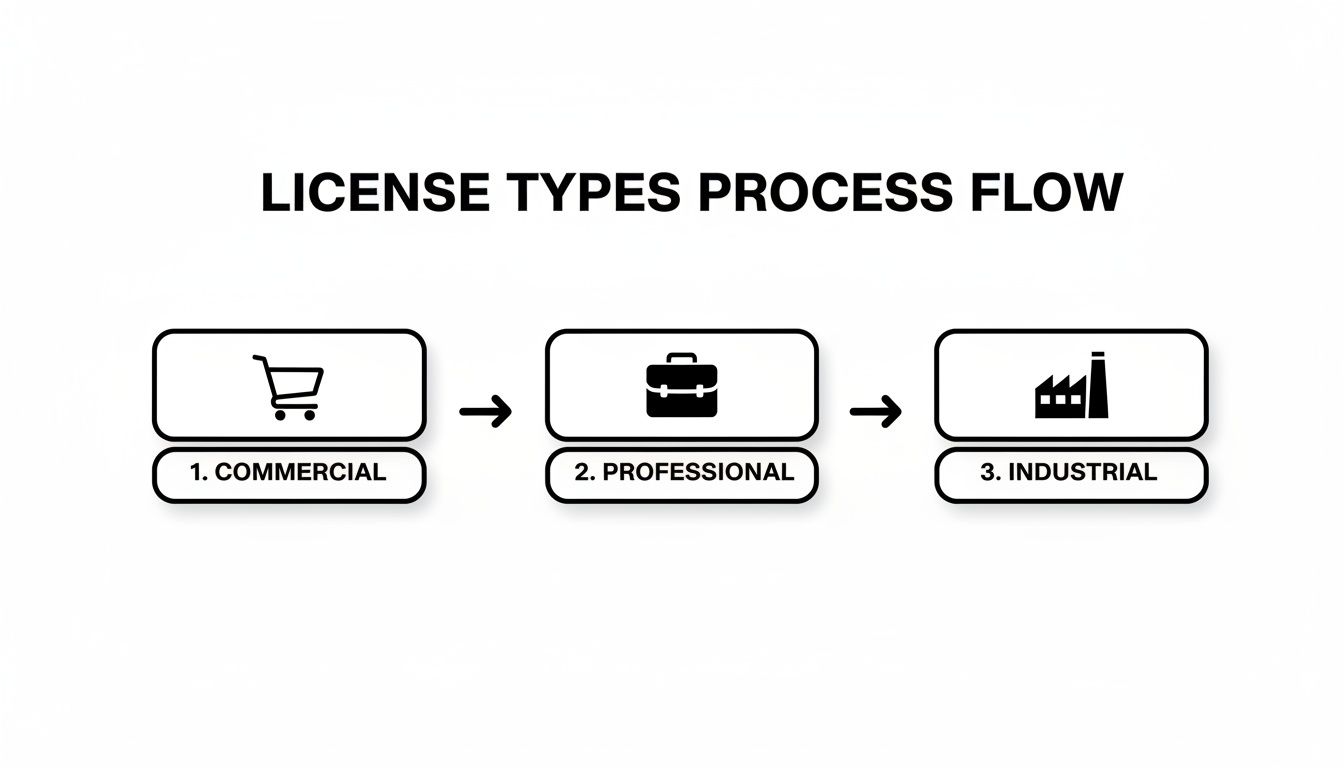
This distinction between commercial, professional, and industrial activities is fundamental, as it dictates the entire path your application will follow.
Stage 1: Define Your Business Activities and Reserve a Name
Your first move is to pinpoint exactly what your business will do. ADDED maintains a massive list of over 4,000 approved activities, and the ones you select will determine your license type and whether you need extra approvals from other ministries. Be specific, because this choice is legally binding.
At the same time, you need to pick a trade name. The name has to be unique and must follow UAE naming rules, which means no offensive language or references to religious or political groups. Once you have a few options, you’ll submit them for reservation. Getting your name approved is the first green light on your journey.
Stage 2: Obtain Initial Approval
With your activities and trade name sorted, the next milestone is securing the Initial Approval. This is basically a preliminary nod from ADDED, confirming they have no objection to your business idea moving forward.
It's important to remember that the Initial Approval is not your license to operate. Think of it as permission to continue with the next steps, like drafting your legal documents and finding an office. It validates your business concept within the government's framework.
To get this, you’ll need to submit an application with passport and visa copies for all shareholders. This certificate is usually valid for six months, giving you a good amount of time to get everything else in order.
Stage 3: Draft and Notarise Legal Documents
This is where you formalise your company’s legal structure. If you’re setting up a Limited Liability Company (LLC), the key document is the Memorandum of Association (MOA). This document is the blueprint for your company, detailing its structure, who owns what, management duties, and how it will operate.
Other company types might require a Local Service Agent (LSA) agreement or other legal papers. All these documents must be drafted in both Arabic and English and then officially notarised by a UAE public notary. This step makes your business and the relationships between its partners legally official.
Stage 4: Secure a Compliant Commercial Space
For most mainland licenses in Abu Dhabi, having a physical address is a must. You’ll need to lease a commercial property that’s right for your business and is located in an area zoned for commercial use. You can’t, for instance, run a medical clinic out of an industrial warehouse.
After you sign the tenancy contract, it must be registered through the Abu Dhabi Municipality’s Tawtheeq system. This platform authenticates your lease, and the Tawtheeq certificate it generates is a non-negotiable requirement for your final application. It’s the official proof of your business address.
Stage 5: Final Submission and License Issuance
You're on the home stretch. Now it's time to gather all the documents you’ve collected and submit them to ADDED in one complete package. This will include:
- The final, completed license application form
- Your Initial Approval certificate
- The trade name reservation certificate
- Your notarised Memorandum of Association (MOA)
- The Tawtheeq certificate for your office lease
- Passport copies for all partners and managers
- Any external approvals you secured from other government bodies
Once ADDED verifies and approves your submission, you'll receive a payment voucher for the license fees. As soon as that’s paid, your official trade license in Abu Dhabi will be issued. With this license in hand, your company is officially registered and ready to do business in the emirate.
Exploring Free Zones as a Powerful Alternative
While setting up on the Abu Dhabi mainland gives you direct access to the entire UAE market, it's certainly not the only route to success. For many international entrepreneurs and businesses with a global focus, Abu Dhabi’s free zones are a very compelling alternative.
Think of it this way: the mainland is the city's main high street. You can trade with everyone locally, but you have to follow the standard city-wide rules. A free zone, on the other hand, is like a dedicated international business park within that city. It has its own laws and offers unique perks designed specifically for global trade.
The biggest draw for setting up in a free zone is the level of control and financial freedom it gives you. This makes it a fantastic choice for businesses centred on import/export, international services, or any operation that doesn't need a physical shopfront in the local market.
Core Advantages of an Abu Dhabi Free Zone
Opting for a free zone for your trade license in Abu Dhabi comes with a handful of key benefits that are particularly attractive to foreign investors. These are designed to create a business-friendly and profitable environment.
- 100% Foreign Ownership: This has always been the standard in free zones. Unlike the mainland's past requirements, you get full control of your business from day one without needing a local Emirati partner.
- Full Profit Repatriation: You are completely free to send 100% of your capital and profits back to your home country. There are no restrictions, ensuring your earnings are always accessible to you.
- Zero Customs Duties: Companies operating within a free zone are usually exempt from customs duties on goods they import and export. For trading businesses, this is a massive cost saving.
- Tax Benefits: Free zones offer major tax incentives, including exemptions from corporate and personal income taxes, which is a cornerstone of the UAE's appeal for global entrepreneurs.
When you put these benefits together, you get a business ecosystem that’s not just cost-effective but also gives you the operational freedom to compete on a global scale.
Spotlight on Abu Dhabi's Premier Free Zones
Abu Dhabi is home to several world-class free zones, each with its own focus on specific industries. This specialisation helps create powerful business clusters where companies in the same field can collaborate and innovate.
A perfect example is the Abu Dhabi Global Market (ADGM), a leading international financial centre ideal for fintech, asset management, and professional services firms. Its growth has been nothing short of impressive; ADGM issued a record-breaking 1,869 new licences in the first half of the year alone, which is a 47% year-on-year increase. This surge has cemented its position as the MENA region's fastest-growing financial hub, with assets under management jumping by 42%. You can explore more about ADGM's remarkable growth and what it means for the region.
Other top zones include:
- Masdar City Free Zone: A global hub for sustainability and clean technology, attracting companies in renewable energy, AI, and R&D.
- KIZAD (Khalifa Industrial Zone Abu Dhabi): An industrial and logistics powerhouse, perfect for manufacturing, trading, and large-scale industrial operations.
Choosing between a free zone and the mainland isn't about which one is better overall, but which one is strategically better for your business. The decision hinges entirely on your target market, business activities, and long-term growth plans.
Mainland vs. Free Zone: Which Is Right for You?
To make the best decision, it really helps to see a direct comparison. This table breaks down the fundamental differences, helping you align your business goals with the right operational framework.
Mainland vs. Free Zone Business Setup in Abu Dhabi
| Feature | Mainland Company | Free Zone Company |
|---|---|---|
| Market Access | Can trade directly anywhere in the UAE and take on government projects. | Primarily operates within the free zone and internationally. Requires a local distributor for mainland sales. |
| Ownership | 100% foreign ownership is now available for many activities. | 100% foreign ownership is standard across all activities. |
| Office Space | A physical office with a Tawtheeq tenancy contract is usually mandatory. | Offers flexible options, including flexi-desks and virtual offices, reducing overheads. |
| Visas | Visa eligibility is generally tied to the size of the physical office space. | Visa packages are often included in the license setup, with clear quotas. |
| Customs Duty | Standard customs duties apply to imported goods. | 0% customs duty on goods traded within or exported from the free zone. |
Ultimately, a mainland company gives you unrestricted access to the local UAE economy, while a free zone company offers a more streamlined, cost-effective base for international operations with significant financial perks. Your choice should directly reflect where your customers are and how you plan to serve them.
Understanding the Required Documents and Costs

Getting a trade license in Abu Dhabi is a clear-cut process, but its success depends entirely on having your paperwork in perfect order. Even a single missing document or an incorrectly filled form can cause frustrating delays, putting your business launch on hold. The key to a smooth and quick application is preparing everything ahead of time.
Think of it like building a puzzle. Each document is a critical piece that must fit exactly right to reveal the complete picture—your fully licensed company. If even one piece is missing, the picture just won't be complete.
The Essential Document Checklist
To kick things off, you'll need to gather a specific set of documents for both the company and every shareholder. While the exact requirements might change slightly based on your legal structure and business activity, this core checklist is pretty standard for a mainland company.
For All Shareholders and Managers:
- Passport Copies: You'll need clear, colour copies for every single person involved.
- UAE Visa Page Copies: This is for any non-GCC nationals who are already UAE residents.
- Emirates ID Copies: A must-have for all residents of the UAE.
- No Objection Certificate (NOC): If a shareholder is already employed in the UAE, they might need an NOC from their current sponsor giving them the green light to open a new business.
For the Company Itself:
- Completed Application Form: The official form from the Abu Dhabi Department of Economic Development (ADDED).
- Trade Name Reservation Certificate: This is the proof that your chosen business name has been approved and is officially yours.
- Initial Approval Certificate: The preliminary thumbs-up from ADDED.
- Notarised Memorandum of Association (MOA): The formal legal document that spells out your company's structure and shareholder agreements.
- Tawtheeq (Tenancy Contract): Your registered commercial lease, which proves you have a physical office space.
- Business Plan: For some professional activities, you might be asked to submit a detailed business plan to show your venture is viable.
Pulling all this paperwork together can feel like a huge task, but getting it right is non-negotiable. An experienced business setup consultant makes sure every document is correctly prepared, attested, and submitted, which gets rid of the risk of rejection and saves you a lot of valuable time.
A Transparent Look at the Costs
Just as important as your documents is your budget. The total cost of a trade license in Abu Dhabi isn't one single number; it's made up of several different fees. Understanding this breakdown helps you plan your finances properly and avoid any nasty surprises down the line.
While the final bill will depend on your unique setup, here are the main costs you can expect to see:
- License Issuance Fee: This is the main government fee for the license itself. It changes based on your business activity and legal form.
- Trade Name Registration: A fee to secure and register your unique business name.
- Office Rent and Tawtheeq: The annual rent for your commercial space is a big part of the cost, along with the fee for registering the contract through the Tawtheeq system.
- Notarisation Fees: These are the charges for getting your MOA and other legal documents officially notarised.
- External Approvals: If your business needs a special sign-off from other ministries (like the Ministry of Health or Education), there will be extra fees.
At PRO Deskk, we specialise in providing cost-effective business setup solutions designed just for you. Our team will walk you through these costs, making sure everything is transparent from the very beginning. For a precise and personalised quote, WhatsApp Us Today for a Free Consultation.
How Professional PRO Services Streamline Your Setup
Trying to get a trade license in Abu Dhabi on your own can feel like navigating a maze. The rules can be complex, and one small mistake can lead to long delays. While it's certainly possible to handle it yourself, partnering with a professional business setup consultant turns a stressful process into a smooth and predictable one.
Think of an expert partner as your dedicated guide. They handle every single detail so you can put your energy where it truly belongs: building and growing your business.
This is where Corporate PRO Services make a real difference. Instead of you spending countless hours trying to coordinate with various government departments, a professional team does it all for you. They manage everything from getting initial approvals and registering your trade name to securing the final license, ensuring every document is submitted perfectly the first time.
This kind of hands-on support is invaluable. The legal requirements for a mainland company in Abu Dhabi, for example, are quite different from those in a Dubai free zone. Our specialists know the ins and outs of each jurisdiction and can give you tailored advice on the best structure for your business, whether that’s a mainland LLC or a free zone entity.
Your Strategic Partner in Business Formation
Choosing the right partner gives you more than just administrative help; it gives you a strategic advantage. An experienced firm understands the subtle but critical nuances of the UAE's regulatory environment.
This deep knowledge is especially important in a market that’s always growing and changing. For instance, recent data shows a 29% increase in new licences issued in Abu Dhabi's agriculture, fisheries, and livestock sectors. A huge 61.8% of this growth was concentrated in the Al Ain Region alone. A skilled consultant can spot these emerging opportunities for investors like you. You can read more about Abu Dhabi's sector-specific growth to see these trends for yourself.
A professional PRO service doesn't just process paperwork; it proactively clears the path for your business launch. This expert oversight prevents costly errors and significantly reduces the time it takes to get your company operational.
Our commitment covers every aspect of your business setup. We are:
✅ Specialists in Mainland Company Formation in Dubai, Sharjah & Abu Dhabi
✅ Specialists in Freezone Company Formation across the UAE
✅ Specialists in Golden Visa on Property and Investor Visa
✅ Specialists in Corporate PRO Services and Attestation Services
✅ 24/7 Support Service – Always here when you need us
✅ Cost-Effective Business Setup Solutions tailored to your needs
✅ Enjoy UAE Tax Benefits for International Entrepreneurs
By entrusting your setup to experts, you save time, avoid stress, and launch your Abu Dhabi company with the confidence that every legal box has been ticked correctly.
📞 Call Us Now: +971-54-4710034
💬 WhatsApp Us Today for a Free Consultation
Frequently Asked Questions
When you're looking to get a trade license in Abu Dhabi, a few questions always pop up. We get them all the time. Here are some straightforward answers to help clear things up so you can move forward with confidence.
Can I Get a Trade License in Abu Dhabi Without an Office Space?
Yes, you absolutely can, but it depends on your business. For instance, the 'Tajer Abu Dhabi' license is a great option that allows entrepreneurs in over 1,200 specific sectors to get started without a physical office for the first three years.
For most standard mainland licenses, though, you'll still need a registered physical office address. This has to be backed up by a Tawtheeq tenancy contract. The best way to know for sure is to check. Our mainland company formation specialists can tell you in a heartbeat if your business activity qualifies for an exception.
How Long Does It Take to Get a Trade License in Abu Dhabi?
The timeline really hinges on your specific business activity, your chosen legal structure, and how well-prepared your documents are. If all your paperwork is in perfect order and you don't need any special approvals from other government bodies, you could be looking at anywhere from a few days up to two weeks.
Now, if your business is in a sector like healthcare or education, you'll need extra clearances from various ministries, and that will naturally add more time to the process. This is where working with a professional PRO service makes a huge difference—they make sure every submission is right the first time, helping you sidestep those common, frustrating delays.
The single biggest reason for delays? Incomplete or incorrect paperwork. Just one small mistake can push your application right back to the beginning. That's why having an expert from a firm specialising in Corporate PRO Services oversee the process is so valuable for getting set up quickly and correctly.
What Is the Difference Between Initial Approval and the Final Trade License?
Think of the initial approval from the Abu Dhabi Department of Economic D<evelopment (ADDED) as a thumbs-up to proceed. It’s the government officially saying they have no issue with your chosen business name and activities. This approval is your green light to go ahead and lease an office and get your legal documents drafted.
But, and this is crucial, it’s not a license to start operating your business. The final trade license is the official document you get only after every single legal and structural requirement has been met. You can only legally start trading, sending invoices to clients, and running your business once that final license is in your hands.
Do I Need a Local Sponsor for a Mainland Company in Abu Dhabi?
It used to be that for most mainland LLCs, you needed a UAE national sponsor who held 51% of the shares. That was the rule. However, thanks to some major legal changes, that's no longer the case for a huge number of commercial and industrial activities.
Today, 100% foreign ownership is a reality for thousands of business activities on the Abu Dhabi mainland. While a few strategic sectors might still require a local partner, most international entrepreneurs can now enjoy full control of their companies. Our specialists are always up-to-date on the latest rules and can give you specific guidance for your activity to ensure you're fully compliant.
At PRO Deskk, we take complicated procedures and turn them into simple, successful results. Whether you're setting up on the mainland or in a free zone, or need to secure your investor visa, our team offers clear, cost-effective solutions with 24/7 support.
📞 Call Us Now: +971-54-4710034
💬 WhatsApp Us Today for a Free Consultation at https://prodesk.ae