
If you've spent any time in the UAE, you'll eventually come across the need for a Police Clearance Certificate in Dubai. It's an official document from the Dubai Police confirming you don't have a criminal record from your time here. You might also hear it called a Good Conduct Certificate—they're the same thing.
This certificate is a key requirement for many of life's big steps, whether you're starting a new job, applying for immigration to another country, or aiming for a long-term visa like the Golden Visa.
Understanding the Dubai Police Clearance Certificate
Think of the Police Clearance Certificate (PCC) as an official testament to your good standing in the community. It's the government's way of verifying your lawful conduct, giving employers, immigration authorities, and other official bodies the assurance they need.
It’s a standard piece of paperwork for many significant processes, both within the UAE and when you're dealing with authorities abroad. The need for it pops up more often than you might think. Starting a new job in a sensitive field like finance? You'll need one. Applying for residency in Canada or Australia? It's non-negotiable. This simple document is all about demonstrating your credibility and trustworthiness.
To give you a quick overview, here's a summary of what's involved.
Dubai Police Clearance Certificate At a Glance
| Attribute | Details |
|---|---|
| Document Name | Police Clearance Certificate (PCC), Good Conduct Certificate |
| Issuing Authority | Dubai Police |
| Validity Period | 3 months from the date of issue |
| Purpose | Employment, Immigration, Visa Applications (e.g., Golden Visa), Business Setup |
| Who Needs It? | Current residents, former residents, new employees, business owners |
| Application Channels | Online (Dubai Police app/website), In-person (service centres) |
| Approx. Processing Time | 24 hours to 5 working days (depending on the channel and case) |
| Basic Fee (Residents) | Approx. AED 100 for Arabic, AED 200 for English |
This table covers the basics, but the specifics of who needs one and why are worth looking at more closely.
Who Typically Needs a PCC?
The requirement for a Police Clearance Certificate in Dubai isn't just for a niche group; it's quite broad. You'll likely need to get one if you fit into any of these categories:
- New Employees: Many companies, especially those in government, finance, or education, make a PCC a mandatory part of their background checks before you can start work.
- Immigration Applicants: If you're planning a move to countries like Canada, Australia, the UK, or the US, they will almost always ask for a PCC from every country you've lived in for more than a few months, including the UAE.
- Golden Visa Hopefuls: To get a long-term residency visa like the UAE Golden Visa, you'll have to submit a Good Conduct Certificate to prove you have a clean slate.
- Business Owners: When you're setting up a new mainland company in Dubai or applying for certain trade licences, the authorities might ask for a PCC from the owners or partners.
- Former UAE Residents: People who used to live in Dubai often find they need this certificate for jobs or residency applications in their new home country.
A common point of confusion is its name. Whether it's called a Police Clearance Certificate, a Good Conduct Certificate, or a Certificate of Good Conduct, they all refer to the same official document issued by Dubai Police.
With over 500,000 applications processed annually across the UAE, it's a routine but critical document. If you're applying from outside the country, a key step is getting a fingerprint card attested by a UAE embassy, which can add significant time to your application. You can find more details in this complete guide on the Dubai police clearance certificate.
Validity and Key Considerations
One of the most important things to remember is the PCC's short lifespan. It's only valid for three months from the date it's issued.
This means timing is everything. If you apply too early, the certificate could expire before you have a chance to submit it, and you'll have to start the whole process over again. This can be frustrating and cause serious delays.
This is where having an expert on your side makes a difference. At PRO Deskk, our specialists in Corporate PRO Services live and breathe these details. We help you plan your application perfectly, making sure all your documents are correct and submitted at just the right time. Whether you need it for a Golden Visa or to finalise your mainland company formation in Dubai, our 24/7 support is here to make sure everything goes smoothly.
Applying for Your PCC as a Current UAE Resident
If you're currently living in the UAE, getting your police clearance certificate in Dubai is a surprisingly slick and digital-first process. The days of endless paperwork and standing in long queues are pretty much over, thanks to smart apps and online portals. Let's walk through everything you need to know, from getting your documents in order to hitting that final submit button.
The absolute cornerstone of your application is a valid Emirates ID. This one card is tied directly to your residency file and contains the biometric data the system relies on for verification. If your Emirates ID is expired or you’re having issues with it, you need to sort that out first. Our detailed guide on how to get an Emirates ID covers that entire process. You simply can't move forward with an online application as a current resident without it.
Gathering Your Essential Documents
Before you even think about opening an app or a website, get your documents ready. It will make the whole thing go so much smoother. While the system cleverly pulls most of your details from your Emirates ID, you'll still need to have clear, digital copies of a few key things.
Here’s a quick checklist of what you'll need:
- A Valid Emirates ID: This is completely non-negotiable for anyone applying as a resident.
- A High-Resolution Passport Copy: Make sure the copy is sharp and clearly shows your photo, personal details, and passport number.
- A Recent Passport-Sized Photograph: This needs to be a clear, recent digital photo with a white background, just like the ones you'd use for any official application.
- Active UAE PASS Account: While it's not a document, your UAE PASS account is essential. It’s your secure digital identity for logging into almost all government portals, including the Dubai Police and MOI platforms.
Save these files in a folder on your phone or computer where you can find them easily. It’ll save you from a mad scramble later on.
Choosing Your Application Channel
As a resident, you have a couple of great, user-friendly digital options for applying for your police clearance certificate in Dubai. Honestly, the choice often just comes down to personal preference, as both get the job done efficiently.
Your main options are:
- The Dubai Police App or Website: For Dubai residents, this is the most direct route. The platform is built specifically for Dubai-based services and is known for being fast and easy to navigate.
- The Ministry of Interior (MOI) UAE App or Website: This is the federal platform that covers all the emirates. It's just as reliable and offers a unified service for residents no matter where they live in the country.
Most people in Dubai tend to stick with the Dubai Police app. But if you’re already familiar with the MOI portal from other services, it works perfectly fine. The speed at which these certificates are issued is a real testament to the UAE's digital transformation. Dubai Police processes a massive number of these requests through its e-services, and thanks to biometric integration, turnaround times have hit record speeds, often averaging 24-72 hours for online submissions. You can learn more about these advanced justice e-services on the official UAE government portal.
Insider Tip: If there's any chance you'll use this certificate abroad, always apply for the English version. The default is Arabic, but selecting the bilingual option right from the start will save you the time and money of getting it translated later.
Navigating the Online Application
Once you’ve picked your platform (we'll use the Dubai Police app as our main example here), the application itself is very straightforward. You’ll start by logging in with your UAE PASS, which handles the identity verification for you.
From there, the system will prompt you to fill out the application form. Your personal details, like your name and Emirates ID number, will usually be filled in automatically. You'll just need to enter the reason you need the certificate—whether it's for a new job, immigration, or another purpose.
Next up, you'll upload the documents you got ready earlier. The platform is well-designed for mobile use, so you can easily attach the files right from your phone's photo library. After uploading, you'll be taken to the payment gateway. For residents, the fee is typically around AED 200 for an English certificate.
The last step is to give everything a final once-over to make sure all the information is correct before you submit. You'll get a confirmation message and a reference number, which you can use to track the status. Before you know it, you'll get an email or a push notification from the app letting you know your certificate is ready to download.
How to Get a Dubai PCC from Outside the UAE
Getting a police clearance certificate in Dubai when you're no longer living in the country can feel like a daunting task, but it's a very common requirement. The good news is the process is mostly digital. However, your success hinges entirely on one critical document: a properly prepared fingerprint card.
Let's be clear: getting this one step right is the key to a hassle-free application from abroad.
The entire system for former residents is built to verify your identity from thousands of miles away. It all comes down to getting your fingerprints taken in your current country and then having that document officially recognised by the UAE authorities.
The Crucial Role of the Attested Fingerprint Card
Think of your fingerprint card as the most important piece of the puzzle. You can't just get your fingerprints taken, scan the card, and upload it. It has to go through a specific legalisation process first.
Essentially, this attested card is the international equivalent of using an Emirates ID for verification back in Dubai. It’s the official proof that the fingerprints you're submitting are genuinely yours.
Here’s the journey your fingerprint card needs to take:
- Get Your Fingerprints Taken: Head to a local police station or an accredited fingerprinting agency in the country where you currently reside. They'll take your prints on an official card.
- Local Attestation: Next, that card needs to be stamped by the relevant government authority in your country. This is usually the Ministry of Foreign Affairs or a similar department.
- UAE Embassy Attestation: The final and most important step is taking the now-attested card to the nearest UAE Embassy or Consulate for their official seal. This stamp is what makes the document valid for your Dubai PCC application.
A word of caution: This multi-step attestation process is absolutely mandatory. If you submit an application with a fingerprint card that hasn't been stamped by a UAE Embassy, it will be rejected on the spot. You'll have no choice but to start the entire, often lengthy, process all over again.
Navigating the Online Application from Abroad
Once you have the fully attested fingerprint card in your hands, the rest of the process is straightforward and happens online. You’ll be using the same official portals as residents do—either the Dubai Police website or the Ministry of Interior (MOI) platform—but you'll be logging in as a non-resident.
This flow chart breaks down the core stages for any application, whether you're inside or outside the UAE. The fundamental steps of preparing, applying, and receiving remain the same.
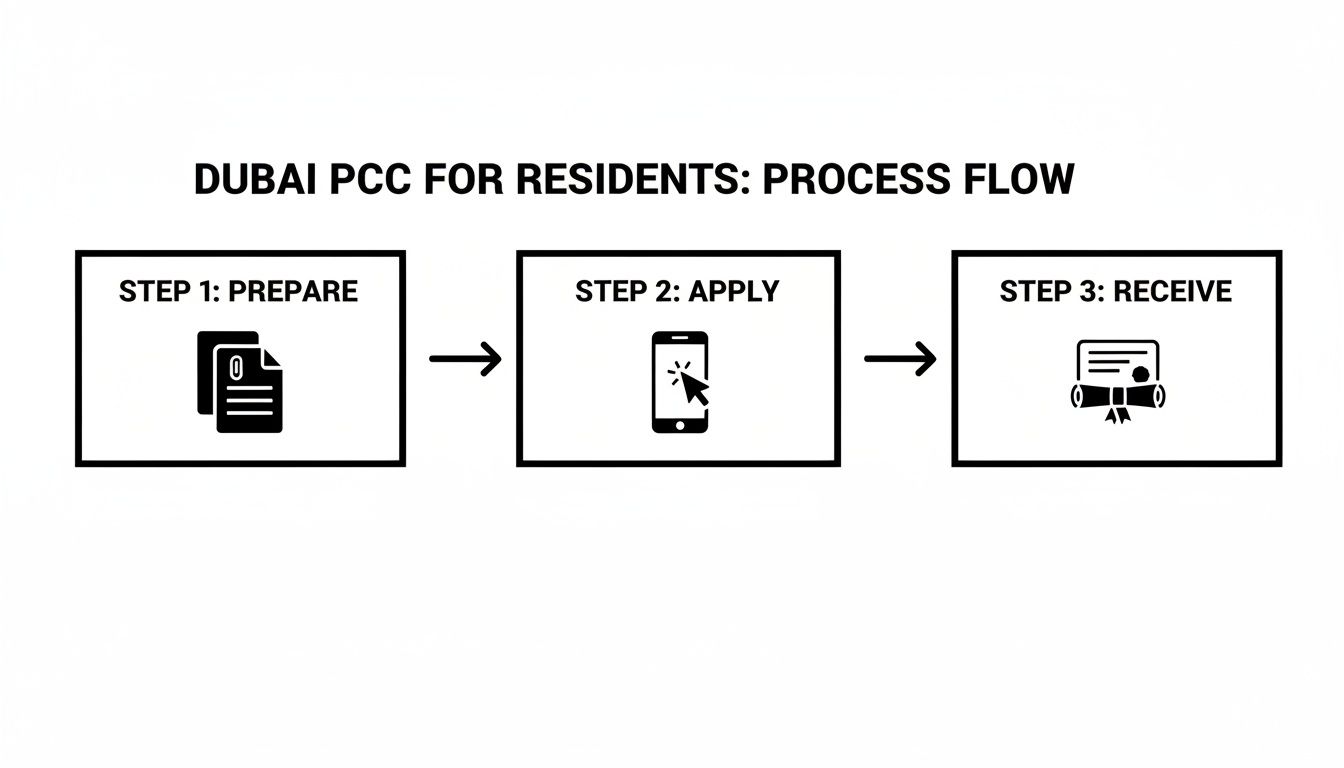
As an overseas applicant, you'll need a few more documents than a current resident. Make sure you have clear digital scans of everything before you begin:
- The Attested Fingerprint Card: A high-quality scan of the card with all the stamps clearly visible.
- Passport Copy: A copy of your current, valid passport's main information page.
- Previous UAE Visa Copy: This is essential. A copy of your last UAE residence visa helps the authorities locate your old file quickly.
- Two Recent Passport-Sized Photos: These should be digital copies with a plain white background.
You'll then fill out the online form, upload these documents, and pay the fee. Expect the cost to be a bit higher for an overseas application, usually around AED 320, which covers the extra verification steps involved.
Overcoming Common Hurdles and Delays
Applying from another country naturally introduces a few potential roadblocks. The most common one we see, by far, is a delay in getting the fingerprint card attested. Processing times at UAE embassies can vary wildly from one country to the next.
Our best advice? Start the attestation process as early as you possibly can. Call the UAE Embassy in your country before you begin to get the latest information on their specific requirements, fees, and timelines.
Another thing that can cause delays is a mismatch in your details. For instance, if the spelling of your name on your old visa is slightly different from your current passport, it could flag your application for a manual review. Double-check every single detail before hitting that submit button.
The process for former residents demands careful attention, especially when it comes to documentation. If you're looking for someone to manage the entire process for you, professional help is a smart move. At PRO Deskk, our specialists handle these overseas applications day in and day out. We can guide you through the attestation maze and manage the final submission, ensuring every step is handled correctly and efficiently.
Costs, Timelines, and How Long Your Certificate Lasts
Getting your head around the costs and timelines for a police clearance certificate in Dubai is key to a smooth process. Nobody wants to get hit with surprise fees or miss a crucial deadline because they underestimated the processing time.
Knowing these details upfront means you can plan your application properly, whether it's for a new job, a Golden Visa application, or an immigration filing. It’s all about confidence.
The fee structure is pretty straightforward and mainly hinges on where you are when you apply. If you're physically inside the UAE, the process is simpler and a bit cheaper. For former residents applying from overseas, the costs are slightly higher, which makes sense given the extra steps involved.
Breaking Down the Application Fees
The price for your Dubai PCC isn't a one-size-fits-all deal; it changes based on your residency status and the language you need the certificate in. My advice? Always go for the English version if there’s even a small chance you'll use it internationally. It’ll save you a ton of hassle with translations later on.
Here’s a clear breakdown of what you can expect to pay:
- Current UAE Residents: You're looking at a standard fee of around AED 200 for an English-language certificate. This is the most common path for people applying for jobs or sorting out visa matters within the country.
- Applicants Outside the UAE: For former residents, the fee is higher, typically about AED 320. This extra cost covers the more involved process of verifying your identity from abroad, including handling the attested fingerprint card.
- Additional Costs: Keep in mind that other charges might pop up. If you need the certificate couriered internationally, that's an extra cost. Likewise, if you need it legally translated into a language other than English or Arabic, you'll have to budget for certified translation services.
The whole process has seen a major shift since the launch of the Dubai Police smart app. Costs for residents have become pretty stable, while the fees for non-residents reflect the international handling required. One of the best updates has been the integration of UAE PASS, which has massively cut down rejection rates by making sure applicant data is pre-verified and correct. You can dive deeper into these services on the official Dubai Police portal.
How Long Does It Take to Get Your Certificate?
Processing times are impressively quick, especially for straightforward applications from current residents. Still, a few things can affect how fast your digital certificate lands in your inbox.
The standard turnaround for an online application submitted by a current resident is often just 24 hours. For overseas applicants, it typically takes a few working days, assuming all documentation, especially the attested fingerprint card, is spot on.
UAE public holidays can add a day or two to the wait time, so it's smart to plan around major holidays like Eid. Also, if your application gets flagged for any reason—like an unclear document or a small mismatch in your details—it might need a manual review, which will naturally extend the timeline.
Comparing Dubai PCC Fees and Timelines
To make things clearer, let’s compare the costs and processing times for different applicants. This table breaks down what you can expect based on your situation.
| Applicant Type | Base Fee (Approx.) | Average Processing Time | Key Considerations |
|---|---|---|---|
| Current Resident | AED 200 | 24 Hours | Requires a valid Emirates ID. Easiest and fastest route via the Dubai Police App. |
| Former Resident (Overseas) | AED 320 | 2-5 Working Days | Needs an attested fingerprint card. Timeline starts after Dubai Police receive all correct documents. |
| Tourist/Visitor | AED 200 | 24 Hours | Application must be made while inside the UAE. Cannot be done after departing. |
As you can see, applying while you're a resident in the UAE is the most efficient option. For those abroad, the key is getting that fingerprint card attested correctly to avoid any back-and-forth.
The Three-Month Validity Period
This is probably the most critical timeline to remember: your Dubai Police Clearance Certificate is valid for exactly three months from its date of issue.
This limited window means your timing has to be strategic. If you apply too early, the certificate could expire by the time you actually need to submit it for your job or visa, forcing you to go through the whole process again.
To nail the timing, just work backwards from your deadline. If you need to hand in your PCC for an immigration filing in two months, the perfect time to apply is about one to two weeks before that. This gives you a nice buffer for any unexpected delays while making sure the certificate is fresh and valid when it matters most.
Juggling these timelines and fees can be tricky, especially when you're on a tight schedule. That's where professional guidance can make all the difference. At PRO Deskk, our team provides Corporate PRO Services and Attestation Services, handling the entire application from start to finish. We make sure your documents are perfect and your submission is timed just right, so you can focus on your next big move without the paperwork headache.
Using Your Dubai PCC Abroad: The All-Important Attestation Process
So, you’ve got your Dubai police clearance certificate in hand. That’s a huge step, but if you're planning to use it for immigration, a new job, or university admission outside the UAE, the work isn't quite finished.
You can't just send the certificate as it is. For it to be recognised by any foreign government, it needs to go through a legal validation process called attestation.
Think of attestation as giving your Dubai PCC an international passport. It’s the official process that proves to overseas authorities that your document is authentic and legally issued. Skip this, and your certificate will almost certainly be rejected, leading to frustrating and expensive delays in your plans.
The Two-Stage Path to Legalisation
Making your PCC valid for international use is a straightforward, two-stage journey. It's vital to follow these steps in the correct sequence, as each stamp of approval builds on the last.
First, everything starts within the UAE. Your newly issued PCC must be taken to the UAE's Ministry of Foreign Affairs (MOFA). Here, officials will verify the document and apply their official stamp, confirming its legitimacy as a document from a UAE government body. This MOFA stamp is the non-negotiable first step; without it, you can't proceed.
The second stage is all about the country where you’ll be using the certificate. Once the MOFA stamp is on it, the document then needs to be submitted to the embassy or consulate of that specific country, located here in the UAE. For example, if you're moving to the United Kingdom, your MOFA-stamped PCC goes to the British Embassy. This final attestation from the embassy is what makes the document legally acceptable in your destination country.
Navigating the Maze of Embassy Requirements
This is where things can get a bit complicated. Every embassy plays by its own rules, and there's no one-size-fits-all approach to attestation. Some might have unique application forms, while others could require you to book an appointment weeks ahead of time.
To save yourself a major headache, doing your homework is key. Before you even think about visiting an embassy, check their official website in the UAE.
Look for answers to these questions:
- What other documents do they need? Will you need copies of your passport, visa, or a specific application form?
- What are the fees and how do I pay? How much will it cost, and what payment methods do they accept—cash, card, or only bank transfers?
- How long will it take? Processing times can vary wildly, from a few days to several weeks. You need to factor this into your schedule.
- How do I submit it? Can you just walk in, or is it strictly by appointment only?
Getting this wrong is more than just frustrating. If your attestation request is rejected for any reason, you often have to start the entire process over—including paying all the fees again. Careful preparation is your best strategy to avoid these setbacks.
Let the Experts Handle the Hassle
The attestation process can feel like a full-time job, especially if you’re up against a tight deadline or have already left the UAE. Juggling MOFA visits with embassy appointments demands time, patience, and a sharp eye for detail.
This is exactly where professional Attestation Services can be a lifesaver.
At PRO Deskk, we take this entire chain of legalisation off your plate. Our team are experts in this field, handling everything from the initial MOFA stamping to the final embassy attestation. We’re familiar with the specific protocols and quirks of different embassies, which lets us get your documents processed correctly and without unnecessary delays.
Find out how our expert documents clearing services can ensure your Dubai PCC is ready for the world stage, completely stress-free.
Common Questions About the Dubai PCC Process
Even with a step-by-step guide, you're bound to have questions when applying for a police clearance certificate in Dubai. Let's tackle some of the most common issues people run into, so you can handle anything that comes your way.
What Should I Do If My PCC Application Is Rejected?
Seeing a rejection notice can be stressful, but don't panic. It's almost always for a simple, fixable reason. The online system will usually give you a brief note explaining what went wrong, like an unclear document scan or a minor outstanding fine.
Your first move is to read that reason carefully. If it's a blurry passport copy, the fix is easy—just re-upload a much clearer version. If it flags a fine, you'll likely need to pop over to a police station or use the app to clear it before you can successfully apply again. For those tricky rejections where the reason isn't obvious, getting a professional on your side can save you a lot of guesswork.
Can I Get a PCC for Time Spent on a Visit Visa?
This is a frequent question, and the answer is generally no. A Police Clearance Certificate is directly tied to your official residency period under an Emirates ID. So, if you were only in Dubai on a tourist or visit visa, you won't be able to get a PCC covering that specific time.
The certificate is designed to vouch for the conduct of individuals who were legal residents in the UAE. If a foreign authority is asking for proof of your record during your time as a tourist, your best bet is to contact Dubai Police directly and ask if any alternative letters or reports can be issued for your unique situation.
Remember, the PCC is a certificate of good conduct linked to your official status as a resident. It's not just about your physical presence in the country.
Does My Police Clearance Certificate Need Translation?
By default, the Dubai PCC is issued in Arabic. When you apply, you'll see an option to request an official English version for a small extra fee. For most immigration or job applications in English-speaking countries, this official English copy is all you'll need.
However, if you're submitting the certificate to an authority in a non-English-speaking country, you will almost certainly need to get it legally translated. This isn't a job for just anyone; it has to be done by a certified legal translator. On top of that, the translated document itself might need its own attestation to be considered valid abroad.
Navigating the finer points of the police clearance certificate Dubai process can quickly become a headache. PRO Deskk is here to make it simple.
✅ Specialists in Mainland Company Formation in Dubai, Sharjah & Abu Dhabi
✅ Specialists in Freezone Company Formation across the UAE
✅ Specialists in Golden Visa on Property and Investor Visa
✅ Specialists in Corporate PRO Services and Attestation Services
✅ 24/7 Support Service – Always here when you need us
✅ Cost-Effective Business Setup Solutions tailored to your needs
✅ Enjoy UAE Tax Benefits for International Entrepreneurs
📞 Call Us Now: +971-54-4710034
💬 WhatsApp Us Today for a Free Consultation at https://prodesk.ae