
For international entrepreneurs, a Dubai offshore company is a game-changer. It’s a powerful legal tool that offers 100% foreign ownership, zero corporate tax, and seriously strong asset protection. Think of it as a non-resident entity, perfect for running your global operations from a stable, business-friendly hub without actually doing business inside the UAE.
Decoding Your Dubai Offshore Company Options

When people talk about an offshore company in Dubai, it's vital to know what it is—and just as importantly, what it isn't. This isn't your typical mainland or free zone company. An offshore entity is built exclusively for international activities. It’s a legal vehicle registered in the UAE, but it’s specifically prohibited from trading within the local market.
This unique setup delivers major advantages for certain business goals, especially tax efficiency, protecting your assets, and making global trade smoother. The UAE has two top-tier jurisdictions where you can establish one: the Jebel Ali Free Zone Authority (JAFZA) in Dubai and the Ras Al Khaimah International Corporate Centre (RAK ICC).
Offshore vs Mainland vs Free Zone
Trying to figure out the UAE's corporate landscape can feel complicated, but it really boils down to three main company types. Picking the right one is the foundation of your success here.
- Offshore Company: This is a non-resident company built for international trade, holding investments, and protecting assets. It can't operate inside the UAE market but gives you the huge benefits of zero tax and high confidentiality.
- Mainland Company: Registered with the Department of Economic Development (DED), a mainland company gets you unrestricted access to the local UAE market. It's the go-to choice if you want to sell directly to UAE customers and government entities.
- Free Zone Company: This structure, registered in one of the UAE's many specialized free zones, allows for 100% foreign ownership and is usually geared toward specific industries. You can trade internationally and within your zone, but you'll need a local distributor to sell on the mainland.
The real difference is your scope of operations. If your target is the local UAE market, go mainland. If you need a physical base for international business, a free zone is a great fit. But if your focus is purely on international dealings and holding assets without a physical UAE presence, the offshore company is hands-down the best choice.
JAFZA vs RAK ICC: A First Look
Both JAFZA and RAK ICC provide the core benefits of a UAE offshore structure, but they have distinct differences that suit different business needs. Making the right call comes down to your specific goals. Getting a handle on your options is the first step, and if you're curious about the broader corporate structures available, our in-depth guide on business setup in Dubai offers some excellent insights.
To get started, let’s look at how these two giants compare. This table breaks down the main distinctions to help you see which one might be a better fit for you.
JAFZA Offshore vs RAK ICC: A Quick Comparison
| Feature | JAFZA Offshore (Dubai) | RAK ICC (Ras Al Khaimah) |
|---|---|---|
| Primary Advantage | The only offshore entity that can own real estate in Dubai. | Highly cost-effective and known for its operational flexibility. |
| Reputation | Globally recognised and associated directly with Dubai's brand. | A modern, internationally respected registry with a strong legal framework. |
| Best For | Real estate investors, holding companies for Dubai assets. | International consultants, IP holding, global trading businesses. |
| Setup Cost | Generally higher due to its premium positioning and location. | More economical, making it popular for startups and SMEs. |
This initial comparison shows that your choice isn't just about a checklist of features; it's about strategic alignment. Are you planning to invest in Dubai property, or are you running a global consultancy from afar? Answering that one question will point you toward the right jurisdiction. We'll dive much deeper into this decision in the sections to come.
Choosing Your Jurisdiction: JAFZA or RAK ICC
Selecting the right jurisdiction for your offshore company in Dubai isn't just a box-ticking exercise; it's the first major strategic decision you'll make.
Your choice between the Jebel Ali Free Zone Authority (JAFZA) and the Ras Al Khaimah International Corporate Centre (RAK ICC) will directly influence your company's capabilities, costs, and long-term potential. While both offer core offshore benefits, they serve distinctly different purposes.
Making the right choice hinges on a simple question: Is your main goal to secure Dubai-based assets, or to create a flexible, low-cost hub for international trade and consulting? The answer will almost certainly point you to the ideal jurisdiction.
JAFZA: The Premier Choice for Dubai Property Ownership
JAFZA's single most compelling advantage is its unique ability to own real estate in designated freehold areas of Dubai. No other offshore structure in the UAE offers this.
This exclusive feature makes a JAFZA offshore company the undisputed champion for real estate investors and high-net-worth individuals looking to structure their property portfolios with maximum asset protection and privacy.
Imagine an international investor planning to acquire several residential apartments in Dubai Marina. By structuring the purchase through a JAFZA offshore entity, they can:
- Protect their personal identity from public land registry records.
- Simplify succession planning, as company shares can be transferred more easily than physical property deeds.
- Create a holding structure for multiple properties under one corporate umbrella.
Beyond real estate, JAFZA’s global brand recognition is a significant asset. Being registered in a Dubai-based, world-renowned free zone adds a layer of prestige that can be beneficial when dealing with international banks, partners, and clients. Our detailed guide on JAFZA offshore company setup provides further insights into leveraging these benefits.
A JAFZA offshore company is the strategic instrument for holding tangible assets within Dubai itself. If your business plan involves Dubai real estate, JAFZA isn’t just an option—it’s the only one that truly fits.
RAK ICC: The Hub for Global Operations and Flexibility
While JAFZA excels in asset holding, RAK ICC has carved out its reputation for cost-effectiveness and operational flexibility. It's the ideal jurisdiction for businesses whose activities are entirely international and don't involve holding physical property in Dubai.
Think of a UK-based IT consultant providing services to clients in Singapore, Australia, and the United States. A RAK ICC offshore company allows them to invoice internationally, manage contracts, and accumulate profits in a tax-neutral environment without the higher overheads of a premium Dubai address.
RAK ICC is particularly well-suited for:
- International Consulting: Professionals in management, finance, or tech can centralise their global billing.
- Intellectual Property Holding: A tech startup can house its patents, trademarks, and software licences in a secure, tax-efficient RAK ICC entity.
- Global Trading: An e-commerce business can use it as a central vehicle for international procurement and sales.
The setup process is often faster and more economical, making it a popular choice for entrepreneurs and small to medium-sized enterprises (SMEs) focused on agile, global operations.
Making a Strategic Decision
The choice becomes clear when you map it to your business model. Both jurisdictions offer sophisticated frameworks for international business, providing 100% foreign ownership and streamlined compliance under globally recognised laws.
JAFZA Offshore, governed by regulations updated through 2018 and 2023, is particularly noted for its unique eligibility to own property in Dubai, pending necessary approvals. Both are world-class options.
When considering your options, it's also helpful to review the overarching laws governing companies and branches in UAE Free Trade Zones. Ultimately, your decision should not be based on cost alone, but on a clear vision of what you want your offshore company to achieve. The right jurisdiction empowers your business, while the wrong one can create unnecessary limitations.
Your Offshore Company Incorporation Roadmap
Setting up an offshore company in Dubai isn't just about filling out forms; it's a strategic process. Getting it right from the start ensures your new entity is fully compliant and perfectly structured for your international business goals.
Understanding each step is key to a smooth launch. This is where the right advice makes all the difference.
The diagram below shows how your core business activity, like real estate investment or global trade, will guide you to the best jurisdiction.
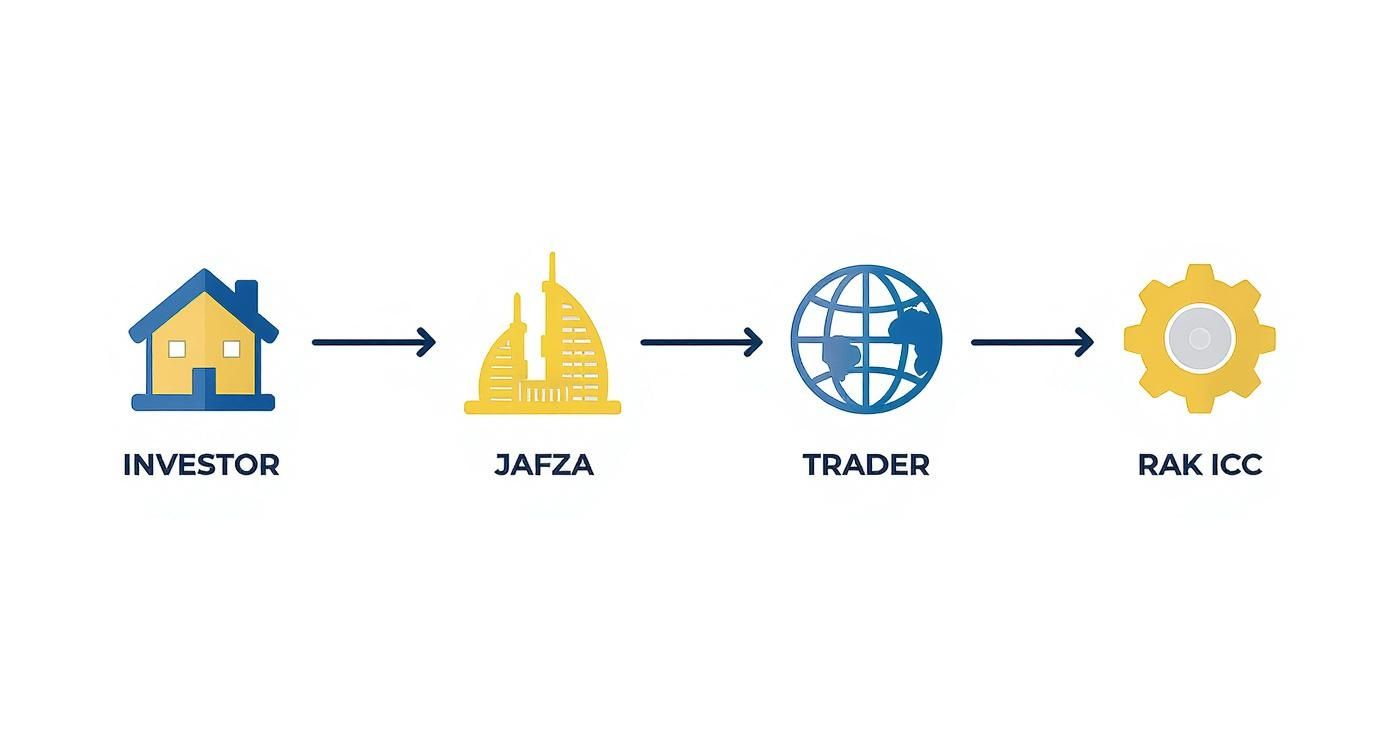
As you can see, investors looking to hold Dubai property are a natural fit for JAFZA. Meanwhile, international traders often find RAK ICC gives them the flexibility they need.
Choosing a Compliant Company Name
First things first: you need a name for your offshore company. This is more than a branding choice—it has to follow strict registry rules. The name you pick cannot suggest any link to local UAE operations or government entities.
For instance, names with words like "Dubai," "UAE," "Bank," "Insurance," or "Municipal" are definite no-gos. Your company name must also end with "Limited" or "Ltd." to show its legal status. I always recommend having three to five options ready, just in case your top choice is already taken.
Defining Your Business Activities
While an offshore company Dubai can't trade inside the UAE, you still have to clearly state its planned international activities on the application. This gives authorities and banks a clear picture of what you're doing.
Some of the most common approved activities are:
- International Trading: Buying and selling goods completely outside the UAE.
- Consulting Services: Offering professional advice to clients based internationally.
- Holding Company: Owning shares in other businesses, whether they're in the UAE or elsewhere.
- Property Holding: Owning real estate in approved freehold areas (this is specific to JAFZA).
- Intellectual Property Holding: Managing things like patents, trademarks, and copyrights on a global scale.
Being specific here is crucial. A vague description like "general business" will almost certainly cause delays or get your application rejected.
The Role of a Registered Agent
Here’s a critical point: you can't form an offshore company in the UAE by yourself. The law requires you to appoint a registered agent who is licensed by the relevant offshore authority, be it JAFZA or RAK ICC.
Think of your registered agent as the official link between you and the registry. They manage the entire application, handle your annual renewals, and give you the required registered office address. This relationship is vital—their expertise is what makes the process seamless.
A good registered agent does a lot more than just file paperwork. They offer strategic advice, spot potential problems before they happen, and make sure your application is positioned for a quick approval. This saves you a huge amount of time and helps you avoid costly errors.
Gathering Your Documentation
When it comes to paperwork, precision is everything. Even a small mistake can lead to major delays. Getting these documents in order from the very beginning is one of the most important parts of the process.
Here’s what’s typically required for every shareholder and director:
- Certified Passport Copy: A clear, valid copy for each individual.
- Proof of Residential Address: A recent utility bill or bank statement (less than three months old) showing the person's name and home address.
- Bank Reference Letter: A simple letter from your personal bank confirming you have a satisfactory relationship with them.
- Curriculum Vitae (CV): A brief professional summary for each shareholder.
Common mistakes like submitting an expired document or a proof of address that doesn't match the passport details can bring everything to a halt. This is where professional guidance is invaluable.
Navigating these requirements is a core part of what we do. As specialists in a full range of company setups—from mainland and free zone to Corporate PRO Services and visa processing—we ensure your entire journey is handled with expertise. You can explore our comprehensive business setup solutions to see how we can assist.
Navigating UAE Corporate Banking and Compliance
Getting your offshore company incorporated is a huge step forward, but the journey isn't over. The next, and arguably most critical, milestone is securing a corporate bank account. This is the moment your international business truly comes to life.
However, let's be clear: opening a bank account for an offshore entity in the UAE isn't a simple tick-box exercise anymore. Banks are under massive pressure to meet strict global compliance standards, and their due diligence process reflects that.

This isn’t just about submitting forms; it’s about proving your business is credible, transparent, and fully compliant. Understanding what UAE banks are really looking for is the secret to making this a smooth process instead of a frustrating roadblock.
Preparing a Strong Bank Account Application
Gone are the days when you could walk in and open an account with minimal fuss. Today, UAE banks conduct exhaustive checks to ensure they aren't unintentionally involved in any illicit activities. A successful application hinges on proving your company's legitimacy and genuine economic purpose.
To get your application approved, you need to be ready with crystal-clear information covering three key areas:
- Ultimate Beneficial Owner (UBO) Structure: Banks need to know exactly who owns and controls the company. Be prepared to present a transparent ownership chart, identifying every person with significant control. Any attempt to hide or complicate this will be an immediate deal-breaker.
- Source of Funds and Wealth: You must be able to clearly document where the initial capital for the business is coming from. This could be savings from a previous job, profits from another venture, or an inheritance. The bank's goal is to verify that the funds are from a legitimate source.
- A Credible Business Plan: Your business plan needs to be specific. It should detail what your company does, who your clients are (outside the UAE), and the types of transactions you expect. A vague, cookie-cutter plan often signals a lack of serious intent and is a top reason for rejection.
A common mistake we see is people treating the bank application like a formality. You have to remember, banks are looking for a compelling story that proves your offshore company is a legitimate global business, not a shell corporation set up for other motives.
The Power of Professional Relationships
Trying to navigate the banking world on your own can be tough. Every bank has its own internal rules and risk tolerance, and these can change without notice. This is where having a corporate services firm in your corner really pays off.
At PRO Deskk, we work with a wide network of local and international banks every single day. This gives us direct insight into what they're looking for right now. We can introduce you to the right people—bankers who understand offshore setups and are open to working with international entrepreneurs. That existing relationship can make all the difference in getting a swift approval.
Ongoing Compliance A Non-Negotiable Reality
Once you're up and running with your bank account, the work doesn't stop. Your offshore company Dubai requires you to keep up with ongoing compliance tasks. If you ignore these duties, you could face serious consequences like heavy fines, a frozen bank account, or even having your company struck off the register.
Your key ongoing responsibilities include:
- Annual Renewals: Each year, you have to pay renewal fees to the offshore authority (JAFZA or RAK ICC) and to your registered agent. This is essential to keep your company in good legal standing.
- Adherence to AML/CFT Regulations: You are required to follow Anti-Money Laundering (AML) and Combating the Financing of Terrorism (CFT) laws. In practice, this means keeping detailed records of your transactions and being able to explain the business reason for them if the bank asks.
- Maintaining Economic Substance: While you don’t need a physical office, you must show that your company has a real business purpose and isn't just a vehicle for avoiding tax.
It’s also wise to understand the basics of a general guide to compliance risk assessment to stay ahead of any potential issues. Our expertise in Corporate PRO Services and Attestation Services means we can manage all these critical deadlines and administrative tasks for you. This frees you up to focus on what you do best: running your global business.
How to Use Your Offshore Company for Global Growth
So, you’ve set up an offshore company. It’s far more than just a legal document or a smart way to manage taxes; think of it as a powerful vehicle for international expansion and managing your assets. Entrepreneurs and investors from all over the world use an offshore company Dubai to find new levels of operational freedom and secure their wealth for the long haul.
At their core, these entities are designed for global business. They position you to run a worldwide operation from a stable, highly respected economic hub. But their real strength is their versatility, and they can serve several key strategic functions to accelerate your growth.
A Powerful Tool for International Trade
One of the most popular uses we see is for international trade. Let’s say you run an e-commerce business. You might be sourcing products from manufacturers in Asia and selling them to customers in Europe and North America.
Using a UAE offshore company as the central trading entity makes this whole process remarkably simple. You can handle all your international invoicing, receive payments from global clients, and pay your suppliers through one single UAE corporate bank account. This centralises your finances in a tax-neutral environment, protecting your profits from the high corporate taxes you might face back home.
Protecting Your Most Valuable Assets
Asset protection is another fundamental part of any offshore strategy. High-net-worth individuals and families often use these structures to hold valuable assets—things like global stock portfolios, real estate located outside the UAE, or even precious metals—in a secure and private way.
By placing these assets under the ownership of an offshore company, you create a clear legal separation between your personal wealth and the assets themselves. This provides a solid shield against potential future liabilities, political instability in your home country, or any unwarranted legal claims that might arise.
The core principle here is diversification, not just of investments, but of legal jurisdiction. Holding assets through a reputable UAE offshore entity adds a powerful layer of protection that is difficult to replicate with domestic structures alone.
The UAE's solid economy only adds to this security. The Central Bank of the UAE is forecasting strong GDP growth of 4 percent for 2024 and expects another 4.5 percent increase in 2025. This kind of economic stability is a huge draw for investors; in fact, the UAE attracts around 37 percent of all Foreign Direct Investment that flows into the Middle East and North Africa. If you want to dive deeper into the region's investment landscape, you can read more about the economic outlook on Statista.
The Ideal Structure for Intellectual Property
For tech companies, creators, and innovators, an offshore company is the perfect place to hold intellectual property (IP). This covers valuable assets like:
- Patents for new inventions
- Trademarks for global brands
- Copyrights for software, media, and creative works
- Licensing rights for proprietary technology
Housing your IP in a UAE offshore company lets you manage global licensing agreements and collect royalties in a very tax-efficient manner. It centralises your most valuable intangible assets in a secure jurisdiction, making it much easier to manage their worldwide use and monetisation.
A Strategic Link to UAE Residency
A common question we get is whether an offshore company can get you a UAE residence visa. The short answer is no; visas are tied to operational mainland or free zone companies.
But this is where a bit of strategic planning comes in. While the offshore company itself doesn't provide a visa, it can be a critical piece of a successful Golden Visa on Property or Investor Visa strategy. The assets and investments held within your offshore company can be used to prove your financial standing and help you meet the eligibility criteria for these long-term residency options.
We specialise in putting together these integrated strategies. We help clients use their offshore structures as part of a bigger plan to secure UAE residency. With our 24/7 support and cost-effective solutions, we make sure every part of your setup aligns with your global growth and personal residency goals. For a free consultation, feel free to WhatsApp Us Today.
Common Questions on Dubai Offshore Companies
When you get down to the final details of setting up an offshore company, you're bound to have some specific questions. It's completely normal. Getting straight answers is key to moving forward with confidence. Here, we tackle the most common queries we get from entrepreneurs looking at setting up an offshore company Dubai.
We'll clear up any confusion around what you can and can't do, whether you need an office, what your annual commitments are, and how it all connects to getting a UAE visa. Think of this as the final checklist to make sure you've covered all your bases.
Can an Offshore Company Do Business Inside the UAE?
This is probably the most important thing to get right, and the answer is a clear no. An offshore company is specifically designed for international business. It is legally barred from trading or offering services directly within the UAE mainland or any of its free zones.
That doesn't mean it's completely disconnected from the UAE, though. An offshore company is legally permitted to:
- Own shares in companies based in the UAE mainland and free zones, which is perfect for creating a holding structure.
- Purchase real estate in Dubai's designated freehold areas (a powerful benefit exclusive to JAFZA offshore companies).
- Open and manage a corporate bank account with a UAE bank to handle its global transactions.
Essentially, you're using the UAE as a secure, tax-efficient base for your global operations, not as a marketplace to sell to.
Is a Physical Office Required for an Offshore Company?
Absolutely not, and that's one of its biggest draws. You don't need to rent or buy any physical office space. Your company's official registered address is simply the address of your appointed registered agent in the UAE. This ticks all the legal boxes.
This setup is a game-changer for international founders. It slashes your overhead costs and keeps your operations lean. You can run a multi-million dollar global business from your laptop anywhere in the world, without the financial burden of a physical office in Dubai.
The whole point is 'virtual presence'. You get the credibility and legal framework of a top-tier jurisdiction like the UAE while staying agile and keeping fixed costs rock-bottom. It's about leveraging the system, not the real estate.
What Are the Annual Renewal Requirements?
To keep your offshore company active and in good legal standing, you have to complete an annual renewal. It's a straightforward process, but it is mandatory. If you miss the deadline, you could face hefty penalties, or worse, your company could be struck off the register.
The renewal really comes down to two things:
- Government Fees: You'll need to pay the annual renewal fee to the relevant authority, whether that's JAFZA or RAK ICC.
- Registered Agent Fees: Your registered agent, who handles all the official paperwork and communication, charges an annual service fee.
As your registered agent, this is something we manage for you from start to finish. We make sure every deadline is met so your company stays compliant without you having to worry about it.
Can I Get a UAE Residence Visa with an Offshore Company?
By itself, an offshore company won't get you a UAE residence visa. This is because residency is linked to companies that have a real operational presence and economic activity inside the UAE, like a mainland or free zone company.
However, an offshore company can be a crucial part of your residency strategy. The assets held within it—like a property portfolio or significant investments—can be exactly what you need to qualify for an Investor Visa or the sought-after Golden Visa on Property. We often help clients structure their affairs this way, using the offshore entity as a foundation to build a successful residency application.
At PRO Deskk, we do more than just register a company for you. We build the right structure for your goals, from choosing the best jurisdiction to handling the tricky parts like banking and visas. Our deep expertise across mainland, free zone, and offshore setups means your business will be structured perfectly for global success.
We are:
✅ Specialists in Mainland Company Formation in Dubai, Sharjah & Abu Dhabi
✅ Specialists in Freezone Company Formation across the UAE
✅ Specialists in Golden Visa on Property and Investor Visa
✅ Specialists in Corporate PRO Services and Attestation Services
✅ 24/7 Support Service – Always here when you need us
✅ Cost-Effective Business Setup Solutions tailored to your needs
✅ Your partners to help you enjoy UAE Tax Benefits for International Entrepreneurs
Ready to see how an offshore company can work for you?
📞 Call Us Now: +971-54-4710034
💬 WhatsApp Us Today for a Free Consultation
Or Contact us for a free consultation to talk through your international plans.