
Setting up a company on the Dubai mainland gives you a powerful advantage: direct, unrestricted access to the entire UAE market. It’s a strategic decision that lets you trade freely, bid on major government projects, and truly position your business for growth across all the emirates.
Getting Started with Your Dubai Mainland Company
Opting for a mainland setup is a big step, but it's one that unlocks the full economic force of the UAE. Unlike a free zone company, which often limits your business to a specific geographical area, a mainland licence means you can operate anywhere. Think of it as the difference between having a shop in a specific mall versus being able to open branches all over the country.
The game has completely changed for international entrepreneurs in recent years. Landmark government reforms now allow foreign nationals to have 100% ownership of mainland companies for the vast majority of business activities. This is a massive shift from the old rule requiring a local Emirati sponsor to hold a 51% stake.
This change really puts Dubai on par with global business centres like Singapore and Hong Kong, making it a much more appealing destination for foreign investment.
Choosing Your Legal Structure
The legal form you choose for your company is a foundational decision. It determines everything from personal liability and ownership rules to how you can operate, so it's crucial to get it right.
Here are the most common options I see entrepreneurs go with:
- Limited Liability Company (LLC): This is, by far, the most popular choice. An LLC creates a legal separation between you and the business, meaning your personal assets are protected from any company debts. It’s the go-to for almost any trading, commercial, or industrial activity.
- Sole Establishment: This is for a single owner who is the sole person responsible for the business and its debts. It’s a common structure for professionals like consultants or designers whose expertise is the core service.
- Civil Company: Think of this as a partnership for qualified professionals in fields like law, engineering, or accounting. The partners in a civil company are typically fully liable for the business's obligations.
To get a deeper feel for these, it's worth spending some time understanding various business structure types and their implications. This will help you match your business ambitions to the right legal framework.
For most people coming from abroad to set up shop, the LLC is the sweet spot. You get the full benefit of the 100% foreign ownership law while still having the crucial financial shield of limited liability.
Decoding the Different Licence Types
Your trade licence, issued by the Department of Economy and Tourism (DET), officially defines what your business is allowed to do. It’s not just a piece of paper; it’s the legal blueprint for your operations.
Comparing Dubai Mainland License Types
This table gives a quick breakdown of the three main licence categories to help you see where your business might fit.
| License Type | Best For | Typical Ownership Structure | Key Consideration |
|---|---|---|---|
| Commercial | Businesses buying and selling goods, like trading, import-export, and e-commerce. | Can be 100% foreign-owned for most activities. | The licence cost can depend on the specific trading activities you choose. |
| Professional | Service-based businesses and skilled individuals offering their expertise, like consultants, designers, and artisans. | Can be 100% foreign-owned, but a Local Service Agent (LSA) is usually required. | The LSA has no ownership or control; they are paid an annual fee for their service. |
| Industrial | Companies involved in manufacturing, processing raw materials, or assembling products. | 100% foreign ownership is available for many industrial activities. | Requires approvals from external bodies and a physical warehouse or factory space. |
Getting this right from the beginning saves a lot of headaches later on. For instance, a digital marketing agency would need a professional licence, while an online store selling apparel would require a commercial licence. An incorrect licence can lead to fines and operational roadblocks down the line.
Navigating Key Documentation and Approvals
Once you’ve locked in your business structure and licence type, the focus shifts from strategy to paperwork. This part of your mainland company setup Dubai journey is all about meticulous execution. Getting the documentation right the first time is the secret to avoiding frustrating, and often costly, delays down the line.
The process kicks off by giving your business a legal identity. This means tackling two critical first steps with the Department of Economy and Tourism (DET), which is the central authority for all business registrations in Dubai.
Securing Your Trade Name and Initial Approval
Your company's trade name is more than just a brand—it's a legal identifier that has to be officially approved and registered. The DET has specific rules you need to follow to avoid having your name rejected. For instance, the name can't be offensive, go against public morals, or be the same as another company's name.
A common slip-up is choosing a name that's too generic or already in use by a business in another emirate. It’s always a good idea to have a list of three to five potential names ready to go; this really improves your chances of a quick approval. After your trade name is reserved, the very next step is to apply for Initial Approval.
This certificate is the government's preliminary nod, confirming they have no objection to you setting up your business. It's the foundational piece of paper that lets you move forward with everything else, like drafting legal contracts or getting approvals from other government bodies.
The infographic below gives you a high-level look at the initial process.
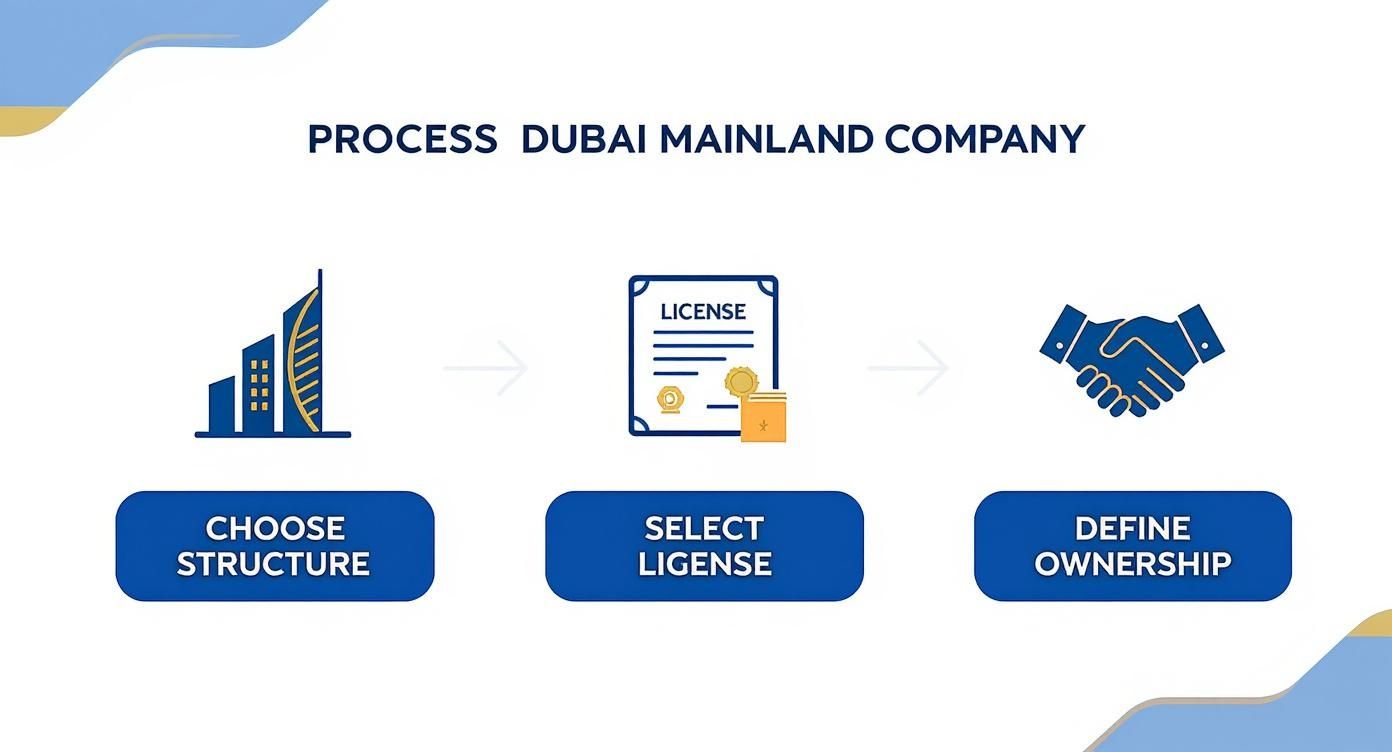
As you can see, finalising your structure, licence, and ownership model is the bedrock you build on before getting into the nitty-gritty of documentation.
Drafting the Memorandum of Association
With your Initial Approval secured, you can now draft one of your company's most crucial legal documents: the Memorandum of Association (MOA). Think of the MOA as your company's constitution. It spells out the rules, responsibilities, and the entire operational framework for your business.
For a Limited Liability Company (LLC), this document is absolutely mandatory and needs to be drafted with precision. It legally defines the core aspects of your business, including:
- Shareholder Details: A clear list of all partners and what percentage of the company they each own.
- Business Activities: A detailed breakdown of the exact services or trade your company is licensed for.
- Capital Contribution: Specifies the amount of capital each partner has invested.
- Management Structure: Lays out how the company will be run and who holds the decision-making power.
- Profit/Loss Distribution: Defines the agreed-upon formula for sharing profits and losses.
The MOA has to be carefully written in both Arabic and English and then notarised by a public notary here in Dubai. Any vagueness or error in this document can lead to serious disputes later on, so it’s vital to get it right. For a closer look at what goes into it, you can learn more about what a Memorandum of Association is and why it’s so important.
Assembling and Submitting Your Document Package
The last step before your licence is reviewed for issuance is putting together and submitting a complete file of all required documents to the DET. This is where being organised really pays off. Believe me, an incomplete application is the number one reason for delays in the mainland company setup Dubai process.
Your submission package will generally need to include:
- The completed application form, signed by the company's legal representatives.
- Passport copies for all shareholders and managers.
- A copy of your Initial Approval certificate from the DET.
- The notarised Memorandum of Association (MOA).
- Proof that your trade name has been reserved.
- In some cases, a No Objection Certificate (NOC) if a shareholder is on a residence visa sponsored by another UAE company.
A critical piece of advice: If your business activity requires approval from a specific government ministry—like healthcare, education, or finance—you will need to secure those external approvals. This has to be done after you get your Initial Approval but before you submit your final application. These approvals can take time, so be sure to factor this into your overall timeline.
This is where bringing in a corporate PRO service specialist can be a game-changer. They know exactly how to get all the attestations done correctly and ensure your file is complete, which drastically increases your chances of a smooth, fast approval from the DET. With our 24/7 support service, we make sure you're never left wondering what to do next.
Securing Your Office and Final Trade Licence
Once you’ve navigated the initial approvals and paperwork, the next big step in your mainland company setup Dubai journey is getting a physical address. This isn't just a formality; for almost every mainland business, having a real, tangible office is a non-negotiable requirement. Think of it as the final piece of the puzzle before the Department of Economy and Tourism (DET) hands over your trade licence.
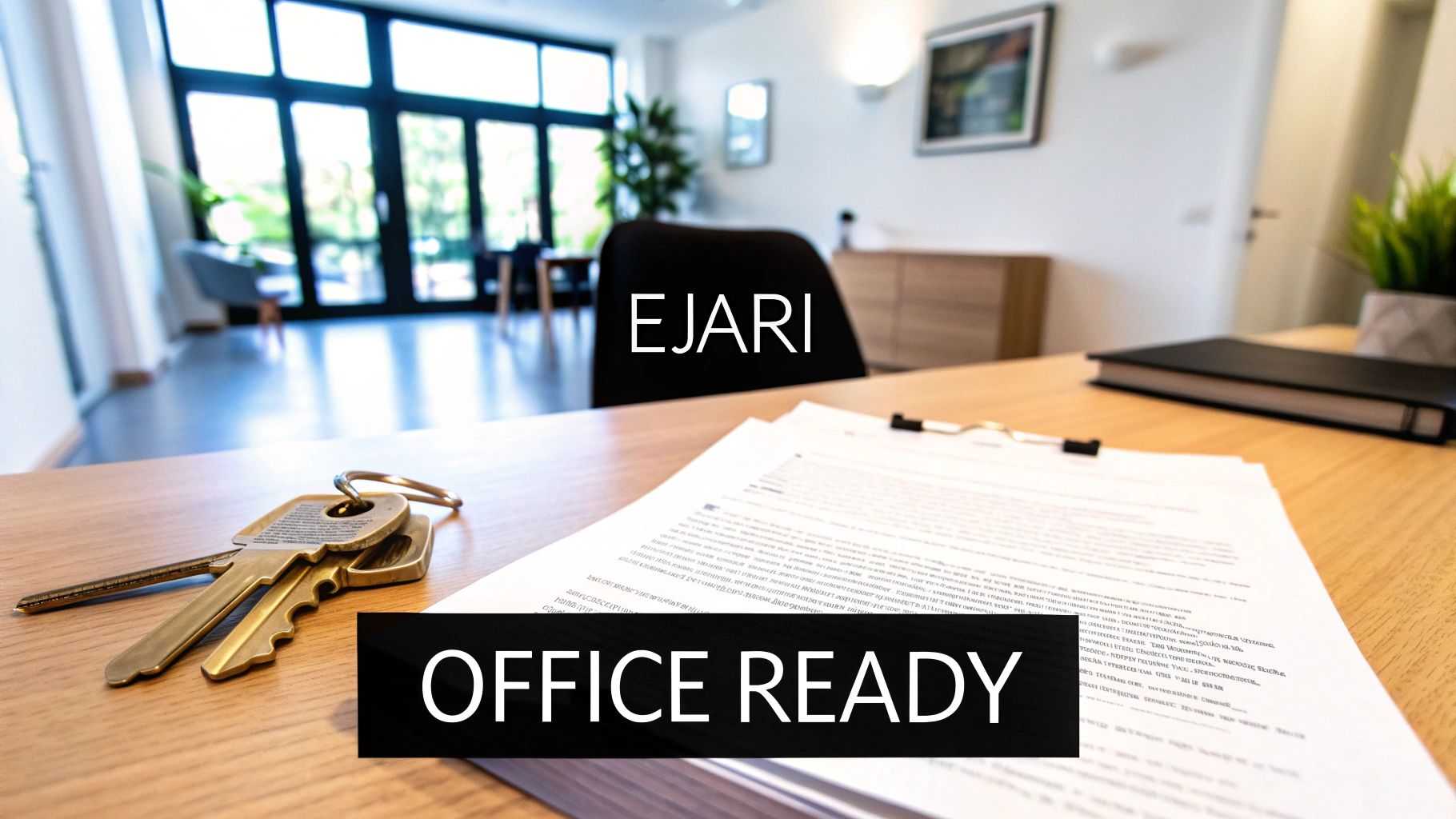
This rule is in place to connect your business to a legitimate commercial spot, and the proof is a crucial document called an Ejari. Essentially, Ejari is the government-mandated system for registering all tenancy contracts in Dubai. It makes your lease official and legally binding. Without a registered Ejari, you simply can't move forward.
Choosing the Right Office Solution
The "office" requirement doesn't mean you have to lock yourself into a massive corporate lease. Dubai’s commercial real estate market is flexible, with plenty of solutions that fit different business needs and budgets. What you choose will really depend on your business activity, how big your team is, and your day-to-day operational needs.
Here are the most common options people go for:
- Traditional Office Lease: This is your classic setup—renting a dedicated space in a commercial building. It gives you the most privacy and freedom to customise, but it also comes with higher costs and longer commitments.
- Serviced Offices: These are a fantastic option if you need a professional address and meeting rooms without the huge upfront investment. They come fully furnished and equipped, usually on flexible terms.
- Co-working Spaces: A very cost-effective business setup solution for startups and solo entrepreneurs. Getting a dedicated desk or a small private office in a co-working facility provides a valid Ejari and some great networking opportunities.
- Flexi-Desks (Smart Desks): This is the most minimal and budget-friendly choice, often perfect for certain professional licences. It provides a legitimate address and Ejari without the expense of a full-time office.
And a practical tip: when you secure your physical office, it's wise to look into modern commercial building security systems from day one to protect your assets and create a safe environment.
Understanding the Ejari and Licensing Process
So, you’ve found your space and signed the tenancy contract. What's next? Your property owner or real estate agent will register that contract in the Ejari system. You’ll then get an official Ejari certificate with a unique barcode—this is the key that unlocks the final stage.
You'll submit this Ejari certificate, along with your other approved documents, to the DET. The authorities use it to verify that your business has a legitimate physical presence that meets Dubai Municipality regulations. It’s a critical compliance check.
This need for a physical office is a major difference between mainland and free zone setups. While many free zones allow for virtual offices, mainland companies almost always need a physical space, which naturally impacts your initial costs and logistics.
Budgeting for Government Fees and Timelines
Getting your office and final licence sorted involves a few more government fees you'll need to budget for. The exact amount can vary, but it’s good to have a clear idea of the costs involved. Once you submit your Ejari and pay the final government fees, the DET will officially issue your trade licence.
How long does this final stage take? Usually, anywhere from a few days to a couple of weeks, from signing the lease to having the licence in your hands. Delays can happen, often due to issues with the tenancy contract or if the office space doesn't comply with zoning rules.
For a full breakdown of the entire process, you can learn more about getting a trade license in Dubai and all its requirements.
Key Takeaway: The Ejari isn't just rental paperwork; it's the mandatory proof the DET needs to see that your company has a real, compliant address in Dubai. Without it, your trade licence application comes to a halt. Planning your office solution carefully is essential for a smooth and timely launch.
Your Trade Licence Is Issued. What's Next?
Getting that official trade licence in your hands is a huge milestone on your mainland company setup Dubai journey. But think of it as the starting pistol, not the finish line. Your company is now a legal entity, but it can't yet hire people, manage money, or sponsor anyone to live and work in the UAE.
This next phase is all about activation. We're shifting gears from dealing mainly with the Department of Economy and Tourism (DET) to working with immigration and labour authorities. It's the critical step that breathes life into your business, turning it from a piece of paper into a fully operational company ready to build a team and bring in revenue.
Getting Registered with Immigration and Labour
Before you can hire your first employee or even sponsor your own visa, you need to get your company registered with two key government bodies: the Ministry of Human Resources and Emiratisation (MOHRE) and the General Directorate of Residency and Foreigners Affairs (GDRFA), which most people just call Immigration.
This registration creates your company's Establishment Card and its Labour file. These are basically digital profiles that plug your company into the government systems for handling all visa and employment matters. In short, they give your company the authority to act as a sponsor.
- Labour File (MOHRE): Absolutely essential for issuing official labour contracts and work permits for any staff you hire.
- Immigration File (GDRFA): This is what you'll need to apply for entry permits and residence visas—for you, your family, and your employees.
Here’s a simple way to look at it: your trade licence gives you the right to do business, but the Establishment Card gives you the right to employ people to conduct that business. This is a non-negotiable step for any mainland company that plans to have a team or sponsor an investor visa.
Applying for Your Own UAE Residence Visa
With your company's Establishment Card active, you can now start the process of getting your own visa. This is usually an Investor Visa, or an Employment Visa if you're officially the company's manager. The process is a clear sequence of steps, and you have to follow them precisely.
Here’s what the typical visa journey looks like:
- Entry Permit: Your company applies for an entry permit, which is the green light to start the in-country visa formalities.
- Status Change: If you're already in the UAE on a tourist visa, you'll need to do a "status change" once the entry permit is issued.
- Medical Fitness Test: This is mandatory. You’ll visit a government-approved health centre for a screening that checks for certain communicable diseases.
- Emirates ID Biometrics: Next, you'll head to a Federal Authority for Identity and Citizenship (ICA) centre to provide your fingerprints and photo for your Emirates ID card.
- Visa Stamping: The final step. Your residence visa gets stamped into your passport, and just like that, you're an official UAE resident.
Completing this process cements your legal status as a resident and business owner in Dubai. It unlocks the ability to do things like lease an apartment in your name, open a personal bank account, and, importantly, sponsor your family members to join you. As specialists in Golden Visa on Property and Investor Visa, we guide clients through every step to ensure a smooth and successful application.
Opening Your Corporate Bank Account
Honestly, this is often where new entrepreneurs hit their biggest hurdle. UAE banks have very strict Know Your Customer (KYC) and anti-money laundering (AML) rules. This means opening a corporate account isn't just a formality; it can be a detailed and sometimes frustratingly long process. Having a trade licence is just the entry ticket.
Banks need to see a solid, credible business plan. They want to understand your business model, where your revenue will come from, who your clients are, and the kind of transactions you'll be making. Be ready to show them more than just your company registration documents.
A critical tip from experience: Do not underestimate the importance of your initial meeting with the bank. First impressions matter immensely. Arrive prepared with a professionally presented file containing all your corporate documents, shareholder details, and a summary of your business activities.
Successfully opening an account really comes down to clear communication and being thoroughly prepared. For some essential advice on navigating this crucial step, check out our detailed guide on opening a business bank account in Dubai.
Choosing the right bank is just as important as having the right paperwork. Some banks are friendlier to startups or certain industries than others. Working with people who know the banking landscape can make a world of difference. As specialists in Mainland Company Formation in Dubai, Sharjah & Abu Dhabi, we frequently help our clients prepare their banking files to give them the best possible shot at success, backed by our 24/7 support service to guide them through it.
Why a Dubai Mainland Company Is Your Strategic Advantage
Setting up a mainland company in Dubai isn't just a box-ticking exercise; it’s a strategic move that sets your business up for powerful, long-term growth across the UAE. While other jurisdictions have their perks, a mainland licence offers a blend of market access, operational freedom, and integration with the local economy that’s tough to beat. Think of it as the ultimate platform for any business with serious ambitions in the region.
The biggest win? Complete freedom to trade directly with the entire UAE market. Unlike a free zone company, which is generally confined to its specific zone or international clients, a mainland licence removes all those commercial barriers. You can sell your products, offer services, and chase customers anywhere from Dubai to Abu Dhabi and Ras Al Khaimah without needing a middleman or local distributor.
This direct-to-market access is a game-changer for businesses in retail, trading, and professional services that need to reach a wide local customer base to thrive.
Unlocking Government Contracts and Prime Real Estate
Another massive benefit of a mainland setup is your eligibility to bid on lucrative government contracts. Government bodies in the UAE, both federal and municipal, are huge clients, spending billions of dirhams every year on all sorts of goods and services. A mainland licence is almost always a non-negotiable requirement to even get a seat at the table for these tenders, opening up a revenue stream that's completely off-limits to most free zone companies.
On top of that, a mainland company gives you total flexibility in choosing where you set up shop. You're not restricted to a designated economic zone. This means you can plant your office, showroom, or retail store in any commercial district in Dubai, putting your business exactly where it needs to be—whether that's in the heart of a financial hub or a high-traffic retail strip.
This unrestricted geographical freedom is huge. It lets you be agile and physically present right where your customers are, which is absolutely critical for building brand visibility and sustaining growth in this competitive market.
A Pro-Business Environment That Inspires Confidence
Dubai's economic policies are deliberately crafted to attract and hold onto foreign investment, and the mainland framework is a direct beneficiary of these initiatives. It’s fertile ground for both scrappy entrepreneurs and established global corporations.
One of the most attractive policies is the UAE's corporate tax structure. A 9% corporate tax has been introduced, but here's the key part: it only kicks in for profits exceeding AED 375,000. This threshold allows startups and small businesses to find their footing and grow without the immediate pressure of taxes. For larger, profitable companies, the rate remains one of the most competitive in the world, encouraging them to reinvest their earnings back into their operations. You can enjoy UAE tax benefits for international entrepreneurs and maximise your returns.
You can see the positive impact of this climate in the city's strong economic numbers. Recent data shows a major uptick in Foreign Direct Investment (FDI) and high confidence scores from businesses operating on the mainland. Just last year, foreign investment in Dubai jumped by a remarkable 28%, fuelled by growth in sectors like technology, healthcare, and logistics. Dubai's economy is on track to grow by about 5.1%, thanks to this diversification and new policies that now allow for 100% foreign ownership across many mainland business activities.
The Business Confidence Index (BCI) for large companies also recently hit 119 points, signalling strong optimism among mainland operators. You can dig deeper into these numbers and discover future insights for Dubai business setup on businesssetupexperts.com.
These figures aren't just statistics; they're proof that a Dubai mainland company is more than just a licence. It’s a solid platform for regional expansion, trusted by international investors for its stability, flexibility, and massive growth potential.
When to Partner with Business Setup Experts
Embarking on a mainland company setup Dubai journey can feel like trying to navigate a maze of government departments, legal documents, and tight deadlines. It's certainly possible to go it alone, but partnering with a professional business setup consultant is often the smartest move you can make.
Think of it as a strategic investment that pays dividends in time, money, and sheer peace of mind.

A good setup expert is a combination of a guide, a project manager, and a specialist liaison. Their entire job is to know the system inside and out—from the Department of Economy and Tourism (DET) to the Ministry of Human Resources and Emiratisation (MOHRE). They translate complex legal jargon into clear, actionable steps, helping you sidestep common mistakes that can delay your launch for weeks, if not months.
The Role of Corporate PRO Services
A huge part of what these experts provide is Public Relations Officer (PRO) services. In the UAE, a PRO is your company's official representative in front of all government bodies.
Instead of spending your own valuable days queuing at various ministries, your PRO handles these interactions efficiently. Their experience is crucial for keeping the process moving forward without any hitches.
Here are just a few of the tasks a PRO service takes off your plate:
- Document Attestation and Clearing: Making sure all your legal paperwork is properly attested, translated, and submitted to the correct departments.
- Government Approvals: Securing the required approvals from ministries and other authorities, which is especially important for specialised business activities.
- Visa Processing: Managing the entire visa lifecycle for investors and employees, from new applications to renewals and cancellations.
- Licence Amendments and Renewals: Handling the annual renewal of your trade licence and any changes you need to make, like adding a new business activity or partner.
Does it Actually Save Money?
Bringing in a consultant might seem like just another expense, but a quick cost-benefit analysis often proves its value. The initial fee usually pales in comparison to the potential costs of mistakes. We're talking about fines for incorrect submissions, delays that cost you revenue, and the high price of your own time being sunk into administrative tasks.
Partnering with a specialist isn't about outsourcing a task; it's about buying expertise and efficiency. It frees you to concentrate on what you do best—building your business, winning clients, and planning your market entry.
This is especially true for complex steps like document verification and government liaison. As recognised specialists in Corporate PRO Services and Attestation Services, we deliver cost-effective business setup solutions designed to prevent expensive errors and get you operational much faster.
When is a Consultant Most Beneficial?
While any entrepreneur can benefit from some expert guidance, there are certain situations where hiring a consultant becomes almost essential.
Consider this real-world scenario: An international entrepreneur wants to open a specialised medical clinic in Dubai. This requires approvals not just from the DET, but also from the Dubai Health Authority (DHA). Unfamiliar with specific DHA regulations, the entrepreneur could easily spend months going back and forth, facing rejections and delays. An expert, on the other hand, knows the exact requirements and has established relationships, turning a potential months-long struggle into a streamlined process.
Here are other times when an expert is a game-changer:
- Complex Business Activities: If your business needs multiple external approvals from different government bodies.
- First-Time Entrepreneurs in the UAE: If you're new to local laws, regulations, and the general way things work here.
- Urgent Timelines: When you need your company up and running as quickly as possible to meet client deadlines or seize a market opportunity.
- Large-Scale Visa Requirements: If you plan on hiring a significant number of employees and need to manage their visas efficiently from day one.
Ultimately, working with a business setup expert transforms the complex process of a mainland company setup Dubai from a daunting challenge into a predictable, managed project.
Your Questions, Answered
Setting up a mainland company in Dubai is a big step, and it’s natural to have questions. Here are some of the most common ones we get from entrepreneurs just like you.
Can a Foreigner Really Own 100% of a Mainland Company?
Yes, absolutely. For most business activities, the old requirement for a local Emirati sponsor to hold 51% of the shares is gone. Foreign investors can now enjoy 100% ownership of their mainland business.
It was a game-changing reform. Just be aware that a handful of strategic sectors might still have specific ownership rules, so it's always smart to double-check the regulations for your exact line of business with an expert.
What’s the Real Minimum Cost for a Dubai Mainland Licence?
This is the million-dirham question, and the answer is: it depends. The cost varies quite a bit based on your licence type, business activities, office rent, and whether you need any special external approvals.
As a rough starting point, a basic professional licence with a flexi-desk office space might begin somewhere between AED 15,000 to AED 25,000. If you're looking at a commercial or industrial licence that requires a proper physical office, the cost will naturally be higher. My best advice is to always request a detailed, itemised quote from us to see a full breakdown of the fees.
Key Takeaway: What’s the difference between mainland and free zone? It all comes down to market access. A mainland company can trade directly anywhere in the UAE and even bid on lucrative government contracts. A free zone company is generally limited to operating within its zone or internationally, often needing a local distributor to tap into the wider UAE market.
How Long Will the Setup Process Actually Take?
From the moment you get your initial approval to having the final trade licence in hand, you're generally looking at a timeframe of one to four weeks.
What causes the variation? It really hinges on how quickly you can get your documents in order, secure your office space (and the Ejari tenancy contract), and whether your business needs approvals from other government departments. Using expert Corporate PRO Services can definitely help speed things along and avoid common delays.
Are There Any Real Tax Benefits?
Yes, the UAE tax benefits are a major draw for entrepreneurs. While the country introduced a 9% corporate tax, it only kicks in for businesses with profits exceeding AED 375,000.
This high threshold is fantastic for new and smaller businesses, giving them plenty of room to grow and reinvest their earnings without an immediate tax burden. It’s a clear signal of Dubai's commitment to creating a pro-business environment.
At PRO Deskk, our specialty is turning your UAE business goals into a reality. We are:
- ✅ Specialists in Mainland Company Formation in Dubai, Sharjah & Abu Dhabi
- ✅ Specialists in Freezone Company Formation across the UAE
- ✅ Specialists in Golden Visa on Property and Investor Visa
- ✅ Specialists in Corporate PRO Services and Attestation Services
- ✅ 24/7 Support Service – Always here when you need us
- ✅ Providers of Cost-Effective Business Setup Solutions tailored to your needs
- ✅ Ready to help you Enjoy UAE Tax Benefits for International Entrepreneurs
📞 Call Us Now: +971-54-4710034
💬 WhatsApp Us Today for a Free Consultation
Contact PRO Deskk today for a seamless business setup experience.