
If you're gearing up to work in the UAE, you've probably heard the term "labour card" tossed around. It’s the absolute cornerstone of legal employment here. But let's clear up a common misunderstanding right away: the old-school plastic card you might be picturing is a relic of the past. Today, your official permission to work is a digital work permit, neatly integrated with your Emirates ID and residence visa.
What Is the Modern UAE Labour Card?
Forget the idea of a separate, physical labour card. In today's UAE, your legal right to work is confirmed by an electronic work permit, issued and overseen by the Ministry of Human Resources and Emiratisation (MoHRE).
Think of your essential documents as a set of interconnected keys for your life in the UAE. Your residence visa is like the master key to your apartment building, giving you the legal right to live here. Your Emirates ID is the main access fob, the one you use for everything from opening a bank account to getting your utilities connected.
So, where does the labour card fit in? It’s the specific keycard that unlocks your office door, authorising you to work for that one particular employer. This digital shift has made things much simpler for everyone, creating a single, unified system that links your immigration, identity, and employment records.
The Evolution from Physical to Digital
The move to a digital work permit was a huge leap forward in the UAE's modernisation drive. Up until the mid-2010s, every expat worker had to carry a separate plastic labour card. It was just another piece of admin to worry about.
By the late 2010s, authorities began phasing out this standalone card. They replaced it with an electronic work permit that’s directly linked to your Emirates ID and employment contract. For companies setting up in Dubai or anywhere else in the UAE, this means that all the critical details—your profession, your sponsor, your permit's expiry date—are now embedded in one digital file. You can dig deeper into these government systems on the MoHRE observatory.
The modern work permit is more than just a replacement; it’s an upgrade. It links your employment status directly to your legal identity (Emirates ID) and residency status (visa), creating a secure and verifiable record of your professional life in the UAE.
Core Components of Your Work Permit
Your electronic work permit is packed with vital information that confirms your employment and protects your rights as an employee. It's not just a formality; it's the legal backbone of your job.
Here are the key details stored in that digital file:
- Employee Information: Your full name, nationality, and the official profession listed in your contract.
- Employer Details: The legal name and licence number of the company sponsoring you.
- Contract Terms: The official start and end dates of both your employment contract and your work permit.
- Unique Identification Numbers: A personal number (often still called the labour card number) that identifies you within the MoHRE system.
Getting your head around this digital system is crucial. It’s what ensures you’re legally employed, protected under UAE labour law, and fully compliant with all national regulations.
How Your Work Permit, Visa, and Emirates ID Connect
For anyone setting up their life in the UAE, getting your head around the different official documents can feel a bit overwhelming at first. You'll hear about work permits, residence visas, and the Emirates ID, and it's easy to get them mixed up. While they all work together, each one has a very specific job to do. Understanding how they fit together is the key to a smooth start in the country.
Think of it as building your legal status here piece by piece. First comes your permission to live in the UAE, then your official ID for daily life, and finally, the specific approval to do your job.
Your Employment Visa (often called a Residence Permit) is the foundation. It's the official stamp in your passport that gives you the legal right to live in the UAE long-term. Without it, you can't really set up a life here.
Then you have the Emirates ID, which is your all-purpose key to everything in the UAE. You'll need this mandatory card for pretty much everything – opening a bank account, renting an apartment, getting a phone plan, or accessing healthcare. It's your official proof of identity everywhere you go.
Finally, the Work Permit (the modern version of the labour card) is what legally allows you to work for your specific employer. It’s the document that connects your residency with your job, making sure you’re covered under UAE labour law.
Differentiating Key Residency Documents
To really get the picture, it helps to see these documents side-by-side. Each is issued by a different government body and has its own main purpose, but they're all linked within a single system that keeps track of your status as a resident and an employee.
This connection is crucial. A delay or problem with one document will almost certainly affect the others. For example, you can't get your work permit until you've passed your medical fitness test, and your residence visa can't be stamped into your passport until that work permit is approved. It's a chain of events.
Here’s a quick table to break down the essentials:
UAE Residency Documents: A Quick Comparison
Understanding the distinct roles of the Labour Card (Work Permit), Employment Visa, and Emirates ID.
| Document | Issuing Authority | Primary Purpose | Typical Validity |
|---|---|---|---|
| Work Permit (Labour Card) | Ministry of Human Resources & Emiratisation (MoHRE) | To legally authorise employment with a specific company. | Typically 2 years |
| Employment Visa | General Directorate of Residency and Foreigners Affairs (GDRFA) | To grant legal residency in the UAE. | Aligned with the work permit, usually 2 years |
| Emirates ID | Federal Authority for Identity, Citizenship, Customs & Port Security (ICP) | To serve as the primary identification for all residents. | Matches the validity of the residence visa |
The Central Role of the Emirates ID
While you need all three documents, the Emirates ID has really become the central piece of the puzzle. These days, your electronic work permit is digitally linked directly to your Emirates ID card. This clever integration means your ID card now also serves as your proof of legal employment.
The digital link between your Emirates ID and work permit is a cornerstone of the UAE's streamlined approach. It eliminates the need for a separate physical card and ensures that authorities can verify your employment and residency status instantly through a single, secure document.
This is exactly why the application steps happen in a specific order. You have to get your medical tests and biometrics done for your Emirates ID before your residence visa can be stamped. Once the visa is stamped, your work permit becomes fully active. To get a deeper look into this part of the journey, check out our guide on how to get an Emirates ID.
For any business, making sure these steps are managed correctly is vital for avoiding frustrating delays and staying compliant with all regulations.
Your Step-by-Step Work Permit Application Journey
Navigating the UAE work permit process might feel like a huge task, but it’s actually a well-defined path. Once you understand the journey from start to finish, the whole procedure becomes much less intimidating and more like a series of manageable steps.
The process officially kicks off the moment you sign your MoHRE-approved job offer. From that point on, your employer’s PRO services team takes the lead on government submissions, and your main job is to show up for a few key appointments. Let's break down exactly what to expect at every turn.
Stage 1: The Entry Permit and Initial Arrival
First things first, your employer needs to secure an employment entry permit for you. Think of this as your official invitation to enter the UAE specifically for work.
It’s a temporary document, usually valid for 60 days, which gives you a window to fly into the country and get started on the rest of the residency formalities. Once the permit is issued, you can book your flight. When you land, immigration officials will process this permit, and the clock officially starts on the next steps.
Stage 2: Medical Fitness and Biometrics
After you’ve arrived, the next phase is critical and requires you to attend two appointments in person. These are non-negotiable steps for securing your residency.
- Medical Fitness Test: You’ll need to visit a government-approved medical screening centre. This usually involves a blood test and a chest X-ray to check for certain communicable diseases. Passing this test is mandatory.
- Emirates ID Biometrics: At a Federal Authority for Identity, Citizenship, Customs & Port Security (ICP) service centre, you’ll provide your biometric data. This means getting your fingerprints scanned and a photograph taken for your official Emirates ID card.
Your company’s PRO will typically schedule these appointments for you and tell you where to go. It’s important to get these done quickly, as the results are needed for the final stage of your application.
This handy flowchart shows how your entry permit leads to your Emirates ID and, finally, your work permit.
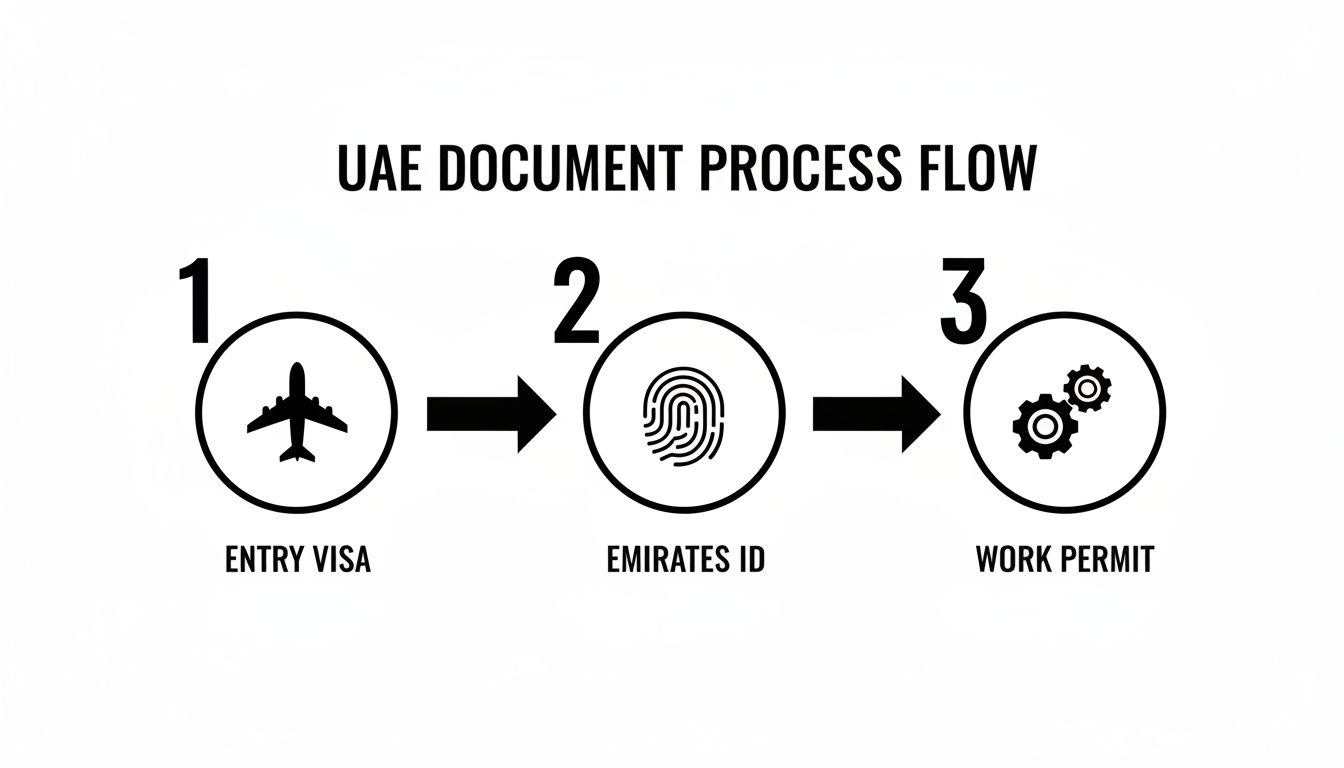
As you can see, it's a step-by-step process where each document approval unlocks the next stage.
Stage 3: Visa Stamping and Work Permit Activation
With a clean medical report and your biometrics in the system, your employer can now submit the final application for your residence visa and work permit (which used to be called the labour card). This is where all the pieces come together.
The visa stamping is the most important part of the whole process. It’s the moment the government officially changes your status from a visitor to a legal resident with the full right to work for your sponsoring company.
The General Directorate of Residency and Foreigners Affairs (GDRFA) will stamp the residence visa directly into your passport. At the same time, MoHRE activates your electronic work permit. This digital permit is linked to your Emirates ID, making it the central document for your life and work in the UAE.
Essential Documents For Your Application
Throughout this journey, both you and your employer will need to have a specific set of documents ready. Delays often happen because of missing or incorrect paperwork, so being prepared is essential. While your employer handles most of the submissions, they will need these from you:
- Passport: A clear copy of your passport with at least six months of validity remaining.
- Passport-Sized Photographs: Recent photos with a white background, taken according to specific government standards.
- Signed Offer Letter: The official MoHRE-format job offer that you signed.
- Attested Educational Certificates: Depending on your job title, your university degree might need to be attested by the UAE Embassy in your home country and the Ministry of Foreign Affairs here in the UAE.
Your employer will add their own corporate documents to the file, like their trade licence and establishment card.
Getting the paperwork right is crucial. You can find out more in our detailed guide on UAE employment visa requirements. Assuming all your documents are in order, the entire process—from your arrival to getting the visa stamped—typically takes between 5 to 10 working days.
Managing Your Work Permit Renewal and Cancellation
Think of your work permit not as a one-and-done document, but as a living part of your employment journey in the UAE. It needs careful management. The renewal and cancellation processes are just as important as the initial application, ensuring you stay on the right side of the law, avoid hefty fines, and can smoothly move between jobs or leave the country when your time is up.
These processes are always led by your employer, but they can't happen without your full cooperation. Getting the timelines and requirements right is a big deal for both you and your company. It's especially critical for businesses juggling multiple visas, from standard employment to investor visas.
The Work Permit Renewal Process
Your UAE work permit is usually valid for two years, perfectly in sync with your residence visa. To keep everything legal and seamless, your employer has to kick off the renewal process before it expires. The good news is the government gives a generous window to get this sorted without any last-minute stress.
The renewal window opens a full 60 days before your permit’s expiry date. This gives your company's PRO plenty of time to pull together the paperwork and get the application in. For you, the most important task is redoing your medical fitness test – it's a must for every renewal cycle.
The steps are pretty straightforward:
- Contract Renewal: First things first, you and your employer will sign a new employment contract.
- Medical Fitness Test: Next, you'll need to head to a government-approved health centre for another medical screening.
- Application Submission: With the new contract and your fresh medical report in hand, your employer submits the renewal application to MoHRE.
- Visa Stamping: Once approved, your renewed residence visa gets stamped into your passport, and your electronic work permit is officially updated for another term.
A timely renewal is about more than just ticking a box for compliance; it's about your stability. If your work permit isn't renewed on time, your employer faces daily fines, and your own legal residency can be jeopardised. This can create a domino effect, causing problems with everything from your bank accounts to your apartment lease.
Handling Work Permit Cancellation Correctly
When you part ways with a company, whether you resign or are terminated, your work permit has to be officially cancelled. This isn't optional—it's a legal requirement to properly close your employment file with the government. A clean cancellation protects both you and your old employer from any potential issues down the line.
Your employer is responsible for starting the cancellation on the MoHRE system. The key document here is the cancellation paper, which you'll need to sign. Your signature on this paper is your confirmation that you've received your full and final settlement, including your end-of-service gratuity. A word of advice: never sign this until you're completely satisfied with your final payout.
Once the work permit is cancelled, the next step is to cancel your residence visa. This is a crucial moment in your transition. After your visa is cancelled, you're usually given a grace period—often 30 days, though this can vary—to either land a new job and start a new visa process or exit the UAE.
Properly closing out one work permit is absolutely essential before a new employer can issue you a new one. Our specialists at PRO Deskk are experts at navigating these transitions. You can find out more in our detailed guide on the visa cancellation procedure in UAE. Our team makes sure every step is handled correctly, paving the way for a smooth exit from one role and a compliant start to the next.
Special Cases and Emiratisation Rules: What You Need to Know
When it comes to the UAE's employment framework and the labour card uae, it's not a one-size-fits-all system. The rules can shift quite a bit depending on where your company is based and who you're looking to hire. Getting a handle on these differences is key to staying compliant and keeping your business running smoothly.
The biggest variations pop up when you compare mainland companies, free zone entities, and the country's major national initiative, Emiratisation. Each one has its own distinct set of rules for work permits and employment.
The Emiratisation Mandate for Mainland Companies
Emiratisation is a huge part of the UAE's national vision. The whole idea is to get more UAE Nationals working in the private sector, and for companies on the mainland, this isn't just a suggestion—it's a hard-and-fast legal requirement with very specific targets.
These businesses have to meet mandatory quotas for hiring Emirati citizens. It’s all part of a larger plan to weave local talent into the workforce, which helps build a stronger and more sustainable national economy. If you don't meet these targets, you're looking at some hefty financial penalties, making it a critical focus for any HR or management team.
Emiratisation is more than just hitting a hiring number; it's a long-term strategy for empowering the national workforce. For any mainland business, staying compliant is a core part of their legal and social license to operate in the UAE.
On top of this, the government has laid out clear rules on pay to make sure these roles are competitive. A major change is on the horizon regarding minimum salaries. For UAE nationals with labour cards in the private sector, from 1 January 2026, the minimum monthly salary will be AED 6,000. Then, from 1 July 2026, any Emirati earning less than that won't count towards a company's Emiratisation quota. This could even lead to a freeze on new work permits until the company gets back in line.
Work Permits in UAE Free Zones
While mainland companies fall directly under the Ministry of Human Resources and Emiratisation (MoHRE), free zones play by their own rules, with their own governing bodies. This creates a kind of parallel system for work permits.
If you’re working for a company inside a free zone—think DMCC, JAFZA, or Sharjah Media City—your work permit comes from that specific free zone authority, not from MoHRE.
Here are the main differences:
- Issuing Authority: The Free Zone Authority itself manages the entire process.
- System Integration: Although they're separate, these systems are still connected to the federal immigration and Emirates ID databases.
- Employee ID: Instead of a MoHRE labour card, you'll usually get an employee ID card issued directly by the free zone.
The goal is exactly the same: to make your employment legal. The key difference is that the application, documents, and specific regulations are all handled internally by the free zone.
Golden Visa Holders and Employment
The UAE's Golden Visa programme is a game-changer for long-term residency, offering it to investors, entrepreneurs, and top professionals without needing a regular employer to sponsor them. This special status really shakes up the work permit situation.
Generally speaking, Golden Visa holders can work in the UAE without the standard, employer-sponsored work permit. This gives them a lot more freedom to work for different companies or even for themselves. It’s a huge plus for businesses trying to attract elite talent who already have this prestigious visa. For a wider view on the different regulations affecting immigrant workers, it can be useful to look at how various employment systems work globally.
Need Help with Visas and Labour Cards? Let PRO Deskk Handle It.

Why risk getting bogged down by costly delays, fines, and administrative headaches when an expert can cut through the red tape for you? Managing the ins and outs of the labour card uae process, visa applications, and government paperwork takes up a huge amount of time and requires specialised knowledge. For any business focused on efficiency and staying compliant, bringing in a professional is simply the smart move.
That’s where PRO Deskk comes in. Our corporate PRO services are built to manage every single detail of the MoHRE and immigration process. Think of us as your dedicated government liaison, freeing you and your team up to focus on what really matters—running and growing your business.
Your Go-To Partner for Mainland and Free Zone Success
Whether you're setting up a brand-new company or managing an established one, our experienced specialists are on hand to offer complete support. We live and breathe the rules for both mainland and free zone company formations across Dubai, Sharjah, and Abu Dhabi.
We've got every aspect of your operational and staffing needs covered:
- ✅ Specialists in Mainland Company Formation in Dubai, Sharjah & Abu Dhabi
- ✅ Specialists in Freezone Company Formation across the UAE
- ✅ Specialists in Golden Visa on Property and Investor Visa
- ✅ Specialists in Corporate PRO Services and Attestation Services
- ✅ 24/7 Support Service – Always here when you need us
- ✅ Cost-Effective Business Setup Solutions tailored to your needs
- ✅ Enjoy UAE Tax Benefits for International Entrepreneurs
When you partner with us, you're not just hiring a service; you're getting a cost-effective solution that lifts the burden of complex admin work off your shoulders. We handle the paperwork so you can get back to your strategic goals.
At PRO Deskk, we believe your focus should be on growth, not paperwork. Our 24/7 support means we are always available to manage your PRO needs, ensuring seamless operations and complete peace of mind.
More Than Just a Labour Card
Our expertise goes far beyond just securing a labour card uae. We offer a full suite of services designed for international entrepreneurs and established businesses looking to make the most of the UAE’s tax benefits and dynamic market.
Here’s what we specialise in:
- Company Formation: We offer expert guidance for setting up businesses in mainland and free zone jurisdictions right across the UAE.
- Investor and Golden Visas: We’re specialists in securing long-term residency through property investment and other qualifying routes.
- Corporate PRO Services: From renewing trade licences to liaising with government bodies, we manage all your corporate admin tasks.
- Attestation Services: We make sure your critical documents are legally recognised and accepted by all the relevant authorities.
Choosing the right partner for these critical functions is key to staying compliant and running an efficient operation. If you're looking into your options, you might find resources on comparing HR outsourcing companies for compliance helpful in finding the right fit for your business needs.
Let PRO Deskk be your trusted advisor. We simplify the complexities of UAE business setup and ongoing management, giving you the freedom to thrive.
📞 Call Us Now: +971-54-4710034
💬 WhatsApp Us Today for a Free Consultation
Got Questions About the UAE Labour Card? We’ve Got Answers.
When it comes to the labour card uae, a few common questions always pop up. It's completely normal to want clarity on these key points. Here are some straightforward answers to help you feel confident about your employment status.
How Can I Check My Labour Card Status Online?
Checking your work permit status these days is refreshingly simple. The Ministry of Human Resources and Emiratisation (MoHRE) has made it easy to get the information you need in just a few clicks.
You’ve got two main options:
- The MoHRE Website: Just head to the official MoHRE site, find the "Services" area, and look for the option to check your work permit or contract details.
- The MoHRE Mobile App: For even quicker access, you can download the app right to your phone. It's perfect for checking things on the go.
For either route, you'll usually need your passport number or the transaction number your employer gave you. Once you pop in the details, you can instantly see and download your electronic labour card uae.
What Are the Fines for a Late Renewal?
The UAE government is very serious about keeping employment regulations in check, and letting a work permit expire comes with penalties for the employer. These fines add up for every single day the permit isn't renewed.
It's not just about the money, either. These penalties can stop a company from being able to process any new work permits until all the outstanding fines are paid off. That’s why getting renewals done on time is a top priority for any business here.
Can I Work for Two Companies at Once?
Your standard work permit ties you to one employer—the one who sponsored you. It doesn’t give you the green light to pick up a second job with another company on the side. Doing so without the right permissions is a serious breach of UAE labour laws.
But that doesn’t mean it’s impossible. The UAE has official pathways for people who want to take on more work. The main way is to get a specific part-time work permit from MoHRE. This requires getting the thumbs-up from both your main employer and your second one.
Think of your standard UAE labour card as being exclusive to one company. If you're looking to work a second job, you need to go through the proper channels and get a separate part-time work permit. This keeps everything above board and protects everyone involved.
Is a Free Zone Labour Card Different from a Mainland One?
Yes, there’s a crucial difference, and it all comes down to who issues it. For a mainland company, your work permit is issued and managed by MoHRE.
If you work for a company in a free zone, however, your work permit comes from that specific free zone’s own governing authority—like the DMCC or JAFZA, for example. The main goal is the same: to make your employment legal. But the application process, the fees, and some of the rules can be a bit different depending on whether you’re on the mainland or in a particular free zone.
Figuring out the ins and outs of UAE company formation and employee paperwork is exactly what PRO Deskk excels at. Our experts handle everything from Mainland and Freezone setups to Investor and Golden Visas, offering complete Corporate PRO Services to keep your business running smoothly and compliantly. With 24/7 support and practical solutions, we take care of the red tape so you can get back to growing your business.
📞 Call Us Now: +971-54-4710034
💬 WhatsApp Us Today for a Free Consultation at https://prodesk.ae