
Before you even think about trade names or business activities, there's a foundational decision you need to make: where will your company legally exist? This isn't just about picking an office location; it's a strategic move that will shape your company's entire future in the UAE.
This first step—choosing your jurisdiction—is critical. Your choice between a Mainland, Free Zone, or Offshore setup dictates everything from your ownership structure and operational scope to your market access and tax liabilities. Getting this right from the start is essential for a smooth launch, while the wrong choice can lead to frustrating roadblocks and unexpected costs later on.
It's a decision that should be baked into your initial strategic planning for your business, long before the paperwork begins. Let's break down what each option really means for you.
Mainland vs Free Zone vs Offshore At a Glance
To give you a quick snapshot, here’s a table that cuts through the noise and compares the core features of each jurisdiction. Think of it as your cheat sheet for making that first big decision.
| Feature | Mainland Company | Free Zone Company | Offshore Company |
|---|---|---|---|
| Ownership | 100% foreign ownership for most activities | 100% foreign ownership | 100% foreign ownership |
| Scope of Business | Can trade anywhere in the UAE and internationally | Restricted to trading within the Free Zone or globally | Can only operate outside the UAE |
| Office Requirement | Mandatory physical office space | Flexi-desk or physical office required | No physical office; registered agent address only |
| Visa Eligibility | Eligible for employee and investor visas | Eligible for employee and investor visas | Not eligible for residency visas |
| Government Contracts | Can bid on and win government projects | Not eligible to bid on government tenders directly | Not eligible |
| Taxation | Subject to UAE Corporate Tax | 0% corporate and personal tax (with conditions) | 0% corporate and personal tax |
| Auditing | Annual audit is typically mandatory | Varies by Free Zone; some require annual audits | Generally not required, but depends on jurisdiction |
This table gives a high-level view, but the best choice always comes down to your specific business model and long-term goals.
The Case for a Mainland Company
If your plan involves trading directly with customers and businesses across the UAE, a Mainland company is almost certainly your best bet. It offers the ultimate freedom to operate anywhere in the country without any middlemen or restrictions.
Mainland companies are registered directly with the Department of Economic Development (DED) in the emirate you choose, whether it's Dubai, Abu Dhabi, or Sharjah. This setup gives you some powerful advantages:
- Trade Directly: You can conduct business freely with anyone, anywhere in the UAE. No restrictions.
- Bid for Government Contracts: This is a big one. Only Mainland companies are eligible to compete for lucrative government tenders.
- Set Up Shop Anywhere: You have the flexibility to open offices, showrooms, or retail stores in any commercial district you like.
Not too long ago, a Mainland company required a local Emirati sponsor. However, recent legal reforms have changed the game, now allowing 100% foreign ownership for the vast majority of business activities. This makes it an incredibly attractive option for international entrepreneurs, especially those in consulting, retail, or restaurants who want to tap directly into the local market.
The Allure of a Free Zone Company
For entrepreneurs whose focus is on international trade, a Free Zone company is a compelling proposition. With over 40 Free Zones scattered across the UAE, many are themed around specific industries like technology, media, finance, or logistics. They are purpose-built economic areas designed to attract foreign investment with a package of powerful incentives.
Think of a Free Zone as its own economic island with a distinct set of rules and regulations. This autonomy allows them to offer benefits you simply won't find on the Mainland, making them a magnet for global businesses.
So, what's the appeal? The key advantages are hard to ignore:
- 100% Foreign Ownership: This has always been the cornerstone of the Free Zone model, giving you complete control over your business.
- Full Repatriation of Profits: You can send 100% of your profits and capital back to your home country without any restrictions.
- Tax Exemptions: Free Zone companies benefit from exemptions on both corporate and personal income taxes, a major draw for entrepreneurs worldwide.
The catch? A Free Zone company can't trade directly with the Mainland market; you'd typically need a local distributor for that. But for import/export businesses, international consulting firms, or e-commerce platforms with a global customer base, it's the perfect structure.
If you're weighing these two options, our guide on the differences between a https://prodesk.ae/free-zone-vs-mainland-dubai/ offers a much deeper dive into the nuances.
Once you’ve locked in the right jurisdiction for your new venture, it's time to get down to the brass tacks of actually registering your company. This is the part where your vision starts to become a real, legal entity. While it can seem like a mountain of paperwork and approvals, it's really just a logical sequence of steps. Knowing what's coming next is half the battle.
The process kicks off with something creative: choosing your trade name. This isn't just a branding exercise; the name has to play by the rules set by the Department of Economic Development (DED) or your chosen free zone authority. It needs to be unique, can't violate public morals, and must steer clear of any religious or government-sounding names.
After you've successfully reserved your name, the next milestone is getting your initial approval. Think of this as the authorities giving you a green light to proceed with the rest of the application. It’s a crucial step that confirms your business activity and ownership structure are viable before you sink more time and money into the process.
Securing Your Trade Name and Initial Approval
Nailing down a trade name is one of the first, and most important, hurdles. The name has to be completely unique and not already taken by another company in the UAE. The authorities are also quite strict about names that could be seen as offensive, blasphemous, or include references to Allah or other religious figures. Another common trip-up? You generally can't use abbreviations of your name, like "J. Smith Consulting," unless you use your full legal name.
Here are a few tips I've picked up over the years:
- Check Availability First: Your business setup consultant can run a quick, real-time check on the official registry to see if your dream name is free.
- Have Backups Ready: Always have two or three alternative names in your back pocket. It’s a simple thing, but it can save you days if your first choice gets rejected.
- Know the Unwritten Rules: Avoid buzzwords like "Global," "International," or "Middle East." Unless you can show a very strong business case for using them, they're likely to be turned down.
With your trade name approved and reserved, you’ll then get an Initial Approval Certificate. This document is the government's official nod, confirming they have no objection to you setting up your business. You'll need it for almost every step that follows, from drafting legal documents to finalizing your licence.
Drafting Legal Documents and Applying for Your Licence
With that initial approval secured, the focus shifts to the legal backbone of your company: the Memorandum of Association (MOA). If you're setting up on the mainland, this document has to be drafted in both English and Arabic. It lays out the ownership structure, what your business will do, and the responsibilities of each partner. Once drafted, it must be notarised by a public notary here in the UAE.
The MOA is effectively your company's constitution. It dictates the rights and duties of shareholders and governs how your business operates. Getting this wrong can lead to serious legal headaches down the road, which is why having it professionally drafted and attested is money well spent.
You’ll also find that crafting an effective business plan at this stage is a huge help. A clear plan defines your business activities, which is critical for the next step: applying for the right business licence.
The UAE has a few main types of licences, each tied to specific activities:
- Commercial Licence: This is for any business involved in trading, import/export, or just buying and selling goods.
- Professional Licence: Tailored for service-based businesses, consultancies, and skilled professionals. These often allow for 100% foreign ownership.
- Industrial Licence: This is a must for any company involved in manufacturing, production, or other industrial activities.
This flowchart breaks down the initial decision-making process for entrepreneurs choosing a jurisdiction in the UAE.
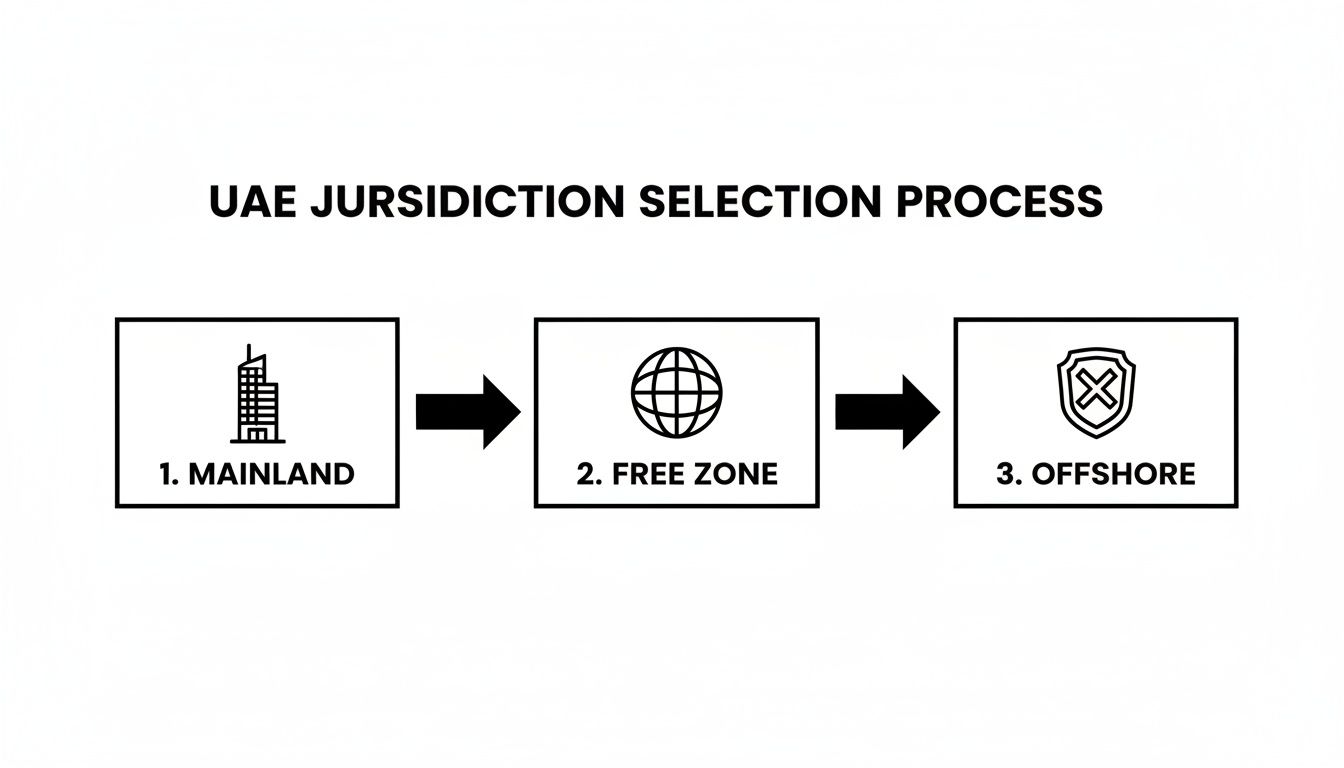
As you can see, the choice between Mainland, Free Zone, or Offshore is the first major fork in the road, and each path comes with its own set of rules and market access.
Finalising Registration with Labour and Immigration
Once your trade licence is issued, you’re on the home stretch. There are just two final, but absolutely vital, steps before you can legally hire people and start operating. First up is getting your Establishment Card. It's a small but powerful card that registers your company with the Ministry of Human Resources and Emiratisation (MOHRE) and the General Directorate of Residency and Foreigners Affairs (GDRFA).
This card is your golden ticket to the visa system. Without it, you can't apply for your own investor visa or sponsor visas for your employees. It essentially activates your company's file in the federal immigration database.
The entire registration system is built to handle incredible volume. Ministry of Economy data from 2025 showed the UAE added around 250,000 new companies in a single year, pushing the total past 1.4 million. This explosive growth is fuelled by major reforms like allowing 100% foreign ownership and modernising over 80% of economic laws. For you, this means you’re plugging into a highly efficient and well-oiled machine.
Lastly, you have to register your company with the Wages Protection System (WPS). This is an electronic salary transfer system that makes sure your employees are paid correctly and on time. It's a mandatory requirement for every private sector company, designed to protect workers' rights and ensure transparency. The authorities monitor this very closely, so compliance is non-negotiable.
With those final registrations complete, your company is officially open for business in the UAE.
Handling Post-License Essentials and Visas
Holding your new trade licence is a huge milestone, but it’s really just the beginning. Think of it as the key that unlocks the next, equally critical phase: getting your company fully operational.
Now, your focus needs to shift from registration paperwork to the practicalities of opening a corporate bank account and sorting out your residency visa. These aren't just administrative hoops to jump through; they are the absolute foundation for doing business, hiring people, and actually living in the UAE.
Securing Your Corporate Bank Account
This is where many entrepreneurs hit their first major roadblock. Opening a corporate bank account in the UAE is often much tougher than people anticipate. Banks here are incredibly thorough with their compliance checks and Know Your Customer (KYC) processes.
Just waving your new trade licence isn't going to cut it. Banks need to see a legitimate business with a solid plan. They’ll want to know about your shareholders, your business model, and the kinds of transactions you'll be making.
To avoid getting stuck, you need to be over-prepared. Here's what you should have ready to go:
- A Detailed Business Plan: Lay out your activities, who you're selling to, and your financial forecasts.
- Shareholder Profiles: Provide professional CVs for all shareholders to demonstrate credibility.
- Proof of Business: If you have any draft contracts, supplier agreements, or even just a professional website, it all helps.
- Source of Funds: Be ready to clearly explain where your initial capital is from.
So many people make the mistake of only talking to one bank. Every bank has a different risk appetite. One bank's 'no' could easily be another's 'yes'. Working with a setup consultant who already has relationships with multiple banks can save you weeks of hitting dead ends.
The Residency Visa Process Unpacked
As soon as your company’s Establishment Card is issued, you can start the visa process for yourself, your family, and any staff you plan to hire. This is the multi-step journey that officially changes your status from visitor to resident, allowing you to live and work here long-term.
For a business owner, the first step is typically applying for an investor visa. This starts with an entry permit, which you'll use to either enter the UAE or, if you're already here, change your status to complete the residency steps.
Once the entry permit is approved, you’ll need to complete three key steps inside the country:
- Medical Fitness Test: This is a standard blood test and chest X-ray done at a government-approved health centre.
- Biometrics Appointment: You'll visit a Federal Authority for Identity and Citizenship (ICA) centre to have your fingerprints and photo taken.
- Emirates ID Application: Your official UAE identification card is applied for at the same time as your biometrics.
After these are done and your medical test comes back clear, the final visa is stamped into your passport. This stamp is your proof of legal residency, usually valid for two years.
Exploring the Prestigious Golden Visa
For entrepreneurs and investors making a significant commitment to the UAE, the Golden Visa is a far more attractive option. It's a long-term residency visa, valid for up to 10 years, which offers much greater stability and peace of mind.
Qualifying as an investor usually means meeting specific criteria, like investing in a property worth at least AED 2 million or hitting certain business investment targets. The benefits are significant, including sponsoring your family and being able to stay outside the UAE for long periods without your visa being cancelled. We specialise in helping clients navigate both the Golden Visa on Property and Investor Visa pathways.
The move towards digitisation has completely changed the game for company registration timelines. By 2025, top free zones like RAKEZ, SPC Free Zone, IFZA, and Dubai Silicon Oasis can get a company fully incorporated in just 1 to 5 working days, thanks to things like digital MoAs and e-signatures. But this speed comes with strict compliance on federal regulations like Ultimate Beneficial Owner (UBO) disclosure and corporate tax registration. Having expert PRO guidance to manage this blend of speed and scrutiny is more valuable than ever. You can read more about the key business registration changes in 2025.
Breaking Down the Costs and Timelines
When it comes to launching your UAE business, vague estimates just won't cut it. You need a clear picture of the financial and time commitments ahead to avoid budget blowouts and frustrating delays.
Let's move past the guesswork and get into the real numbers and timelines you should expect. After all, a solid business is built on a realistic plan.
Unpacking the Core Government Fees
No matter where you decide to set up, certain government fees are simply part of the process. Think of these as the non-negotiable costs paid directly to the authorities to legally establish your company.
Your first official expense will be for your trade name reservation. Once your name is secured, you'll pay for the initial approval, which is the government's nod to proceed with your business idea. The biggest chunk of the government fees is usually for the licence issuance itself, which varies depending on your chosen business activity.
- Trade Name Reservation: A one-time fee that secures your unique brand identity.
- Initial Approval Certificate: The cost for getting the preliminary green light for your application.
- Trade Licence Issuance: The main fee for your one-year business licence, which you'll need to renew annually.
These are just the headline costs. If you're setting up in Dubai Mainland, for instance, you might run into other fees for things like market access or special approvals depending on your industry.
The Hidden Costs Entrepreneurs Often Overlook
It’s a classic mistake to only budget for the big government fees. In reality, several other third-party and operational costs are just as critical but are often forgotten in the excitement of starting up.
One of the biggest is office rent. For a Mainland company, having a physical office with a registered tenancy contract (Ejari) is almost always a must. Free Zones are a bit more flexible and offer cost-effective options like flexi-desks, but it's still an expense you can't ignore.
Here are a few other costs that can easily slip through the cracks:
- Document Attestation and Translation: If your personal or corporate documents come from outside the UAE, they need to be legally attested and translated into Arabic. This involves multiple steps, and each one has a fee.
- Corporate PRO Services: While it's an upfront investment, hiring a professional PRO service can save you from making costly mistakes and frees up a huge amount of your time. They handle all the government paperwork and legwork.
- Visa Application Fees: Every residency visa—for you, your family, or your employees—comes with its own set of government fees.
To help you get a clearer picture, here’s a sample breakdown of the kind of costs you might encounter.
Estimated Costs for UAE Business Setup (Sample Breakdown)
| Cost Item | Mainland (Approx. AED) | Free Zone (Approx. AED) | Notes |
|---|---|---|---|
| One-Time Fees | |||
| Trade Name Reservation | 500 – 1,000 | 500 – 1,000 | Secures your business name. |
| Initial Approval | 150 – 500 | 500 – 1,500 | Preliminary government approval. |
| Memorandum of Association (MOA) | 1,500 – 3,000 | Included in package | Notarisation is required for Mainland. |
| Establishment Card | 2,000 – 2,500 | 1,500 – 2,500 | Required for visa processing. |
| E-Channel Registration | 2,500 – 5,000 | 2,500 – 5,000 | Mandatory for immigration services. |
| Visa Application & Medical | 3,500 – 5,000 | 3,500 – 5,000 | Per person (includes medical & Emirates ID). |
| Annual Recurring Costs | |||
| Trade Licence | 10,000 – 25,000+ | 8,000 – 20,000+ | Varies greatly by activity and jurisdiction. |
| Office Space / Flexi-Desk | 15,000 – 50,000+ | 5,000 – 15,000 | Physical office often mandatory for Mainland. |
| Local Service Agent (LSA) Fee | 7,000 – 15,000 | N/A | For professional licences on Mainland. |
Remember, these figures are just estimates. The final cost will depend on your specific business activity, the number of visas you need, and your choice of jurisdiction.
For a deeper dive, our guide on the business setup cost in Dubai provides more detailed scenarios and figures.
Setting Realistic Timelines for Mainland and Free Zone Setups
Time is money, especially when you're starting a business. Free Zones are famous for their speed, but a Mainland setup involves more government touchpoints, which naturally extends the process.
A typical Free Zone company registration can be incredibly quick. If you have all your documents in order, you could be fully licenced within 1 to 5 working days. The whole process is designed to be fast: name reservation, licence application, and issuance often happen one after the other.
On the other hand, a Mainland company formation is a bit more involved and usually takes between 1 to 3 weeks. This timeline accounts for getting initial approvals from the Department of Economic Development (DED), having your Memorandum of Association notarised, and securing your office lease before the final licence is issued.
Once your licence is in your hands, the visa process will add another 2 to 3 weeks. This covers applying for the entry permit, doing your medical tests and biometrics in the UAE, and finally getting the visa stamped in your passport. Factoring this entire timeline into your plan from the start will help manage expectations and make for a much smoother journey.
Why You Need a Business Setup Partner
While you can technically navigate the UAE's business setup maze on your own, the most successful entrepreneurs rarely do. The process is layered with legal nuances, unwritten rules, and bureaucratic hurdles that can easily derail an unprepared founder.
This is where partnering with a specialist isn't just a convenience—it's a powerful strategic move.
Engaging an expert transforms a complex, time-consuming challenge into a managed process. Instead of spending weeks trying to understand the differences between hundreds of business activities or figuring out which government portal to use, you can lean on professionals who do this every single day. Their experience is your shortcut.
The right partner immediately saves you time and, crucially, money. Common mistakes like choosing a mismatched business activity, filing incorrect paperwork, or missing a key approval can lead to significant delays and hefty fines. A specialist knows how to sidestep these pitfalls, ensuring your application is correct the first time.
Navigating Mainland and Free Zone Complexities
The choice between a Mainland and Free Zone company is one of the biggest decisions you'll make, and a setup partner brings much-needed clarity. They help align your business goals with the correct jurisdiction, drawing on deep experience in both Mainland company formation in Dubai, Sharjah, and Abu Dhabi and Free Zone setups across the UAE.
This expertise is invaluable. For instance, they can advise if your business model requires direct access to the local market (pointing towards Mainland) or if a tax-efficient Free Zone hub is a better fit for international operations. Getting this guidance upfront prevents costly restructuring down the road.
A seasoned business setup consultant doesn't just process paperwork; they act as your strategic advisor. Their goal is to build a corporate structure that is not only compliant today but also flexible enough to support your company's growth tomorrow.
Beyond the initial setup, the real value emerges in ongoing support. This is where dedicated Corporate PRO Services become essential.
The Power of Professional PRO Services and Beyond
Think of a professional Public Relations Officer (PRO) as your representative on the ground, liaising directly with government departments. This is a critical function when you need to handle everything from initial approvals and document attestation to visa renewals and labour contracts. They know the people, the processes, and the shortcuts.
This professional support extends to other vital areas:
- Visa Assistance: Securing your Investor Visa or the prestigious Golden Visa on Property requires precise documentation and follow-up. A partner manages this entire journey for you and your family.
- Bank Account Opening: They provide crucial assistance in preparing the extensive documentation required by UAE banks, increasing your chances of a swift account opening.
- Ongoing Compliance: Regulations change. A good partner keeps you informed about your obligations, from corporate tax registration to WPS compliance, ensuring you never miss a deadline.
Ultimately, using a specialist is about mitigating risk and boosting efficiency. It’s a cost-effective business setup solution that allows you to enjoy the full UAE tax benefits for international entrepreneurs without getting bogged down in administration. With 24/7 support, help is always available.
By outsourcing the administrative burden, you free up your most valuable asset—your time—to focus on what truly matters: growing your business. You can learn more about how business setup consultants in Dubai provide this level of comprehensive support.
Common Questions About Setting Up a Company in the UAE
When you’re thinking about starting a business in the UAE, a lot of questions pop up. It’s a big step, after all. To help clear things up, here are some straightforward answers to the queries we hear most often from entrepreneurs just like you.
Can a Foreigner Own 100% of a Company in Dubai Mainland?
Yes, absolutely. This is one of the biggest and most welcome changes we've seen in recent years. Thanks to major legal reforms, foreign investors can now have 100% ownership of their Mainland companies for a huge number of business activities.
The old rule, which required a local Emirati sponsor to hold 51% of the shares, is gone for over a thousand commercial and industrial licences.
That said, a few strategic sectors, like those linked to national security or certain regulated fields, still have their own specific ownership rules. This is why it’s so important to consult with specialists in Mainland Company Formation in Dubai, Sharjah & Abu Dhabi to get the latest advice for your exact business plan.
What Is the Minimum Cost to Start a Business in the UAE?
There's really no one-size-fits-all answer here, as the final cost boils down to the choices you make. The biggest factors are the jurisdiction (Mainland or a specific Free Zone), the licence type you need, your office setup (a physical space versus a flexi-desk), and how many visas you'll be applying for.
For some, a basic Free Zone package can be surprisingly affordable, with some starting from as low as AED 5,999. On the other hand, a Mainland company with a proper office lease and several employee visas will naturally require a larger upfront investment.
To make sure there are no hidden surprises down the line, always ask for a cost-effective business setup solution that gives you a completely transparent, itemised quote. This should clearly list all government fees and any professional service charges.
How Long Does It Take to Register a Company in the UAE?
The timeline can be anything from just a few days to a couple of weeks. If speed is what you need, Free Zones are built for it. Specialists in Freezone Company Formation across the UAE can often get a licence issued in just 1-5 working days, as long as all your documents are ready and correct.
A Mainland setup is a bit more of a journey, typically taking around 1-3 weeks. The extra time is because you need approvals from several government departments, like the Department of Economic Development and the Notary Public. This is where having experts with Corporate PRO Services can make a massive difference; they know how to navigate the system, avoid common mistakes, and keep the process moving smoothly.
Do I Need a Physical Office to Set Up a Company in the UAE?
It really depends on where you set up and what kind of licence you have. Many Free Zones are incredibly flexible, offering cost-effective options like virtual offices or flexi-desks. For startups and international entrepreneurs, these are fantastic because they meet the legal requirement for a registered address without the heavy cost of a traditional office.
For a Mainland licence, however, a physical office with a registered tenancy contract (known as an Ejari) is nearly always a must. The size of the office you need is often tied to your business activity and how many employee visas you plan to get. It’s a key budget item to factor in from the start if you're going the Mainland route.
✅ Specialists in Mainland Company Formation in Dubai, Sharjah & Abu Dhabi
✅ Specialists in Freezone Company Formation across the UAE
✅ Specialists in Golden Visa on Property and Investor Visa
✅ Specialists in Corporate PRO Services and Attestation Services
✅ 24/7 Support Service – Always here when you need us
✅ Cost-Effective Business Setup Solutions tailored to your needs
✅ Enjoy UAE Tax Benefits for International Entrepreneurs
📞 Call Us Now: +971-54-4710034
💬 WhatsApp Us Today for a Free Consultation at https://prodesk.ae