Thinking of starting a business abroad? It can feel like a minefield. But setting up a company in a Dubai free zone is a surprisingly clear path for international entrepreneurs.
This structure is designed to give you 100% foreign ownership, massive tax advantages, and the freedom to repatriate all your profits. It effectively removes many of the usual roadblocks, making Dubai one of the most appealing places in the world to do business.
Why a Dubai Free Zone Is a Game Changer
Usually, setting up shop in a new country means wrestling with complex ownership laws, high taxes, and piles of red tape. Dubai’s free zones flip that script completely.
The entire model was created to pull in foreign investment by offering a pro-business environment that cuts down on bureaucracy and maximises your potential for growth. It’s an ecosystem built for speed and global reach.
Imagine launching your company without needing a local partner. You keep full control. That’s the core appeal right there. Add to that the UAE's incredible tax benefits, and you've got a serious advantage when it comes to scaling your business.
The Strategic Edge of a Dubai Free Zone
The perks go well beyond just ownership and taxes. Dubai’s location is a natural bridge connecting Asia, Europe, and Africa—an unbeatable logistical advantage for anyone in trade, e-commerce, or services.
Here are a few key benefits that make a real difference to your daily operations:
- Total Profit Repatriation: You are free to send 100% of your capital and profits back to your home country. No strings attached.
- World-Class Infrastructure: You get access to modern offices, state-of-the-art warehouses, and advanced transport networks that keep your business running smoothly.
- Industry-Specific Hubs: Many free zones are built for specific sectors like tech, media, or finance. This creates powerful opportunities for networking and collaboration with people in your field.
This unique mix makes a free zone company setup in Dubai more than just a legal structure; it's a launchpad for going global. For a closer look at how this stacks up against other local options, have a read of our guide on free zone vs mainland company in Dubai.
A Thriving Ecosystem Built for Growth
Dubai's free zones have completely changed the game by offering 100% foreign ownership, a huge draw for entrepreneurs looking at the UAE market.
As of June 2024, there are 30 active free zones in Dubai, with another—the Dubai Carpets Free Zone—on the way. This makes it the emirate with the highest concentration of free zones in the UAE.
Their impact is massive. Dubai's free zones handle over 60% of the UAE’s goods exports, which has turned the city into a global trade powerhouse. Just look at the International Free Zone Authority (IFZA). Founded in 2018, it has become incredibly popular with small and medium-sized businesses thanks to its quick setups and flexible capital requirements.
Choosing a free zone isn't just about getting a licence. It's about placing your business in an ecosystem that's designed to help you succeed on a global scale. The right support makes all the difference.
As specialists in Mainland and Freezone Company Formation across the UAE, we offer cost-effective business setup solutions tailored to your needs. Our expertise extends to Golden Visas, Investor Visas, and a full suite of Corporate PRO and Attestation Services, all designed to help international entrepreneurs enjoy the UAE's tax benefits. With our 24/7 support, we’re always here when you need us.
📞 Call Us Now: +971-54-4710034
💬 WhatsApp Us Today for a Free Consultation
Choosing the Right Free Zone for Your Business
With over 30 free zones in Dubai, probably the biggest mistake I see entrepreneurs make is assuming they’re all the same. They're not. Think of this decision less like picking an office location and more like choosing a strategic partner for your company's future. The "best" free zone is simply the one that clicks perfectly with your business model, your budget, and where you see yourself in five years.
Getting this right from day one is absolutely critical for a smooth free zone company setup in Dubai. Each zone is its own little ecosystem with its own rules, industry focus, and costs. Pick the wrong one, and you could be dealing with operational headaches, surprise expenses, and a general mismatch with what your business actually needs to thrive.
Aligning Your Business with the Right Industry Hub
Your first filter should always be industry. Dubai has done an incredible job of creating specialised hubs that bring together talent and infrastructure to help certain sectors flourish. It just makes sense — a tech startup belongs in an environment buzzing with innovation, not in a logistics park.
- For Technology and Innovation: Look no-further than Dubai Silicon Oasis (DSO). It’s a purpose-built community for tech companies, designed as an integrated place to live and work.
- For Media and Creative Arts: Dubai Media City (DMC) and Dubai Studio City are the go-to hubs. They have the infrastructure and networking opportunities that are essential for anyone in media production, advertising, or content creation.
- For Global Trade and Logistics: Jebel Ali Free Zone (JAFZA) is a global powerhouse. It’s one of the world's largest logistics hubs, directly linked to a major seaport and airport, making it a no-brainer for import-export businesses.
- For Commodities Trading: The Dubai Multi Commodities Centre (DMCC) is a world leader for businesses trading everything from gold and diamonds to coffee and tea.
This specialisation means you’re instantly surrounded by potential clients, partners, and suppliers. It creates a powerful network effect that can really accelerate your growth.
Dubai Free Zone Comparison for Popular Business Sectors
To help you visualise this, here’s a quick comparison of some popular free zones and what they're best known for. It's a great starting point to see how these hubs cater to different business needs and might help you narrow down your options.
| Free Zone Name | Industry Focus | Ideal For | Key Advantage |
|---|---|---|---|
| DMCC | Commodities, Professional Services | Traders, consultants, crypto businesses | Global reputation and networking |
| JAFZA | Logistics, Trading, Manufacturing | Import/export, large-scale industrial | Unmatched port and logistics access |
| IFZA | General Trading, Professional | Startups, SMEs, consultancies | Cost-effective and flexible packages |
| Dubai Media City | Media, Advertising, Marketing | Creative agencies, production houses | Central hub for the media industry |
| DIFC | Finance, FinTech, Legal | Banks, asset managers, law firms | International regulatory framework |
Choosing the right ecosystem is half the battle won. The environment you operate in can significantly influence your path to success, so it's worth taking the time to research which community fits you best.
Understanding Licence Types and Business Activities
Once you've shortlisted a few zones, the next step is nailing the licence type. This is non-negotiable. Getting it wrong will bring your application to a grinding halt.
There are three main categories:
- Commercial Licence: This is for any business involved in trading, importing, or exporting goods.
- Professional Licence: For service-based businesses, consultants, and individual professionals.
- Industrial Licence: For any company involved in manufacturing, processing, or assembly.
A simple example: if you’re developing and selling software, you need a Professional Licence. But if you’re importing and reselling electronics, you’ll need a Commercial Licence. A mismatch here will mean going back to square one, costing you both time and money.
Your business activities must be listed exactly as approved on your trade licence. Trying to operate outside of that scope is a serious compliance breach and can lead to hefty fines.
Evaluating Costs and Scalability
It's easy to get drawn in by the appeal of a premium free zone, but you have to be realistic about the costs. A common pitfall is underestimating the total cost of setup and, just as importantly, the annual renewal fees. Beyond the zone itself, you also need to think about the different different business structure types available, as this choice affects both your costs and your liability.
Look at everything—registration fees, licence costs, office rent (is a flexi-desk enough or do you need a private office?), and how many visas you're entitled to. These costs can vary dramatically from one zone to another. For a clear look at the more budget-friendly options, our guide on the cheapest free zones in the UAE is a great resource.
As specialists in Freezone Company Formation across the UAE, our team provides cost-effective solutions built around your specific needs. We’ll help you choose a free zone that not only fits your budget today but also gives you the room to grow tomorrow. We're available 24/7 because we know these foundational decisions can't wait.
Your Company Formation Checklist
You've done the hard work and picked the perfect free zone. What's next? It's time to turn that business idea into a legal, operational reality. This is where the paperwork starts, and while it might look like a mountain of forms and documents, it’s really just a series of straightforward tasks. Let's walk through the practicalities of a free zone company setup in Dubai and turn this process into a clear action plan.
The whole journey kicks off with reserving your company's trade name and getting the initial nod of approval from the free zone authority. These first steps are crucial—getting them right from the start saves you from major headaches and delays down the road. After that, it's all about methodically gathering your documents, sorting out your office space (whether physical or virtual), and finally, getting that official business licence in your hands.
To make things clearer, this flowchart breaks down the selection process, highlighting the main things you need to weigh up.
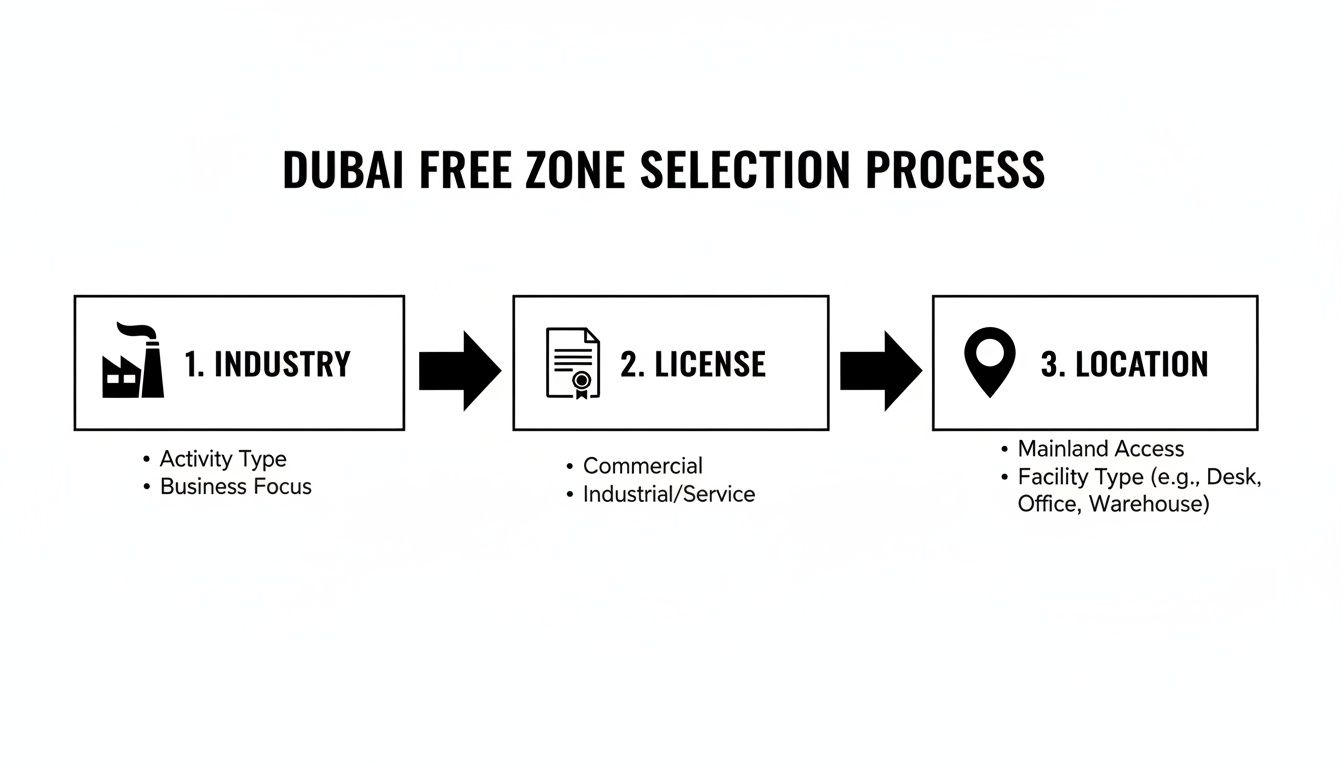
As you can see, it simplifies the journey into three key decisions: matching your industry, picking the right licence, and choosing a strategic location.
Reserving Your Trade Name
Picking a name for your company isn't just a branding decision; it's a legal step with some very specific rules here in the UAE. Your chosen name has to be unique and follow the country's naming guidelines, which means it can't offend public morals or contain any religious references.
Also, be aware that certain words like "Global" or "International" might need extra justification or even come with higher fees. The free zone authority will vet your proposed names, and once one is approved, it’s reserved just for you.
A common mistake we see is people submitting names that are too generic or are already taken. To avoid the back-and-forth that can stall your application, it's always smart to have a few alternative names ready to go.
Securing Initial Approval and Gathering Documents
With your trade name locked in, the next move is to apply for initial approval. This is where you submit a detailed application form plus key personal documents for every shareholder and manager. Essentially, this stage is the free zone authority giving you the green light to proceed with setting up your business.
The list of required documents is fairly standard across most free zones:
- Passport Copies: You'll need clear, colour copies for every person involved in the company.
- Passport-Sized Photographs: These have to meet specific requirements for the background colour and size.
- Business Plan: This isn't always mandatory for simple setups, but more complex activities or certain free zones (like DMCC) will definitely ask for one. It should clearly outline your business goals, what you offer, and who your customers are.
- Proof of Address: A recent utility bill or bank statement for each shareholder usually does the trick.
If a shareholder is already a UAE resident, they might need a No Objection Certificate (NOC) from their current sponsor. Having all these documents prepared and neatly organised beforehand will make the entire process run much more smoothly.
Insider Tip: Double-check that all your documents are high-resolution scans and that passports are valid for at least another six months. Blurry copies and nearly expired passports are two of the biggest reasons for application delays. It’s a tiny detail that can save you weeks of frustration.
Our Corporate PRO Services are designed to handle this for you. As specialists, we manage all the document preparation and attestation, ensuring everything is spot-on the first time to avoid those common administrative snags.
Finalising Your Office and Licence Issuance
Every company in a free zone needs a registered address within that zone's boundaries. But don't worry, this doesn't always mean you need to rent a big, physical office. For many new entrepreneurs, a flexi-desk is the smartest and most affordable option.
A flexi-desk gives you a legitimate business address and lets you use shared office facilities when you need them. It’s the perfect way to start out, keeping your overheads low while meeting all the legal requirements. Of course, if your business needs a physical footprint, you can choose from private offices, co-working spaces, or even warehouses, depending on what the free zone offers.
Once you have your initial approval and you’ve signed your lease agreement—whether for a flexi-desk or a proper office—the free zone will issue an invoice for your registration and licence fees. As soon as that's paid, they will issue your final business licence.
This licence is your official golden ticket to operate. It will state your company name, its legal structure (like an FZE for a single shareholder or FZCO for multiple), and the exact business activities you're allowed to carry out. With this licence, your company is officially registered and ready for the next big steps: applying for visas and opening a corporate bank account.
Our team provides business setup solutions that are tailored and cost-effective. From helping you choose the right office setup to managing payments and document submissions, we take care of the logistics so you can stay focused on your launch. And with our 24/7 support, expert help is always just a phone call away.
📞 Call Us Now: +971-54-4710034
💬 WhatsApp Us Today for a Free Consultation
Securing Your Visa and Corporate Bank Account
Getting your trade licence is a massive milestone in setting up your free zone company in Dubai, but don't pop the champagne just yet. The journey isn't over. Two crucial steps are next, and they are what truly transform your company from an idea on paper into a fully functioning business: getting your residency visa and opening a corporate bank account.
This is where a lot of new entrepreneurs stumble.
Successfully navigating this next phase is less about just filling out forms and more about knowing the unwritten rules. While the visa process is fairly straightforward, opening a bank account demands a strategic touch. UAE banks are incredibly thorough, and if your application isn't perfectly prepared, you're looking at delays or even a flat-out rejection.
Navigating the UAE Residency Visa Process
Think of your business licence as the key that unlocks your UAE residency. The number of visas you can get is tied directly to the company setup package you went with—usually, this comes down to your office space. A simple flexi-desk package might get you one or two visas, while a dedicated physical office opens the door for more.
The application itself is a clear, step-by-step process:
- Entry Permit: First up, the free zone authority applies for an entry permit for you. This is the document that lets you into the UAE specifically to sort out your residency.
- Medical Fitness Test: Once you're in the country, you'll need to complete a mandatory medical screening. It’s a standard procedure involving a blood test and a chest X-ray.
- Emirates ID Biometrics: The final piece of the puzzle is visiting a government service centre to give your biometric data—fingerprints and a photo—for your Emirates ID card. This card becomes your main form of identification in the UAE.
After you've checked these boxes, your passport gets the residency visa stamp, and your Emirates ID is issued. The whole thing usually takes a few weeks from start to finish.
The Realities of Opening a Corporate Bank Account
Frankly, this is often the trickiest part of the entire setup. UAE banks operate under strict compliance and Know Your Customer (KYC) rules designed to prevent financial crime. You can't just show up and ask for an account; you need to build a compelling case for your business.
Bankers need to see a legitimate, viable business with a clear purpose. They're assessing risk. A flimsy business plan or missing documents are immediate red flags. Your job is to make it as easy as possible for them to say "yes."
A well-prepared file is non-negotiable. Banks are looking for substance, clarity, and proof that your business has a genuine physical presence and a solid operational plan. A half-hearted application is a fast track to rejection.
To build that strong case, you'll need a comprehensive set of documents. While the exact list can vary a bit from bank to bank, the core requirements are always the same. Our in-depth guide offers a detailed look into the nuances of how to successfully open a business bank account in Dubai.
Essential Documents for Your Bank Application
Being organised is your best friend here. Before you even think about scheduling a meeting with a banker, get these documents in order and make sure they look professional:
- Complete Company Licence and Registration Documents: This means your trade licence, certificate of incorporation, and share certificates.
- Shareholder and Manager Documents: Have passport copies, visa copies, and Emirates ID copies for everyone involved in the company.
- Detailed Business Plan: This needs to clearly outline your business model, who your customers are, and your financial projections.
- Proof of Business Address: Your office lease agreement is vital, even if it’s for a flexi-desk.
- Founder's Profile: A short CV or a professional summary for each shareholder goes a long way in building credibility.
Having a business services partner in your corner can be invaluable at this stage. They can make sure your file is complete and polished to meet the bank's expectations right from the start.
Our support doesn't stop once your company is formed. We offer Cost-Effective Business Setup Solutions tailored to your needs, which includes hands-on help with both visa processing and opening your bank account. We use our established relationships with banks to make introductions and guide you through the application, helping you avoid the common mistakes that trip up so many entrepreneurs. With our 24/7 support service, we’re always on hand to help you clear these final, critical hurdles.
Finding Growth Opportunities in Dubai Free Zones
So, you've sorted out your licence, visa, and bank account. The heavy lifting of the setup process is behind you. Now comes the real work: where do you find genuine, sustainable growth for your new venture?
Getting a free zone company setup in Dubai is more than just an administrative win; it’s about plugging your business directly into a vibrant economic ecosystem that’s buzzing with opportunity. The true value isn't just in the paperwork—it's in understanding the market and knowing which sectors aren't just surviving, but actively thriving.
Dubai’s free zones have essentially become powerful incubators for specific industries. They create these concentrated hubs of talent, capital, and innovation. For any new business, tapping into these flourishing sectors is the key to going from a startup to a regional powerhouse.
Tapping into High-Growth Sectors
Certain industries are seeing explosive growth within the free zone framework right now. These aren't just passing trends; they are foundational shifts in the regional economy, backed by strong government initiatives and world-class infrastructure. For ambitious entrepreneurs, aligning with these sectors offers a massive strategic advantage.
Here are the key areas where we're seeing the most potential:
- Professional Consulting and Services: Dubai's status as a global business crossroads creates immense demand for expert advisors. Whether it's finance, management, marketing, or IT, a professional licence in a zone like DMCC or IFZA lets consultants serve a huge international client base with incredible efficiency.
- Fintech and Financial Services: Zones like the Dubai International Financial Centre (DIFC) offer a robust and well-regulated sandbox for fintech innovation. With a sharp focus on digital banking, payment gateways, and wealth tech, it’s the perfect launchpad for financial pioneers.
- Artificial Intelligence and Technology: The UAE government is pouring investment into becoming a world leader in AI. Free zones such as Dubai Internet City and Dubai Silicon Oasis provide the infrastructure and talent pools that tech companies need to develop and scale their solutions.
These sectors are a natural fit for the free zone model, which provides the flexibility and support needed for rapid scaling and easy access to global markets.
The E-commerce and Logistics Powerhouse
E-commerce is, without a doubt, one of the fastest-growing sectors for free zone setups in Dubai. It's being fuelled by the Middle East's online shopping boom and the city’s unbeatable logistics network.
Think about this: Dubai Free Zones power over 60% of all goods exported from the UAE. This makes them the perfect base for digital retailers targeting global customers. Zones like DAFZA, JAFZA, and Dubai South are hotspots, offering everything from bonded warehouses and AI-powered demand forecasting to last-mile delivery partners. Same-day delivery is practically standard now. You can find more insights about the top growth sectors in Dubai's free zones on ifza.com.
This logistical supremacy means a startup in JAFZA can source products from Asia, store them tax-free, and then ship orders to customers in Europe and Africa in just a few days. That’s an operational agility that’s almost impossible to replicate anywhere else in the world.
Leveraging the Ecosystem for Global Scale
Ultimately, the goal of your free zone company setup in Dubai is to grow. The infrastructure is just the foundation; your success depends on how you use it.
Picture a UK-based marketing consultancy setting up in Dubai Media City. They are instantly surrounded by the world's biggest advertising agencies, production houses, and media brands.
This proximity isn't just for networking. It's about strategic positioning. By being physically present in the hub of their industry, they gain credibility, access to high-value projects, and insights into regional market trends they could never get from afar.
This is the multiplier effect of a Dubai free zone. You're not just renting an office; you're joining a curated community designed for commercial success.
As specialists in Freezone Company Formation, we help businesses spot these strategic advantages. From picking the right free zone to securing a Golden Visa on Property or an Investor Visa, we make sure your setup is optimised for growth from day one. With our 24/7 support and practical, cost-effective solutions, we empower you to move beyond the paperwork and seize the real opportunities waiting in the market.
Your Top Questions About Dubai Free Zone Setup
Starting a business in a Dubai free zone is an exciting step, but it's natural to have questions. We get them all the time from entrepreneurs just like you. To help clear things up, here are answers to some of the most common queries we handle.
What Is the Main Difference Between a Free Zone and a Mainland Company?
The biggest difference comes down to two things: 100% foreign ownership and where you can legally do business.
A free zone company guarantees you full ownership of your business. However, it generally restricts your direct trading activities to within that specific free zone or internationally. If you want to sell products or services directly into the broader UAE market, you'll typically need to work with a local distributor.
On the other hand, a mainland company lets you trade anywhere in the UAE without any restrictions. While they used to require a local sponsor, recent changes in the law now allow 100% foreign ownership for most business activities.
So, the real question to ask yourself is: where are my customers?
Can I Manage My Free Zone Company from Another Country?
Yes, absolutely. Many free zones are set up specifically to support international entrepreneurs who want to run their businesses from abroad. You can get your trade licence sorted without being a UAE resident.
But there are a couple of practical points to remember. For essential steps like opening your corporate bank account or getting residency visas for yourself or your team, you will need to be physically present in the UAE. This is for mandatory steps like medical tests and giving biometrics for your Emirates ID.
What Is the Realistic Cost of a Dubai Free Zone Setup?
This is the million-dollar question, and the honest answer is: it varies. The total cost for a free zone company setup in Dubai depends on a few key factors:
- Your Choice of Free Zone: Premium zones like DMCC or DIFC naturally have higher setup and renewal costs than more budget-friendly options like IFZA.
- The Type of Licence: A straightforward professional services licence will cost less than a more complex commercial or industrial trading licence.
- Your Office Solution: A flexi-desk is the most cost-effective route. A dedicated private office will, of course, increase your costs.
- Visa Requirements: The number of residency visas you need is a major factor in the overall package price.
To give you a ballpark figure, a basic setup with one visa might start from around AED 15,000. If you need a more comprehensive package with several visas in a well-known zone, you could be looking at AED 50,000 or more.
Always ask for a detailed, itemised quote from your setup consultant. It should clearly break down one-time setup fees from annual recurring costs like licence renewals. This way, you get a full picture of your financial commitment, with no surprises down the line.
What Are the Essential Documents Needed for Setup?
While each free zone might have slightly different requirements, the core documents are pretty standard across the board. Getting these ready ahead of time will make the whole process much smoother.
Here's your basic checklist:
- Clear passport copies for every shareholder and the appointed manager.
- A copy of your UAE entry stamp or current tourist visa page.
- The completed application form from the free zone authority.
Depending on your business activity, some zones might also ask for a simple business plan. If you're already a UAE resident under another visa (like an employment visa), you’ll also need to provide a No Objection Certificate (NOC) from your current sponsor.
We are specialists in guiding entrepreneurs through every stage of setting up and running a business in the UAE. Whether it's Mainland Company Formation in Dubai, Sharjah & Abu Dhabi, or Freezone company formation across the Emirates, we offer straightforward, cost-effective solutions. We also specialize in Golden Visas, Investor Visas, and a full range of Corporate PRO and Attestation services to help international entrepreneurs maximize the UAE's tax benefits. With our 24/7 support, an expert is always just a call away.
✅ Specialists in Mainland Company Formation in Dubai, Sharjah & Abu Dhabi
✅ Specialists in Freezone Company Formation across the UAE
✅ Specialists in Golden Visa on Property and Investor Visa
✅ Specialists in Corporate PRO Services and Attestation Services
✅ 24/7 Support Service – Always here when you need us
✅ Cost-Effective Business Setup Solutions tailored to your needs
✅ Enjoy UAE Tax Benefits for International Entrepreneurs
📞 Call Us Now: +971-54-4710034
💬 WhatsApp Us Today for a Free Consultation
Ready to get started? Find out more about how we can help at https://prodesk.ae.