
It's a common question we get: can a non-resident actually open a bank account in Dubai? The short answer is yes, absolutely. For international entrepreneurs and investors, securing a Dubai bank account for non residents isn't just possible; it's a strategic move towards financial stability and smarter global asset management.
Typically, this involves opening a savings account by providing key documents like your passport and proof of address. Just be aware that these non-resident accounts often have certain limitations and might require a higher minimum balance compared to accounts for UAE residents.
Why Dubai Is the Smart Choice for Your Finances

Choosing Dubai for your banking needs goes far beyond simple convenience. It’s a decision rooted in securing your financial future within one of the world's most stable and dynamic economies.
This isn't just a perception; it's a reality backed by a solid regulatory framework and a government laser-focused on economic growth and diversification. The result is a financial landscape that truly inspires global confidence.
A Hub of Economic Stability and Growth
The UAE’s economic policies are intentionally designed to attract foreign capital, creating a genuinely welcoming environment for investors from all over the world. A critical factor for anyone managing international operations is the complete absence of exchange controls, which allows for the free repatriation of funds without hassle.
This pro-business stance translates into tangible benefits for you as an account holder:
- Asset Protection: A stable political and economic climate shields your funds from the kind of volatility you might see in other regions.
- Global Connectivity: Dubai's strategic location, paired with its advanced banking infrastructure, makes it the perfect base for international transactions.
- Tax Advantages: It's no secret that the UAE's favourable tax environment is a massive draw for entrepreneurs looking to improve their financial efficiency.
The numbers back this up. Recent data from the Central Bank of the UAE shows that non-resident deposits climbed by 5.1% to roughly AED 249.1 billion—a clear sign of growing trust from foreign investors. You can dive into the full analysis of UAE banking trends over on Khaleej Times.
Advanced Digital Banking Platforms
Dubai's banks are at the forefront of financial technology. They offer powerful, intuitive digital platforms that give you the freedom to manage your accounts from anywhere in the world. For a non-resident, this kind of seamless, 24/7 access to your finances isn't just a nice-to-have; it's essential.
For the modern international entrepreneur, a bank account in Dubai is more than a place to store money. It's a strategic tool for global commerce, offering security, flexibility, and access to a world-class financial ecosystem.
Navigating this sophisticated landscape can seem complex at first, but that's where expert guidance becomes invaluable. At PRO Deskk, we specialise in making this process straightforward. Our deep expertise in Mainland and Freezone company formation, combined with our corporate PRO services, ensures your journey to securing a Dubai bank account is both efficient and successful.
And as you set up your financial life here, remember that banking is just one piece of the puzzle. Understanding your options for things like international health insurance for expats is also crucial for building a secure foundation in a new country.
Choosing the Right Bank and Account Type
Getting this part right is probably the most important step in the whole process. Picking the right bank and account type from the get-go will save you a world of headaches, not to mention time and money. It's not about choosing the biggest name you recognise; it's about finding a bank that actually understands and caters to the specific needs of a non-resident.
When you're looking at a Dubai bank account for non residents, your options fall into two main camps: personal and corporate. Let's break down what each one means for you.
Personal Savings Accounts for Non-Residents
If you're an individual who doesn't hold a UAE residence visa, a personal savings account is your go-to option. These accounts are perfect for things like holding funds, making international transfers, or managing income from local investments, like rent from a property you own.
But you need to go in with your eyes open. These accounts come with some specific limitations. You typically won't get a cheque book, which is still a surprisingly common way to pay for big-ticket items in the UAE, like your annual rent. Even more importantly, you won't be eligible for any credit facilities, so personal loans and credit cards are off the table.
These rules aren't there to make your life difficult; they're in place because of strict banking regulations. The good news is that for their main purpose—giving you a secure, stable, and tax-efficient place to keep your money in a major global financial hub—they work brilliantly.
Corporate Bank Accounts for Your UAE Company
For anyone running a business, a corporate bank account isn't just an option; it's a necessity. This account is opened in the name of your registered UAE company, whether that's a Mainland LLC or a setup in one of the many Freezones. A corporate account unlocks the full range of banking services your business needs to operate.
This includes things like:
- Making and taking payments: Absolutely essential for dealing with suppliers, clients, and running payroll.
- Getting credit facilities: This opens the door to business loans, trade finance, and corporate credit cards.
- Multi-currency options: A must-have for any business operating on a global scale.
- Powerful online banking: You'll get robust digital tools to manage your company's finances from anywhere in the world.
Opening a corporate account is definitely a more detailed process. Banks will want to see comprehensive documentation about your business, who owns it, and what it does. This is where working with a specialist like PRO Deskk can really smooth things over, making sure your application is rock-solid and presented professionally.
Comparing Top Dubai Banks for Non-Residents
The banking scene in Dubai is packed with great options, but their rules and service levels for international clients can be worlds apart. What you really need to look at are the minimum balance requirements, how easy it is to apply from abroad, and how good their customer support is for someone in a different time zone.
As of 2025, while opening a Dubai bank account for non residents is more straightforward, banks have tightened their compliance checks. Minimum balance rules are a big one. For example, Mashreq, one of the UAE's oldest banks, is great for non-residents but might ask for a minimum balance of over AED 30,000. On the other hand, big players like First Abu Dhabi Bank (FAB) and Emirates NBD often just require around AED 3,000 to AED 5,000 to avoid monthly fees. Then you have banks like RAKBANK that sometimes offer accounts with no minimum balance at all. For a deeper dive, you can find some great analysis on the best banks for non-residents in the UAE.
To give you a clearer picture, we've put together a simple table comparing some of the most popular choices for non-residents.
Comparing Top Dubai Banks for Non-Residents
This table gives you a clear side-by-side look at the key features and requirements for non-resident accounts at popular UAE banks.
| Bank Name | Account Type | Typical Minimum Balance | Key Benefits for Non-Residents | Common Limitations |
|---|---|---|---|---|
| Emirates NBD | Savings/Current | AED 3,000 – 5,000+ | Excellent digital platform, wide branch network, strong international presence. | Can have stricter in-person verification requirements for some account tiers. |
| Mashreq Bank | Savings | AED 30,000+ (for some non-resident accounts) | Known for its digital-first approach (Mashreq Neo), fast account opening process. | Higher minimum balances can be a barrier for some individual applicants. |
| RAKBANK | Savings | Often no minimum balance | Flexible and often easier to open for non-residents, with competitive remittance rates. | May offer fewer premium banking features compared to larger institutions. |
| FAB | Savings/Current | AED 3,000 – 5,000+ | Largest UAE bank, highly reputable, offers comprehensive wealth management services. | The application process can sometimes be more bureaucratic due to its size. |
This comparison is a great starting point, but remember to look beyond the headline numbers.
Pro Tip: Don't just focus on the minimum balance. Consider the bank's international transfer fees, the responsiveness of their customer service for overseas clients, and the user-friendliness of their online banking app. These factors will have a greater impact on your day-to-day experience.
At the end of the day, choosing the right bank is a personal decision. It all comes down to your financial goals, what you'll be doing in the UAE, and what you're comfortable with. Taking the time to research properly—or better yet, working with an expert who already has relationships with these banks—is your best bet for a smooth start.
Your Essential Document Checklist
Getting your paperwork right the first time is probably the single most important part of opening a Dubai bank account for non-residents. I’ve seen it time and again: a perfectly organised application file tells the bank you’re a serious, prepared, and compliant client. It just makes the whole approval process move so much faster.
Nearly every delay I've encountered stems from incomplete or incorrectly prepared documents. This checklist is designed to cut through the confusion and give you a clear roadmap for both personal and corporate accounts. If you follow it, you can avoid that frustrating back-and-forth with the bank and get it right from day one.
Documents for a Personal Non-Resident Account
When an individual without a UAE residence visa wants to open a savings account, the bank is focused on a few key things: verifying your identity, confirming your address outside the UAE, and understanding where your money is coming from. There’s no room for error here.
You’ll generally be asked to provide these items:
- Certified Passport Copy: This is more than just a quick photocopy. Banks often require it to be certified by a lawyer or notary in your home country. Crucially, they’ll also want to see the page with the entry stamp from your last visit to the UAE.
- Proof of Address: A recent utility bill is the gold standard, and it usually can’t be more than three months old. Your name and full residential address must be clearly visible.
- Bank Reference Letter: This is a formal letter from your bank back home. It needs to confirm you’ve been a customer in good standing for a certain period, like more than six months.
- Professional CV: A brief CV that outlines your professional background helps the bank build a picture of who you are and understand your source of wealth.
- Source of Funds Declaration: Be ready to give a straightforward explanation of where your initial deposit and any future funds are coming from. This is a standard and very important part of the bank's due diligence.
Insider Tip: Make sure every single document is in English. If not, you'll need a certified legal translation. Even small things like mismatched names or addresses between documents are huge red flags for compliance officers and can bring your application to a dead stop.
Documents for a Corporate Bank Account
Opening a corporate account naturally involves a higher level of scrutiny. The bank needs a deep understanding of the business itself, its ownership, and its day-to-day activities. The document list reflects this.
The foundation of your application is your company's official legal paperwork.
- Trade Licence: A valid copy of your trade licence, issued by the relevant authority like a Freezone or the Department of Economy and Tourism.
- Certificate of Incorporation/Registration: This is the official proof that your company legally exists.
- Memorandum of Association (MOA) and Articles of Association (AOA): These documents lay out your company’s purpose, internal rules, and shareholder details.
- Shareholder and Director Registry: A formal list of all current shareholders and directors.
Beyond the company's core documents, the bank will need to know about the people running the show. Expect to provide passport copies, UAE visa pages (if they exist), and Emirates IDs for all shareholders and authorised signatories. Each signatory also has to provide their own proof of address. For a full breakdown, you can find more details in our guide on the Dubai current account opening process.
Finally, you need to paint a clear picture of your business operations. This usually means submitting a business plan, providing details of major suppliers or clients, and sometimes even showing copies of existing or potential contracts to back up your claims. This isn't just about ticking boxes; it's about building a compelling case for why the bank should want your business.
Navigating the Account Opening Process
So, you’ve gathered all your documents and have a complete file ready to go. Now comes the part where you hand everything over to the bank. This is where their internal machinery kicks in, and knowing what happens behind the scenes is crucial for setting your expectations and getting a smooth result.
The whole process hinges on two key things: KYC (Know Your Customer) and due diligence. These aren't just banking jargon; they are serious, mandatory checks every UAE bank performs to combat financial crime. You'll likely deal with a relationship manager, but it's the compliance team working in the background that will be poring over every single detail of your application.
This visual breaks down the essential documents a non-resident needs to get through the initial identity and profile verification stages.
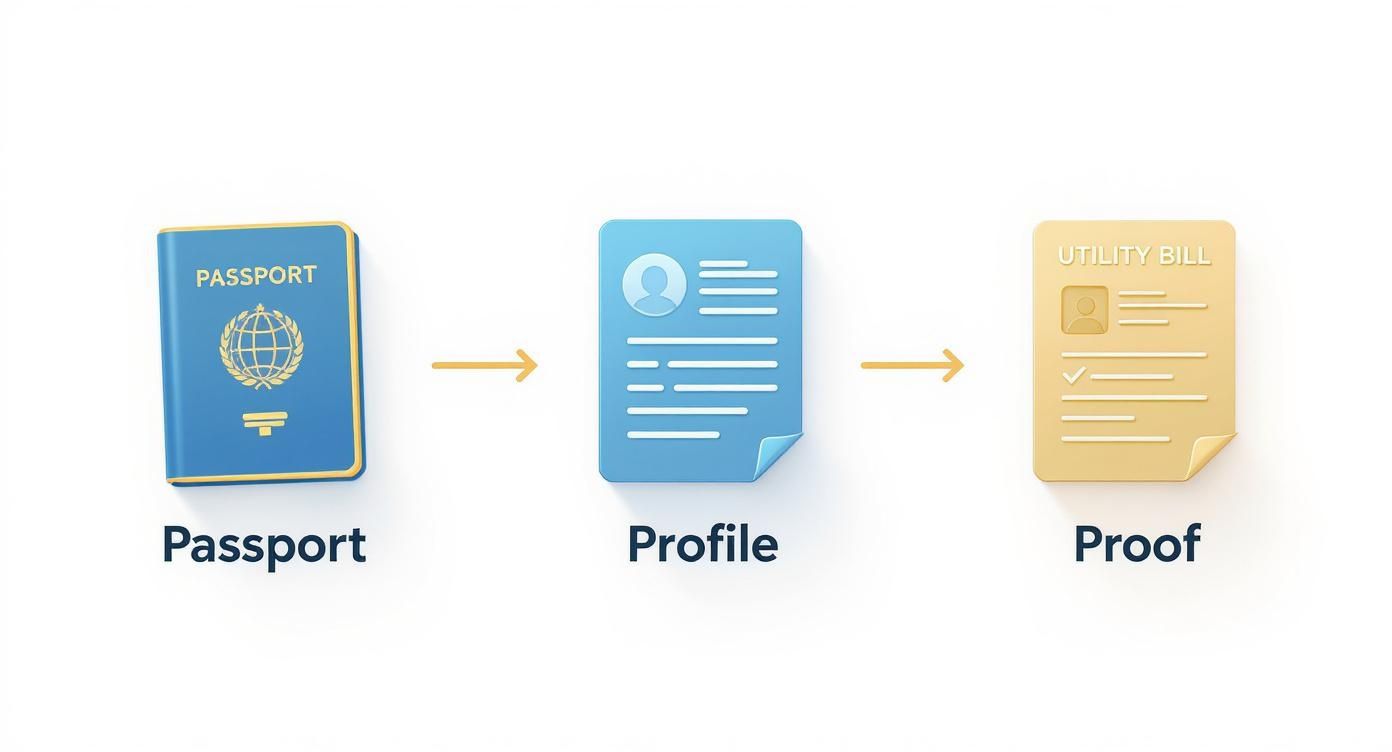
Essentially, the bank builds its initial picture of you from your passport, your professional background, and proof of where you live. This forms the foundation of their KYC checks.
How Long Does It Really Take?
This is probably the first question everyone asks. The honest answer? It depends on the account you want and how well you've prepared your paperwork. For a straightforward personal savings account, assuming everything is in perfect order, you're looking at a wait time of anywhere from two to four weeks.
Corporate accounts are a different beast altogether. They involve much deeper dives into the business itself—its activities, its ownership structure, and where it operates. For a corporate account, a timeline of four to eight weeks is far more realistic. This can sometimes stretch even longer if your business model is complex or has ties to multiple countries.
From our experience, the single biggest thing that slows down an application is missing or unclear information. Any grey area or question mark forces the compliance team to stop and ask for more details, which can add days, or even weeks, to the process. Being crystal clear and thorough from the start is the best way to speed things up.
The In-Person vs. Remote Experience
Traditionally, opening an account meant a trip to the bank to sign papers and meet a representative in person. This is still the simplest and often quickest way to get it done.
However, recognizing the needs of international clients, many banks now offer a remote opening process, which is a massive help.
If you go the remote route, here’s a snapshot of what to expect:
- A Video Call: This is a standard step for the bank to verify your identity face-to-face.
- E-Signatures: Most of the initial paperwork can be signed digitally.
- Courier Service: Some final, critical documents might still require a "wet" signature. You’ll need to send these originals via a trusted courier service.
While incredibly convenient, opening an account remotely can sometimes take a bit longer. Banks might also ask for a higher initial deposit for non-face-to-face applications. We can help point you toward the banks that have the most efficient remote onboarding systems. Our complete guide on how to open a bank account in the UAE dives deeper into these options.
The Source of Funds Hurdle
This is a big one. It's where we see a lot of applications get stuck. Banks are legally required to understand exactly where your money is coming from, especially the initial deposit. You need to provide them with a clear, logical, and provable story.
Just writing "from savings" on the form won't cut it. You have to be ready to back it up with evidence. For instance:
- Salary Slips: If your funds are from your employment income.
- Property Sale Agreement: If you’ve recently sold a house or apartment.
- Investment Portfolio Statements: To show gains from stocks, bonds, or other investments.
- Inheritance Documents: If the money was inherited from a family member.
Think of it as telling a clear story that your documents can easily confirm. A well-prepared source of funds statement makes the compliance team's job easier and can dramatically speed up your approval. Also, during this process, you’ll likely need a local phone number for various SMS verifications. A practical workaround for many non-residents is to rent virtual SMS numbers for verification to get past this step.
At the end of the day, this detailed process is in place for a good reason—it protects the integrity and security of the UAE's financial system, which ultimately benefits everyone. With the right preparation, it's a very manageable journey.
Common Mistakes and How to Avoid Them
Knowing the potential pitfalls when opening a Dubai bank account for non residents is half the battle won. The application process is meticulous for a reason, and even small, unintentional errors can lead to frustrating delays or an outright rejection.
From what we see every day, most issues fall into a few common categories.
The single biggest mistake? Submitting incomplete or improperly prepared paperwork. A bank's compliance team isn't looking for excuses; they need a perfectly organised file that ticks every single box. A missing signature, a blurry passport scan, or a forgotten attestation will bring the entire process to a grinding halt.
Navigating Strict Compliance Hurdles
Banks in the UAE operate under very strict Anti-Money Laundering (AML) and Know Your Customer (KYC) regulations. This isn't just internal policy—it's the law. They are required to be thorough, which means any grey area in your application is a major red flag.
Common compliance-related stumbles include:
- A Vague Source of Funds Statement: Just writing "personal savings" won't cut it. You need to provide a clear, verifiable story of where your money comes from, backed up with documents like salary slips, property sale agreements, or investment statements.
- Ties to High-Risk Jurisdictions: If your business activities or wealth are linked to countries on international high-risk lists, you should expect a much deeper dive from the bank. It’s critical to be completely transparent and provide extensive documentation to clarify your position from the start.
- Failing the Minimum Deposit Requirement: Non-resident accounts almost always have higher minimum balance requirements. Not meeting the initial deposit or letting the balance drop below the threshold soon after opening can lead to your new account being shut down.
We've seen applications get stuck for weeks over a simple source of funds letter that wasn't detailed enough. The key is to think like a compliance officer: provide a story that is both clear and easily proven by the documents you submit.
Misunderstanding Account Limitations
Another common trip-up comes from a simple misunderstanding of what a non-resident account can and cannot do. These accounts are built for savings and international transfers.
Expecting a cheque book or access to credit facilities like loans and credit cards is a frequent misconception that often leads to disappointment.
For business owners, trying to run corporate transactions through a personal non-resident account is a critical error. Banks monitor account activity very closely. Using a personal account for business is a direct violation of their terms and can result in your account being frozen or closed immediately.
The Power of Professional Guidance
Avoiding these mistakes really comes down to meticulous preparation and understanding the bank's perspective. This is precisely where getting professional help makes a world of difference.
Partnering with a specialist firm like PRO Deskk ensures your entire application package is flawless before it even gets to the bank. Our experts review every document, help you structure your source of funds statement for total clarity, and use our relationships with the banks to anticipate and solve potential compliance questions.
With our cost-effective business setup solutions and corporate PRO services, we remove the guesswork, making sure your application is positioned for a swift and successful approval.
Get Expert Help with PRO Deskk
Trying to open a Dubai bank account for non-residents can feel like navigating a maze. It’s definitely doable on your own, but the reality is that strict compliance checks, endless paperwork, and nuanced bank requirements can quickly become a headache. This is where bringing in a specialist like PRO Deskk makes all the difference.
We work with UAE banks every single day. That experience gives us a deep understanding of their internal processes and regulatory demands. More importantly, it means we have established relationships that help us get things done. We can often spot potential red flags in an application before they even become a problem, making sure your file is presented in the best possible light right from the start.
Your Partner in Banking and Business Setup
Think of us as your dedicated guide through the entire process. We offer:
✅ Specialists in Mainland Company Formation in Dubai, Sharjah & Abu Dhabi
✅ Specialists in Freezone Company Formation across the UAE
✅ Specialists in Golden Visa on Property and Investor Visa
✅ Specialists in Corporate PRO Services and Attestation Services
✅ 24/7 Support Service – Always here when you need us
✅ Cost-Effective Business Setup Solutions tailored to your needs
✅ Enjoy UAE Tax Benefits for International Entrepreneurs
Our integrated approach is especially useful if you're also in the process of a Mainland Company Formation in Dubai or a Freezone Company Formation across the UAE, as we can align your banking application with your business setup seamlessly.
At PRO Deskk, you’re not just hiring someone to fill out forms. You're getting a partner who is genuinely invested in helping you access all the UAE Tax Benefits for International Entrepreneurs, but without all the administrative friction.
A crucial part of any application is getting the paperwork properly legalised. Our team is well-versed in handling these official requirements. You can see how we manage this by looking into our professional documents clearing services—a vital component for any compliant submission.
And because questions can pop up at any time, our 24/7 Support Service means you're never left wondering. We're always here to offer clarity and guidance when you need it.
Ready to get your Dubai bank account opened without the hassle?
📞 Call Us Now: +971-54-4710034
💬 WhatsApp Us Today for a Free Consultation
Got Questions? We’ve Got Answers
Even with the most detailed guide, there are always a few specific questions that pop up. Here are some of the most common ones we hear from clients who want to open a Dubai bank account for non residents. Let's tackle them head-on.
Can I Really Open a Dubai Bank Account Remotely?
Yes, you can, and it's a popular option. Many of Dubai’s top banks have adapted their procedures for international clients who can't be here in person. But it's not quite a one-click process.
Going the remote route usually means a few extra steps:
- You'll likely need a higher initial deposit than if you were to apply at a branch.
- Get ready for a mandatory verification video call with a bank representative.
- In some instances, the bank might still require you to pop into a branch later on to provide a final "wet" signature on certain forms.
This is where having a partner on the ground makes a world of difference. At PRO Deskk, we know which banks offer the smoothest remote experience and can walk you through their specific verification requirements, making sure everything is handled correctly from the start.
How Long Does This Whole Process Take?
The timeline can really vary, and it almost always comes down to two things: the type of account you’re opening and how complete your paperwork is. Any delay is typically due to missing documents or follow-up queries from the bank's compliance team.
For a personal savings account, if all your documents are in perfect order, you're looking at about two to four weeks. A corporate account is a more involved affair, so you should budget for four to eight weeks for the bank to complete its due diligence and get the account fully active.
Are There Any Limits on International Money Transfers?
One of the biggest advantages of banking in the UAE is the lack of foreign exchange controls. You are completely free to transfer your funds anywhere in the world without restriction.
That said, every bank here is legally obligated to adhere to Anti-Money Laundering (AML) regulations. If you suddenly make a very large or unusual transfer, it could trigger a query from the bank. It's simply good practice to keep clear records of your major transactions so you can answer any questions quickly if they arise.
Is a UAE Residence Visa Absolutely Necessary?
To open a non-resident savings account, no, you do not need a UAE residence visa. These accounts are specifically designed for people without residency.
Just keep in mind the limitations. These accounts generally don't come with a cheque book or give you access to loans and credit cards. If you want a full-featured current account with all the perks, a UAE residence visa is a must. For corporate accounts, the company must be registered here, but the business owners themselves don't need to be residents.
Navigating the ins and outs of opening a bank account in Dubai is much simpler with an expert by your side. PRO Deskk specialises in company formation and banking assistance, offering cost-effective solutions tailored to your needs. With our 24/7 support and deep relationships with UAE banks, we ensure your journey is efficient and successful. Start your seamless business setup with PRO Deskk today.