
Getting a business license in Abu Dhabi is your first real step to launching a venture in the UAE's capital. It's more than just paperwork; it’s about choosing the right jurisdiction, defining your business activities, and getting the green light to operate legally in a city that's quickly becoming a global business powerhouse.
Why Abu Dhabi Is Your Next Business Destination
Entrepreneurs and international investors are flocking to Abu Dhabi, and it’s easy to see why. The emirate has successfully pivoted from its oil-rich past to build a dynamic, diversified economy. This isn't just talk—there are real, tangible opportunities here for everyone, from nimble tech startups to established multinational corporations.
Securing a business license in Abu Dhabi is your entry ticket into this thriving ecosystem. The city's commitment to creating a top-tier business environment shines through in its world-class infrastructure and supportive regulations. To get a real sense of the scale of this growth, you only need to look at the leading real estate developers in Abu Dhabi, whose projects mirror the boom happening in the commercial sector.
A Magnet for Entrepreneurs
The numbers speak for themselves. Abu Dhabi recently saw a massive 16% jump in new economic licenses on the mainland—a clear sign of its growing appeal. This surge is backed by high standards of transparency and governance that give investors confidence.
One of the most popular options, the 'Tajer Abu Dhabi' license for small and medium-sized businesses, saw a 20% increase. This license is a game-changer because it allows new businesses to start up without a physical office for the first three years. You can dig into the official numbers in recent government reports.
This pro-business approach offers some serious advantages:
- Strategic Location: Abu Dhabi is perfectly positioned as a logistical hub between East and West.
- Jurisdiction Choices: You have options. Set up on the Mainland, in a specialised Free Zone, or within the prestigious Abu Dhabi Global Market (ADGM). Each has its own distinct benefits.
- Tax Benefits: The UAE's tax environment is a major draw, featuring zero personal income tax and highly competitive corporate tax rates.
At PRO Deskk, we see these benefits play out every day. Our clients—whether they're solo investors going for a Golden Visa or large corporations needing complex document attestation—consistently tell us how Abu Dhabi's framework supports their long-term growth.
Making the right choice from the start is absolutely critical. A Mainland license gives you unrestricted access to the local market, while a Free Zone setup is ideal for international trade. These initial decisions shape your company's entire future, which is why getting expert guidance is so important.
With our deep expertise in company formation across all jurisdictions and our dedicated 24/7 support, PRO Deskk is here to help you navigate it all. We make sure your setup is smooth, cost-effective, and perfectly suited to what you need to succeed.
Choosing Your Business Jurisdiction: Mainland vs Free Zone vs ADGM
Picking the right jurisdiction for your business in Abu Dhabi is probably the single most critical decision you'll make at the start. It’s not just a box-ticking exercise; this choice fundamentally shapes your company's future, dictating everything from ownership structure and market access to your long-term growth potential.
It's about finding the perfect operational environment that aligns with your specific business model.
Let's move beyond abstract definitions and look at how this plays out in the real world. Imagine you're launching a high-end retail boutique in a popular mall. You absolutely need direct access to the local market, making a Mainland license the only practical choice.
Now, consider an international e-commerce business that warehouses products in the UAE and ships them globally. For them, the tax advantages and world-class logistics of a Free Zone are a massive advantage.
Finally, think of a fintech startup building a new payment gateway. They require a powerful regulatory framework that global financial institutions trust. In this scenario, the Abu Dhabi Global Market (ADGM), with its English common law system, offers the credibility and legal muscle needed to attract serious investors and partners.
The Mainland Advantage: Unrestricted Market Access
Setting up on the Abu Dhabi Mainland means your business is registered directly with the Department of Economic Development (DED). The biggest draw here is the complete freedom to trade across the entire UAE market. You can open multiple branches wherever you like and bid on valuable government contracts without any restrictions.
In the past, this route always required a local Emirati sponsor. However, recent reforms have been a complete game-changer, now allowing 100% foreign ownership for a huge list of business activities. This has thrown the doors wide open for international entrepreneurs to take full control of their ventures.
A mainland setup is the perfect fit for:
- Physical businesses like retail shops, restaurants, and medical clinics.
- Consultancies and service providers who target local companies and government entities.
- Trading businesses that need to distribute goods throughout the UAE.
If your primary customer base is within the Emirates, the mainland is often the most strategic path forward. You can get a more detailed look at the specifics of business setup in Abu Dhabi to see if this option aligns with your goals.
The Power of Free Zones: A Global Business Hub
Abu Dhabi's free zones are designated economic areas that offer a unique package of benefits, tailored mainly for businesses engaged in international trade or specific industries. Think of them as self-contained ecosystems with their own rules and regulations, separate from the mainland. Their primary appeal lies in the powerful incentives they offer.
The core benefits of a Free Zone license are hard to ignore: 100% foreign ownership is standard, you get full repatriation of profits and capital, and you are exempt from import and export duties. This creates a highly efficient, low-tax environment for international operations.
This flowchart offers a simple way to visualise which path might be the best for your business.
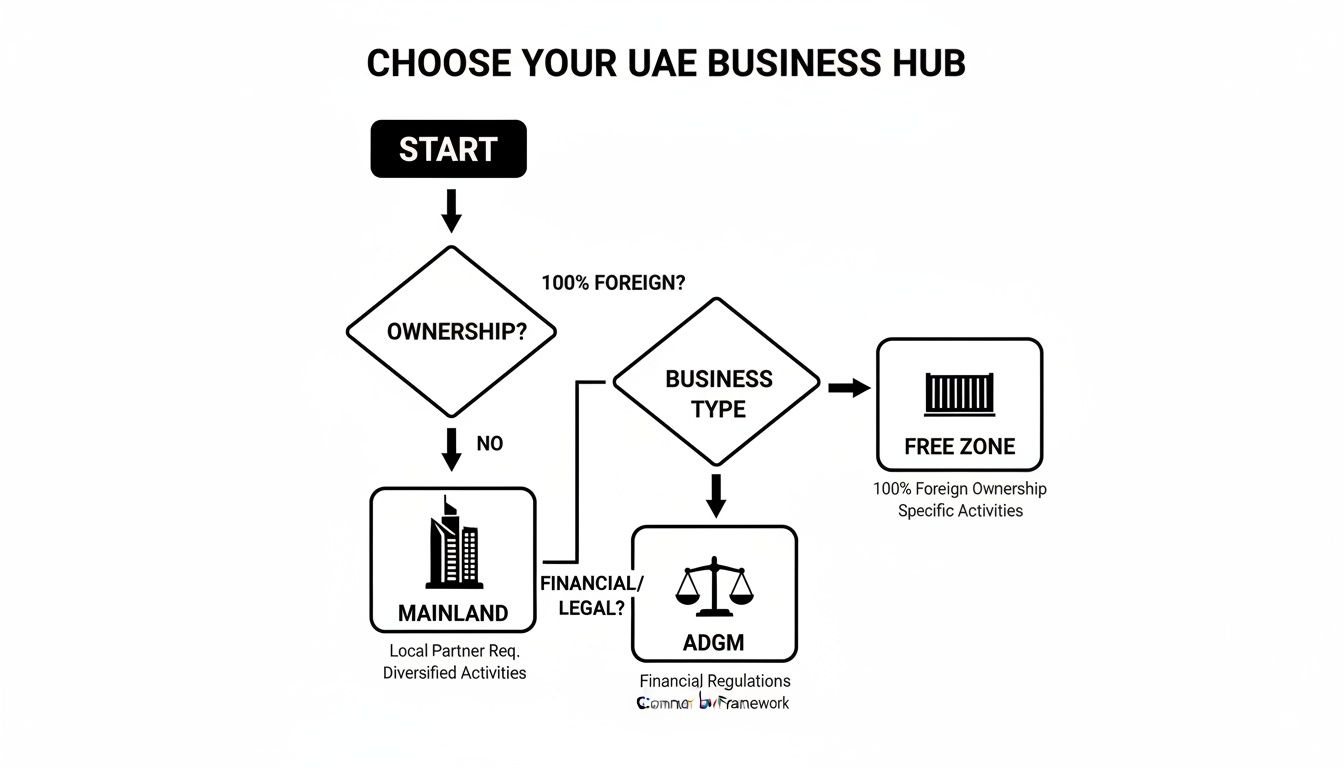
As you can see, the decision really comes down to your target market and business activities.
Many free zones are also themed around a particular industry, creating a dynamic community of like-minded businesses. For instance, Masdar City is a hub for sustainability and renewable energy, while KIZAD focuses on industrial and logistics operations. Working with experts like PRO Deskk can help you pinpoint the ideal free zone that provides the most cost-effective solution for your sector.
Jurisdiction Showdown: Abu Dhabi Mainland vs Free Zone vs ADGM
To make the choice clearer, let's break down the key differences in a simple, side-by-side comparison.
| Feature | Mainland | Free Zone (General) | ADGM (Financial Free Zone) |
|---|---|---|---|
| Ownership | Up to 100% foreign ownership for most activities. | 100% foreign ownership is standard. | 100% foreign ownership. |
| Market Access | Unrestricted access to the entire UAE market. | Trade is limited to within the free zone and internationally. A local agent is needed for mainland trade. | Operates as an offshore financial centre. Specific rules for engaging with the UAE market. |
| Office Space | Physical office space is usually required. | Flexible options, including flexi-desks and virtual offices. | Requires a registered office address within ADGM. |
| Legal Framework | UAE Federal Law. | Governed by the rules of the specific free zone authority. | Independent jurisdiction based on English Common Law. |
| Best For | Retail, trading, services targeting the local UAE market. | Import/export, international trade, specific industry clusters (e.g., media, tech). | Financial services, asset management, fintech, legal services, holding companies. |
This table highlights the core distinctions, showing that the "best" jurisdiction is entirely dependent on your business's needs and ambitions.
ADGM: The International Financial Centre
The Abu Dhabi Global Market (ADGM) is in a league of its own. It’s not just a free zone; it's an international financial centre built on an independent legal system derived from English common law. This structure makes it incredibly appealing to global financial institutions, investors, and high-net-worth individuals who need a familiar and robust legal environment.
Its growth has been nothing short of explosive. ADGM recently shattered records by surpassing 11,000 active licenses, cementing its position as the largest international financial centre in the MENA region. In just six months, nearly 1,900 new licenses were issued—a staggering 47% year-on-year increase. This ecosystem is a powerhouse, home to hundreds of major banks and asset managers alongside thousands of non-financial firms.
Choosing ADGM is a strategic move for:
- Financial services firms like asset managers, banks, and fintech companies.
- Law firms and professional service providers that operate under common law.
- Holding companies and special purpose vehicles (SPVs) for international investments.
Ultimately, the choice between Mainland, Free Zone, and ADGM comes down to your business goals. A clear analysis of your target market, operational needs, and long-term vision is the essential first step to securing the right business license in Abu Dhabi.
From A to Z: A Step-by-Step Guide to Getting Your Licence
Getting a business licence in Abu Dhabi can feel like a mountain to climb, but it's really more of a clear path with distinct milestones. If you break it down, you'll see a logical sequence of steps. Each one, from defining your company's purpose to finally holding your trade licence, builds on the last.
The entire journey is designed to make sure your new venture is compliant, properly structured, and ready to operate within the emirate’s legal framework. By understanding this roadmap, you can turn a potentially daunting task into a manageable project.
Laying the Groundwork: Business Activity and Legal Form
Before you even think about filling out an application, two foundational decisions need to be made. These choices will dictate your entire setup process.
First, you have to be crystal clear about your business activities. The Abu Dhabi Department of Economic Development (ADDED) has a massive list of over 4,000 approved activities. Your choice here directly determines the licence type you’ll need—commercial, professional, industrial, or something else entirely.
For example, a business selling electronics will need a commercial licence. A firm offering IT consulting, on the other hand, falls under a professional licence. It's vital to get this right from the start, as some activities require special pre-approval from specific government ministries.
Next up is choosing a legal structure. This decision defines your company's legal identity and, importantly, its liability. Some common options you'll see are:
- Sole Proprietorship: Owned and run by one person.
- Limited Liability Company (LLC): By far the most popular choice for SMEs, as it protects the owners from business liabilities.
- Branch of a Foreign Company: An extension of an existing international business.
Opting for an LLC, for instance, shields your personal assets from any business debts—a critical safety net for most entrepreneurs. Here at PRO Deskk, we help you analyse your business model to pick the perfect legal form, setting you up for long-term success.
Getting Your Name and the Initial Go-Ahead
With your activity and legal form sorted, it's time to secure your company's identity. This kicks off with reserving a trade name. Your chosen name must be unique and follow UAE naming conventions—nothing offensive, no religious references, and it can't already be taken.
Once your name is approved, you'll apply for Initial Approval. Think of this as a preliminary nod from the authorities, confirming they have no objection to your business idea. This document is essential; without it, you can't move on to drafting official contracts or leasing an office.
The Initial Approval is your green light. It means the government has looked at your concept and given you the preliminary thumbs-up to formalise your structure and find a physical location.
Drafting Your Core Documents and Finding a Home
This is where your business really starts to take shape, both on paper and in the real world. For most structures, especially an LLC, you'll need to draft a Memorandum of Association (MOA). This is the company's constitution, detailing everything from ownership structure and share capital to business objectives.
The MOA must be notarised by a public notary in the UAE. This step is incredibly meticulous, and a single error can cause major delays. At the same time, you have to secure a registered office address. For most mainland licences, this involves leasing a physical office and registering the tenancy contract through Abu Dhabi's Tawtheeq system. This registered lease is your non-negotiable proof of a physical presence.
Having an expert partner to handle these administrative hurdles is a game-changer. The process of getting documents in order—from attestation to translation—is incredibly time-consuming. PRO Deskk's expertise in documents clearing services makes sure every paper is correctly prepared, notarised, and submitted, helping you dodge the common errors that bring applications to a halt.
The Final Stretch: Submission and Licence Issuance
You've got all your documents lined up: the Initial Approval, notarised MOA, and your registered tenancy contract. Now you're ready for the final submission. This complete package goes to the relevant authority—either ADDED for a mainland company or the specific free zone authority.
At this stage, government departments conduct a final, thorough review of your application. If everything is in order, they'll issue a payment voucher. Once you settle this payment, your official business licence is issued.
This licence is the key that unlocks everything. It legally permits you to operate in Abu Dhabi, allowing you to open a corporate bank account, sponsor employee visas, and officially start trading. With our corporate PRO services, we handle the direct liaison with government bodies for you, giving you real-time updates and making sure your application moves as swiftly as possible.
Required Documents and Realistic Cost Breakdowns
Getting your business license in Abu Dhabi really boils down to two things: having your paperwork in order and having a clear budget. Nail these, and you'll avoid the common delays and surprise costs that can derail an otherwise solid business plan. This is where the theoretical part ends and the practical steps begin.
Navigating the documentation is all about precision. A single missing document or an incorrectly attested paper can bring your entire application to a screeching halt. That’s where our experience with corporate PRO services really pays off—we make sure every detail is perfect before it's submitted. Likewise, a fuzzy budget is a recipe for disaster. We believe in total transparency, breaking down every potential cost so you know exactly what to expect.
Your Definitive Document Checklist
The exact list of paperwork can shift a bit depending on whether you choose the Mainland or a Free Zone, and what your company's legal structure is. Still, there's a core set of documents you'll need for almost any application.
For individual entrepreneurs and shareholders:
- Passport Copies: A clear, valid copy for every single shareholder, partner, and manager involved.
- UAE Visa Page and Emirates ID: If you're already a UAE resident, these are non-negotiable.
- Entry Stamp or Visit Visa: Needed for any non-resident shareholder who is physically in the UAE while the application is being processed.
- Proof of Address: A recent utility bill works perfectly here to verify the home address of each shareholder.
For corporate shareholders (if another company will own shares):
- Certificate of Incorporation: This needs to be attested by the UAE Embassy in its country of origin.
- Certificate of Good Standing: This shows that the parent company is compliant and in good standing back home.
- Memorandum of Association (MOA): The parent company’s foundational legal document, which also requires attestation.
- Board Resolution: A formal document from the parent company's board that explicitly approves setting up the new entity in Abu Dhabi.
Getting every document correctly prepared and attested is an absolute must. Our team handles this intricate process, coordinating with embassies and ministries to guarantee your corporate papers are 100% compliant with UAE regulations.
Demystifying the Costs of Your Abu Dhabi License
"So, what's the real cost?" It's the first question on everyone's mind. The truth is, there's no single magic number. Your final investment is a mix of your license type, jurisdiction, office needs, and the number of visas you require.
Instead of giving you a vague estimate, let’s break down the components that make up the total figure. This way, you can see exactly where your investment is going.
Here's a clearer picture of the potential expenses you'll encounter when setting up your business in Abu Dhabi, comparing Mainland and Free Zone options side-by-side.
Estimated Costs for an Abu Dhabi Business License
| Cost Component | Mainland (Approx. AED) | Free Zone (Approx. AED) | Notes |
|---|---|---|---|
| Trade Name Reservation | 600 – 2,000 | 500 – 1,500 | Cost varies based on name type (e.g., foreign names may cost more). |
| Initial Approval | 150 – 500 | Included in package | A mandatory step to confirm the business activity is permitted. |
| License Issuance Fee | 5,000 – 15,000 | 8,000 – 25,000+ | The core government fee, dependent on the business activity and legal form. Free Zone fees are often part of a package. |
| Office/Lease Agreement | 15,000 – 50,000+ (Annual) | 5,000 – 20,000+ (Annual) | Mainland often requires a physical office with Tawtheeq. Free Zones offer cost-effective flexi-desks or shared offices. |
| Establishment Card | 600 – 1,000 | 600 – 2,000 | Required for visa processing. |
| Visa per Person | 4,000 – 6,500 | 3,500 – 6,000 | Includes medical test, Emirates ID, and visa stamping. Price varies based on standard vs. investor visa. |
| PRO & Setup Services | 3,000 – 10,000 | 2,500 – 8,000 | Professional fees for managing the entire setup process. |
| Notary/Attestation Fees | 500 – 2,500 | 500 – 2,500 | For legalising documents like the Memorandum of Association (MOA). |
This table provides a solid baseline, but keep in mind that these are estimates. Your specific business activity and operational needs will ultimately determine the final costs.
For certain ventures, especially in hospitality, using a specialised tool like a restaurant startup costs calculator can be incredibly helpful for projecting your initial capital needs.
At PRO Deskk, we create tailored packages that bundle these services into a single, transparent price. We make sure there are no hidden fees, giving you a clear financial roadmap from the very start.
Life After Your License: The Real Work Begins
Getting your business license in Abu Dhabi is a huge milestone, but it’s really just the starting line. Think of it as the key to your new office; now you have to furnish it, hire your team, and actually open for business. The next few steps are all about turning that piece of paper into a living, breathing, and compliant company.
This is where many entrepreneurs get bogged down in the details. Suddenly, you’re dealing with banks, visa applications, and ongoing legal duties. It’s a lot to handle, but if you tackle it systematically, you can move smoothly from setup to full-scale operation.
Getting Your Business Up and Running
The absolute first thing you need to do is open a corporate bank account. You can't operate a business without one. In the UAE, your trade license is the main document banks will ask for just to start the conversation. A dedicated business account is critical for managing your money, taking payments, and keeping a clean line between your personal and company finances.
The process isn't always straightforward. Banks have a long list of required documents—trade license, Memorandum of Association, shareholder passports, and more. We help our clients cut through the red tape by tapping into our long-standing relationships with major UAE banks, making the whole process much quicker.
Next up: visas. Your new business license is your ticket to sponsoring residency for yourself, your staff, and your family.
- Investor Visa: This secures your own residency as the business owner.
- Employment Visas: You'll need these to legally hire your team.
- Family Visas: This allows you to bring your spouse and children to live with you in the UAE.
For investors and high-net-worth individuals, we also handle the prestigious Golden Visa application, which offers long-term residency with some fantastic perks. Our team takes care of the entire visa journey, from the initial application and medical tests right through to getting the final stamp in the passport.
Staying Compliant and Renewing Your License
Running a business in Abu Dhabi means keeping up with a few ongoing responsibilities. If you let these slip, you could face fines or even have your operations suspended, so it’s important to stay on top of them.
A major new requirement is Corporate Tax. Every business in the UAE now has to register for Corporate Tax with the Federal Tax Authority (FTA). You need to understand what’s required of you and register on time to avoid penalties. For a clear breakdown, take a look at our guide on how to register for corporate tax in the UAE.
Remember, your business license isn’t a one-and-done deal. You have to renew it every year. This means submitting updated documents, like your renewed office lease (Tawtheeq), and paying the government renewal fees.
This annual renewal is non-negotiable for keeping your business legal. On the bright side, the government's push to diversify the economy is constantly opening up new doors for investors. For example, Abu Dhabi's agriculture and fisheries sector recently saw a 29% jump in new licenses, fueled by food security initiatives. The Al Ain Region is a hotbed for this growth, grabbing 61.8% of these new licenses. It's a perfect example of how government strategy creates real opportunities on the ground, a trend noted in a recent Abu Dhabi Media Office report.
Your Partner for the Long Haul
This is exactly where PRO Deskk’s 24/7 support and corporate PRO services really shine. We don't just hand you a license and walk away; we stick around to help you manage all these essential tasks.
We’ll handle your annual license renewals, process all your employee visas, and send you reminders for important compliance deadlines. We become your outsourced admin team, freeing you from the paperwork so you can put 100% of your energy where it belongs: growing your business in Abu Dhabi's exciting market.
Your Top Questions About Abu Dhabi Business Licences, Answered
Starting a new business, especially in a new country, naturally brings up a lot of questions. When it comes to setting up in Abu Dhabi, we find that most entrepreneurs have the same core concerns—how long will it take, can I own it all myself, and what do I actually need to get started?
Here, we'll tackle the most common queries we get every day. Think of this as straight-to-the-point advice from people who've been through this process countless times.
How Long Does It Take to Get a Business Licence in Abu Dhabi?
Honestly, the timeline can vary quite a bit. It’s not a simple, fixed process and really depends on your chosen jurisdiction and the specific activity you're undertaking. If you're going for a straightforward Mainland licence and all your documents are perfectly in order, it can be surprisingly fast—sometimes just a few days, or up to two weeks.
Free Zones are well-known for their efficiency and can often issue licences even quicker. The main thing that can extend the timeline is the need for external approvals. If your business is in a sector like healthcare or education, you'll need a green light from a specific ministry, and that just takes more time.
At PRO Deskk, our job is to map out this entire journey for you. We know where the potential delays are, so we make sure every piece of paper is flawless before it's submitted. This lets us give you a realistic timeline you can actually plan around.
Can a Foreigner Have 100% Ownership of a Business in Abu Dhabi?
Yes, you absolutely can. This is one of the biggest and most welcome changes to UAE business law in recent years. For a massive list of over 1,000 commercial and industrial activities on the Abu Dhabi Mainland, 100% foreign ownership is now the standard. This change did away with the old requirement of needing a UAE national sponsor for most types of businesses.
And in Abu Dhabi's free zones, like ADGM and Masdar City, 100% foreign ownership has always been one of the main attractions. Our consultants will dig into your business model to confirm if your activity is on the list for full ownership on the mainland, or if a free zone setup makes more strategic sense for you.
What Is the Difference Between a Commercial and a Professional Licence?
Getting this right is crucial because it dictates your company's entire legal structure. A commercial licence is for any business that involves trading—basically, buying and selling goods. This covers everything from a small retail shop to a large-scale import-export operation or an e-commerce store.
A professional licence, on the other hand, is for businesses and individuals who provide services based on their expertise. We’re talking about consultants, designers, IT specialists, or skilled artisans. The key legal difference often comes down to liability and the ownership rules. We’ll help you pinpoint the exact licence category that matches what you do, so you're fully compliant from day one.
Do I Need a Physical Office for My Abu Dhabi Licence?
Whether or not you need a physical office really comes down to your jurisdiction and business type. Several free zones have brilliant, flexible options like flexi-desks or virtual office packages. These are a great way to meet the legal requirement for a registered address without the high overheads, making them perfect for startups and solo entrepreneurs.
On the Mainland, the popular 'Tajer Abu Dhabi' licence allows certain businesses to operate without a physical office for the first three years. However, for most mainland companies—especially if you plan on sponsoring employee visas—you'll need a registered physical office lease. This is officially recorded through the Tawtheeq system. Our specialists at PRO Deskk can point you towards a compliant, budget-friendly office solution that fits your real-world needs.
At PRO Deskk, we're more than just consultants; we're your dedicated partners for success in the UAE. Our expertise covers every aspect of your business journey.
✅ Specialists in Mainland Company Formation in Dubai, Sharjah & Abu Dhabi
✅ Specialists in Freezone Company Formation across the UAE
✅ Specialists in Golden Visa on Property and Investor Visa
✅ Specialists in Corporate PRO Services and Attestation Services
✅ 24/7 Support Service – Always here when you need us
✅ Cost-Effective Business Setup Solutions tailored to your needs
✅ Enjoy UAE Tax Benefits for International Entrepreneurs
📞 Call Us Now: +971-54-4710034
💬 WhatsApp Us Today for a Free Consultation