
Think of an Abu Dhabi trade license as your company's official passport to do business in the UAE's capital. It’s the government-issued permit that makes it legal for you to operate, opening the door to one of the world's most dynamic and business-friendly economies.
Your Essential First Step into Abu Dhabi's Market
Jumping into a business venture in Abu Dhabi is exciting. You're looking at a strategic global location, incredible infrastructure, and policies built to help investors succeed. But before any of that, the single most critical step is securing the right trade license. This isn't just a piece of paper; it’s the legal backbone of your entire company.
This official permit comes from one of two places: the Abu Dhabi Department of Economic Development (ADDED) if you’re setting up on the mainland, or a specific free zone authority. Your choice between these two jurisdictions—Mainland or Free Zone—is a big one, as it will define everything from your company’s ownership structure to where you can operate and who you can sell to.
Understanding the Core Components
The whole journey starts with pinning down exactly what your business will do. This core activity determines the type of license you'll need. While there are countless specific business activities you can choose from, they all generally fall into three main categories. Each is tailored for a different kind of business, ensuring everyone is properly regulated.
- Commercial License: This is for any business focused on trading—buying, selling, importing, or exporting goods.
- Professional License: If you're offering services or your expertise, this is the one for you. Think consultants, designers, accountants, and other skilled professionals.
- Industrial License: This license is required for any business involved in manufacturing, production, assembly, or processing raw materials into finished goods.
Choosing the right license and jurisdiction from the very beginning is absolutely critical. Getting this wrong can box you in operationally, lead to surprise costs, and cause major delays. It basically sets the entire course for your company's legal and financial future here in the UAE.
Why Expert Guidance Matters
Getting your license isn't a one-step process. You'll need to navigate trade name reservations, initial approvals, document attestations, and the final submission. Each part has its own set of rules and common traps. This is exactly why bringing in a company formation specialist is such a smart move. For a deeper dive into the whole process, have a look at our complete guide on business setup in Abu Dhabi.
A good PRO team turns what can be a confusing, multi-step procedure into a smooth and efficient launch. Once you’ve successfully sorted out your trade license, the next natural step for many is getting online. For great advice on that, you can learn how to start an e-commerce company. By letting experts handle the complex paperwork for you, you’re free to concentrate on what you do best—building your business and taking full advantage of the UAE's pro-business environment right from day one.
Choosing the Right Type of Trade License
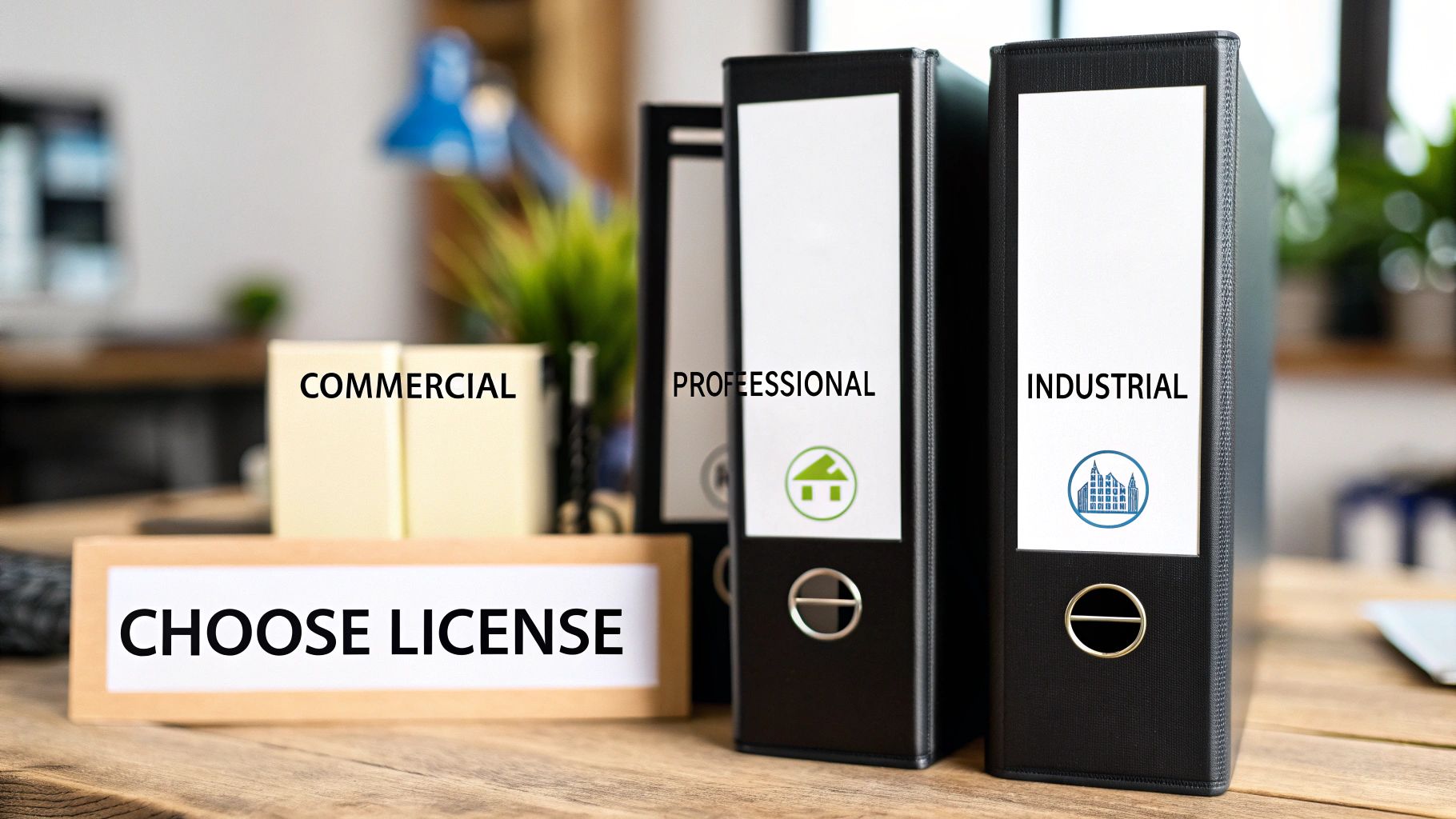
Picking your Abu Dhabi trade license isn't just a box-ticking exercise; it's the single most important decision you'll make right after deciding to set up shop here. Think of it like choosing the right tool for a very specific job. You wouldn’t use a hammer to saw wood, right? In the same way, your license has to perfectly match what your business actually does.
Getting this wrong can cause all sorts of problems, from operational roadblocks to unexpected costs and regulatory headaches nobody wants. Your core business function determines the category you fall into. Abu Dhabi's system is built to make sure every company—whether it's selling goods, offering expert services, or manufacturing products—operates under the proper legal framework.
Let's break down the main categories to help you find your perfect fit.
The Commercial License: Your Merchant’s Passport
Picture your business as a merchant ship, sailing the globe to buy goods in one port and sell them in another. The Commercial License is your official passport to do just that. It's the essential permit for any company involved in buying, selling, or moving goods.
This license covers a massive range of activities, making it one of the most popular choices for entrepreneurs. Key activities under a Commercial License include:
- General Trading: Buying and selling a wide variety of goods.
- Import and Export: Bringing products into the UAE or shipping them out to international markets.
- Retail and E-commerce: Selling directly to customers, whether from a physical shop or an online store.
- Real Estate Brokerage: Facilitating property sales and leases.
If your business revolves around tangible products, this is almost certainly the license you need. It’s your legal key to managing inventory, handling logistics, and diving headfirst into Abu Dhabi’s dynamic trade economy.
The Professional License: A Specialist's Credential
Now, what if your business isn't about goods, but about your expertise? The Professional License is your specialist's credential, officially validating your right to offer services based on your unique skills, education, or craft.
This license is specifically designed for service-based businesses and individual practitioners like consultants, artisans, and technicians who monetise their knowledge. Unlike a commercial license, the focus is squarely on intellectual or manual labour, not physical products.
This license is a favourite among international entrepreneurs because, even on the mainland, it often allows for 100% foreign ownership. This is done by appointing a Local Service Agent (LSA), who simply acts as your representative for government paperwork but holds no shares or decision-making power in your company.
Examples of businesses that need a professional license include:
- IT and Management Consultancy
- Marketing and Advertising Agencies
- Legal and Accounting Firms
- Educational and Training Institutes
- Medical Clinics and Salons
The Industrial License: The Manufacturer's Blueprint
For anyone who creates, assembles, or transforms raw materials into finished products, the Industrial License is the essential 'manufacturer's blueprint.' This license is for the makers and innovators physically building something new within the emirate.
Getting an Industrial License is a more involved process. It requires approvals from various government bodies, including the Ministry of Economy and civil defence, to ensure all safety and environmental standards are met. This license is the foundation for setting up factories, workshops, and production plants, empowering you to contribute to Abu Dhabi's expanding industrial sector.
The broader UAE has seen an explosion in business formation, with over 1.5 million active commercial licenses now on record—a historic high. This growth, fuelled by digital transformation and new legal frameworks, highlights the country's appeal as a top-tier business destination. You can discover more about the UAE's thriving business environment on dubai-businesscapital.com.
To help you visualise the differences, here’s a quick comparison of the mainland license types.
Abu Dhabi License Types at a Glance
This table offers a comparative overview of mainland licence types to help you choose the right one for your business activities.
| Licence Type | Primary Business Activities | Key Feature | Best For |
|---|---|---|---|
| Commercial | Trading, import/export, retail, e-commerce, real estate. | Covers the buying and selling of physical goods. | Entrepreneurs in trade, retail, and logistics. |
| Professional | Consultancy, services, crafts, IT, marketing, education. | Based on individual skills and expertise. | Service providers, consultants, and skilled artisans. |
| Industrial | Manufacturing, production, assembly, processing. | Involves the physical creation of products from raw materials. | Businesses setting up factories or production plants. |
Choosing the right license from the start ensures your business is built on a solid legal foundation, ready for growth in Abu Dhabi.
A Note on Free Zone Licenses
Finally, it's important to touch on Free Zone Licenses. These aren't a separate category like Commercial or Professional. Instead, think of them as a jurisdictional version of those licenses.
You'll still be issued a Commercial, Professional, or Industrial license, but it will be governed by the specific rules of a free zone, like ADGM or Masdar City. These zones offer incredible benefits like 100% foreign ownership for all license types, full repatriation of profits, and exemption from customs duties, making them a magnet for international businesses.
Mainland vs Free Zone: Deciding Where to Operate
Choosing where to set up your business in Abu Dhabi is one of the most important decisions you'll make. It’s a bit like deciding between opening a shop right in the middle of a bustling city centre, with access to every customer walking by (that’s the Mainland), or setting up in a specialised, high-tech business park designed for international trade (that’s a Free Zone).
This choice goes right to the heart of your Abu Dhabi trade license. It will shape everything from who you can do business with to your company's ownership structure and how you can grow. A Mainland license plugs you directly into the UAE’s local economy, while a Free Zone license is your ticket to the global stage from day one.
The Mainland Advantage: Access to the Entire UAE Market
Setting up a Mainland company is the traditional path and gives you the most direct route to doing business right here in the UAE. This license, issued by the Abu Dhabi Department of Economic Development (ADDED), gives you the complete freedom to trade anywhere across all seven emirates without any restrictions.
The biggest plus? Unbeatable market access. You can rent an office anywhere you like in Abu Dhabi, work with any other company in the UAE, and—crucially—bid on lucrative government contracts. If your plan is to serve the local community or partner with other UAE-based businesses, going Mainland is almost always the best move.
- Unrestricted Trading: You can do business anywhere in the UAE without needing a local agent to act on your behalf.
- Government Projects: This is a big one. Only Mainland companies can bid on and win valuable contracts from government and semi-government bodies.
- Geographical Freedom: You have the liberty to set up your office or shop in any of Abu Dhabi's commercial districts.
This direct connection to the local market is the real power of a Mainland license. It lets you build a strong local brand and become a genuine part of the UAE’s economic landscape.
The Free Zone Powerhouse: Built for Global Business
Free Zones, on the other hand, are special economic areas created specifically to attract foreign investment. They play by their own rules and regulations, separate from the Mainland's legal system. Think of them as self-contained business hubs, each one often focused on particular industries like media, tech, or finance.
For international entrepreneurs, the benefits are huge, especially when it comes to ownership and finances:
- 100% Foreign Ownership: You keep full control of your business. There’s no need for a local Emirati partner, which is a major draw for investors from around the world.
- Tax Exemptions: You can benefit from 0% corporate and personal income tax, a powerful way to maximise your profits.
- Customs-Free Environment: With zero customs duties on imports and exports, it's the perfect setup for businesses involved in international trade.
- Full Repatriation of Profits: You are completely free to send 100% of your capital and profits back to your home country.
Free Zones are purpose-built to make international business as straightforward as possible. With their streamlined paperwork, top-notch infrastructure, and industry-specific networking events, they offer a powerful launchpad for global growth.
A perfect example of this is Abu Dhabi’s financial centre, the Abu Dhabi Global Market (ADGM). It has exploded in popularity to become the largest international financial hub in the MENA region, with its total number of active licenses now soaring past 11,000. This incredible growth is thanks to its pro-business environment and its unique status as the only jurisdiction in the region that directly applies English Common Law. You can read more about ADGM's remarkable expansion on adgm.com.
While Free Zone companies are generally meant to operate within their zone or internationally, many modern free zones offer more flexible options these days. For a deeper dive into what's possible, you can explore our guide on a UAE Free Zone business setup. Getting expert advice is key to navigating these differences and picking the right spot. At PRO Deskk, we handle both Mainland and Free Zone setups all the time, making sure you choose the path that truly fits your vision.
The Step-By-Step Licence Application Process
Getting your Abu Dhabi trade licence might feel like a huge, complicated puzzle at first. But the best way to look at it is as a straightforward journey with clear, sequential steps. When you break it down into manageable chunks, the path to launching your business becomes much easier to navigate.
Think of it like building a house. You can’t put up the walls before you’ve poured the foundation. In the same way, each step in the licence application builds on the one before it, making sure your business has a rock-solid legal structure.
The following infographic lays out the two main pathways for setting up in Abu Dhabi—one for the mainland and one for the free zones.
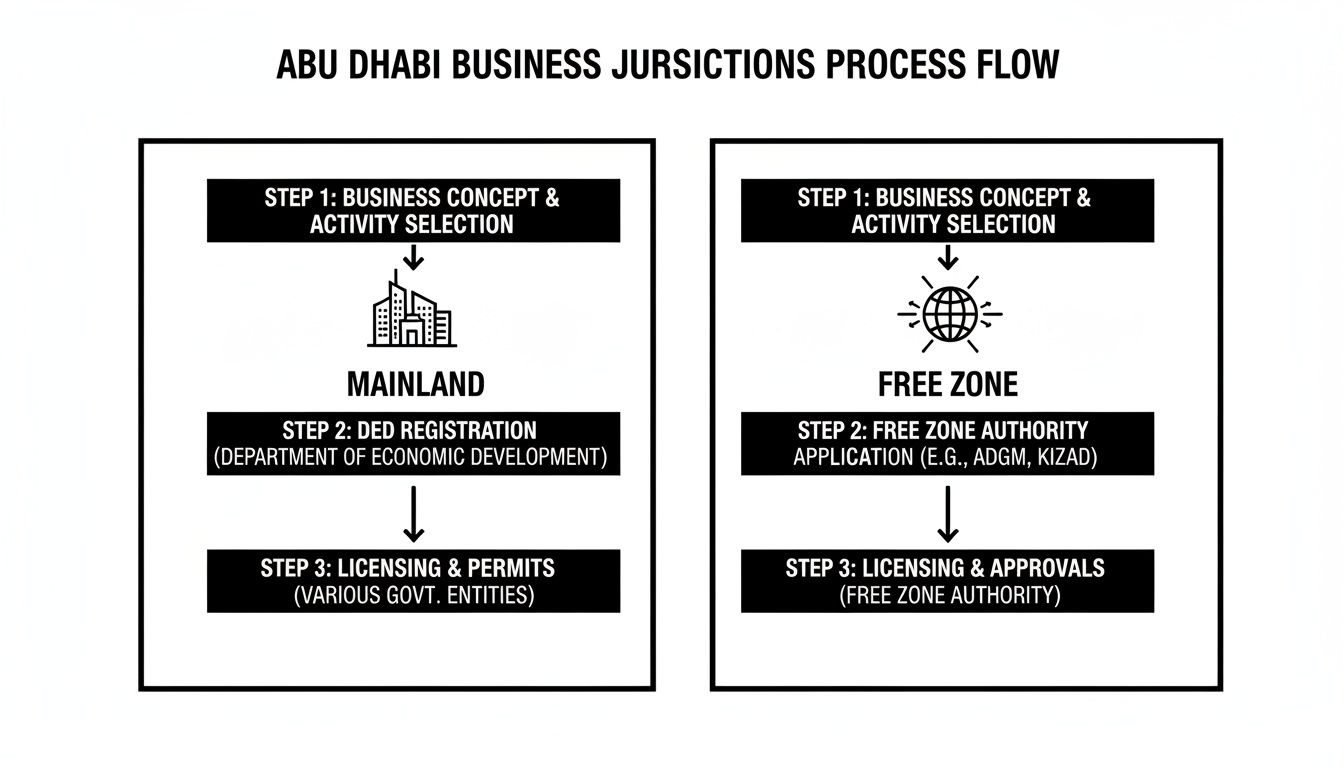
As you can see, while both routes share foundational steps like choosing an activity and a name, the authorities you deal with and the final requirements are different. This really highlights how important it is to pick the right path from the very beginning.
Step 1: Finalise Your Business Activities and Legal Form
Before you do anything else, you need to decide exactly what your business will do. Are you trading goods, offering consultancy services, or manufacturing products? The Abu Dhabi Department of Economic Development (ADDED) has a list of over 2,000 approved activities to choose from. Your choice here directly shapes what kind of licence you'll get (Commercial, Professional, or Industrial).
Next up is selecting a legal structure, which defines how your business is owned and operates. Common options include a Sole Proprietorship, a Limited Liability Company (LLC), or a branch of a foreign company. This is a critical decision, as it has major implications for ownership, liability, and future compliance.
Step 2: Reserve Your Unique Trade Name
Your company's name is its identity. In Abu Dhabi, it must be completely unique and follow specific naming rules. The name can't violate public morals, include religious or political references, or be the same as an existing local or global brand.
You’ll submit your proposed names through the ADDED portal or your chosen free zone authority. Once one is approved, the name is reserved for you, clearing the way for the next stages of your application.
Step 3: Secure Initial Approval
Think of the Initial Approval as a preliminary green light from the authorities. It confirms they have no objection to you setting up your business and is essential before you can start drafting legal documents or signing office leases.
This step is like getting pre-approved for a mortgage; it doesn't mean you own the house yet, but it signals that you're on the right track and can start finalising the major commitments. It essentially validates your business concept in the eyes of the regulators.
This approval is a must-have to continue the process, especially if your business activity needs special permissions from other bodies, like the Health Authority or the Ministry of Education.
Step 4: Prepare Your Legal Documents
With your initial approval secured, it's time to prepare and notarise your company’s core legal documents. The most important of these is the Memorandum of Association (MOA). For sole proprietorships, this would be a Local Service Agent (LSA) agreement instead.
The MOA is a detailed document that outlines:
- The names and details of all shareholders.
- The ownership structure and how share capital is distributed.
- The company’s objectives and business activities.
- The management structure and how profits or losses are shared.
This document has to be drafted in both Arabic and English and then notarised by a UAE notary public. Since it’s the legal charter of your company, getting it right is crucial. This is where a corporate PRO service can be invaluable, ensuring your MOA is drafted perfectly to head off any future disputes.
To help you stay organised, here's a quick rundown of the key paperwork you'll be gathering.
Document Checklist for Abu Dhabi Trade Licence Application
| Document Type | Purpose | Key Consideration |
|---|---|---|
| Application Form | Official request to ADDED or the free zone authority. | Must be filled out completely and accurately. |
| Trade Name Certificate | Confirms your business name is approved and reserved. | Ensure it matches the name on all other documents. |
| Initial Approval Certificate | The authority's preliminary no-objection certificate. | A prerequisite for drafting your MOA and signing a lease. |
| Memorandum of Association (MOA) | The legal constitution of your company (for LLCs). | Must be notarised by a UAE public notary. |
| Passport Copies | Identification for all shareholders and managers. | Must be valid for at least six months. |
| Emirates ID Copy | For UAE resident partners or managers. | Required for identity verification within the UAE. |
| Tenancy Contract (Tawtheeq) | Proof of a physical business address in Abu Dhabi. | Must be registered with the Tawtheeq system. |
| External Approvals | If required for specialised business activities. | Examples: approvals from Health Authority or Ministry of Education. |
Having these documents ready will make the final submission process much smoother.
Step 5: Obtain a Physical Office and Tenancy Contract
Most mainland businesses in Abu Dhabi are required to have a physical office space. This is a non-negotiable step to prove your company has a legitimate commercial address. You’ll need to sign a tenancy contract for your office and register it with Abu Dhabi’s Tawtheeq system.
This registered tenancy contract is a mandatory document for your final licence submission, serving as official proof of your business address. Free zones can be more flexible, often offering options like flexi-desks or shared workstations that meet the address requirement.
Step 6: Final Submission and Payment
This is the final hurdle. You’ll compile all your documents—the trade name certificate, initial approval, notarised MOA, passport copies of all partners, and your registered tenancy contract (Tawtheeq)—and submit them to ADDED or the relevant free zone authority.
Once your application is reviewed and given the final approval, you’ll receive a payment voucher for the licence fees. After you've paid, your official Abu Dhabi trade licence will be issued. Congratulations! Your company is now legally registered and ready to operate, apply for visas, and open a corporate bank account.
Breaking Down the Costs and Timelines for Your Licence
Every entrepreneur has two big questions on their mind when starting out: "How much is this going to cost?" and "How long will it take?" Getting a clear picture of the financial and time commitments for your Abu Dhabi trade licence is key to planning properly and kicking things off on the right foot.
There isn't a single price tag that fits every business, but things get a lot less fuzzy when you know what the main expenses are. The final bill will depend on your specific business activity, your company's legal structure, and whether you're setting up on the Mainland or in a Free Zone. This guide gives you a realistic idea of what to expect.
A Clear Look at the Main Expenses
It's helpful to think of your total setup cost not as one big number, but as a collection of smaller fees that each cover a specific part of the process. Once you understand these individual components, managing your budget becomes much simpler.
Here are the primary costs you'll likely run into:
- Government Fees: These are standard charges you can't avoid, covering essential steps like reserving your company's trade name and getting the initial approval from the authorities.
- Licence Issuance Fee: This is the main fee you'll pay to the Abu Dhabi Department of Economic Development (ADDED) or your chosen free zone authority once they give the final green light to issue your trade licence.
- Office Rent and Tenancy Contract (Tawtheeq): For most Mainland companies, having a physical office space is a must. This cost covers your annual rent plus the fee for registering your tenancy contract in the official Tawtheeq system.
- Visa Processing Costs: If you plan on hiring employees or sponsoring your own residency, you'll need to set aside a budget for investor or employment visa applications, medical tests, and Emirates ID fees.
- Third-Party Attestation Costs: Important documents, like your Memorandum of Association (MOA) and sometimes even your educational certificates, will need to be legally translated and attested, which comes with its own set of fees.
The total investment can really vary, but getting a clear, itemised quote from a business setup specialist is crucial. At PRO Deskk, we build our cost-effective solutions on transparency, so you know exactly what you’re paying for with no hidden surprises.
Understanding the Application Timeline
Just like the costs, the time it takes to get your Abu Dhabi trade licence can also change depending on a few key things. A simple application might be wrapped up in just a few weeks, whereas more complicated setups could take a couple of months.
The biggest factors that can affect your timeline are how complex your business activity is and whether you need any extra approvals from outside bodies. For example, getting a general trading licence is usually quicker than getting a licence for a medical clinic, which needs a thumbs-up from the Health Authority.
Abu Dhabi is really committed to helping entrepreneurs, and you can see that in their streamlined processes and creative licencing options. The 'Tajer Abu Dhabi' licence, which is perfect for startups and SMEs, has seen its issuance jump by 20%, showing just how popular it is. This licence category, which now includes over 1,200 activities, lets businesses operate without a physical office for the first three years, which dramatically cuts down on initial costs and setup time. You can learn more about Abu Dhabi's remarkable business growth on adra.gov.ae.
Working with an experienced PRO service provider like PRO Deskk can make a huge difference in speeding things up. We handle all the paperwork and talk to the government departments for you, helping you sidestep common delays and get your business up and running as fast as possible.
Why Partnering with PRO Deskk Makes All the Difference
Trying to navigate the legal maze for an Abu Dhabi trade license on your own can be tricky. It's a path filled with specific legal nuances and bureaucratic hurdles where one small misstep can lead to serious delays and unexpected costs. That's why having an expert guide isn't just a convenience—it's a core part of a smart business strategy. A trusted partner can turn what feels like an overwhelming challenge into a clear, manageable process.
That’s where PRO Deskk comes in. We’re here to ensure your business launch in the UAE is a success story from day one. Our team has deep expertise in every part of company formation, whether you’re setting your sights on the local market with a Mainland company or aiming for global reach from a Freezone. We specialise in getting your company structured correctly right from the start, making sure you're fully compliant and ready to operate.
Your Complete Business Setup Partner
Getting the license is just the first step. We provide a full suite of services designed to support you as your business grows. Our goal is to handle all the administrative heavy lifting so you can stay focused on what you do best: running your business.
Here’s a snapshot of how we can help:
✅ Specialists in Mainland Company Formation in Dubai, Sharjah & Abu Dhabi
✅ Specialists in Freezone Company Formation across the UAE
✅ Specialists in Golden Visa on Property and Investor Visa
✅ Specialists in Corporate PRO Services and Attestation Services
✅ 24/7 Support Service – Always here when you need us
✅ Cost-Effective Business Setup Solutions tailored to your needs
✅ Enjoy UAE Tax Benefits for International Entrepreneurs
We see our role as turning your entrepreneurial vision into a reality on the ground. By taking care of the complex paperwork and liaising with government departments, we free you up to focus on what truly matters—building your enterprise in one of the world's most dynamic economies.
Our dedicated team also excels at managing all the requirements that come after your company is set up. To get a better idea of how we handle ongoing compliance and government interactions, learn more about our comprehensive corporate PRO services in the UAE.
Let's start your journey today. Get in touch for a free, no-obligation chat and find out how we can make your Abu Dhabi business setup a complete success.
📞 Call Us Now: +971-54-4710034
💬 WhatsApp Us Today for a Free Consultation
Frequently Asked Questions
Getting your head around the details of an Abu Dhabi trade license can bring up a few common questions. Here are some straightforward answers to help you start your business journey in the capital on the right foot.
What Is the Difference Between a Commercial and a Professional License?
Think of it this way: a Commercial License is for businesses that deal in goods, whether you're importing and exporting, running a retail shop, or launching an e-commerce store. It’s all about trading products.
On the other hand, a Professional License is built for service-based businesses that rely on a person's specific skills and expertise. This covers everything from consultancies and design studios to accounting firms.
One of the biggest distinctions, especially on the mainland, used to be ownership. While recent changes now allow 100% foreign ownership for many commercial activities, professional licenses have long offered this advantage. They do this by appointing a Local Service Agent (LSA), who acts as a representative but has no shares or say in how you run your business.
Can I Get a Trade License Without a Physical Office?
Yes, in some cases, you absolutely can. Abu Dhabi has created specific licenses to make this possible, like the 'Tajer Abu Dhabi' license. It’s designed for entrepreneurs and lets them operate for three years without leasing a physical office, which is a huge help in cutting down those initial setup costs.
Many free zones also offer clever workarounds like 'flexi-desks' or virtual office packages. These solutions give you a legitimate commercial address that satisfies the legal requirements. It's worth remembering, though, that most standard mainland licenses and certain regulated industries will still need you to have a proper physical office with a registered tenancy contract (Tawtheeq).
How Long Does It Take to Renew a Trade License?
Good news here – renewing your Abu Dhabi trade license is usually much faster and easier than the first application.
As long as all your documents, like your tenancy contract and any other permits, are up-to-date and ready to go, you can often get the renewal done online in just a day or two. The system is designed to be efficient so you can keep your focus on running your business, not on annual paperwork.
Working with a dedicated PRO service means you'll never have to worry about missing a renewal deadline. This proactive step helps you avoid fines, keeps your company in good standing, and ensures your operations continue without any hitches.
Partnering with PRO Deskk ensures you have expert guidance every step of the way, from initial application to seamless renewals. We handle the complexities so you can focus on growth.
📞 Call Us Now: +971-54-4710034
💬 WhatsApp Us Today for a Free Consultation at https://prodesk.ae